The idea: spin a curve, and every point draws a circle
Draw a curve in the xz-plane and spin it about the z-axis. A point (x, 0, z) of the curve keeps its height z and its distance |x| from the axis, so it moves on a horizontal circle of radius |x|. All those circles together are a surface of revolution. The canvas spins the curve 30° per step: copies of the curve (the meridians) stay behind, the circles (the parallels or rings) grow as arcs, and after 360° the mesh is complete.
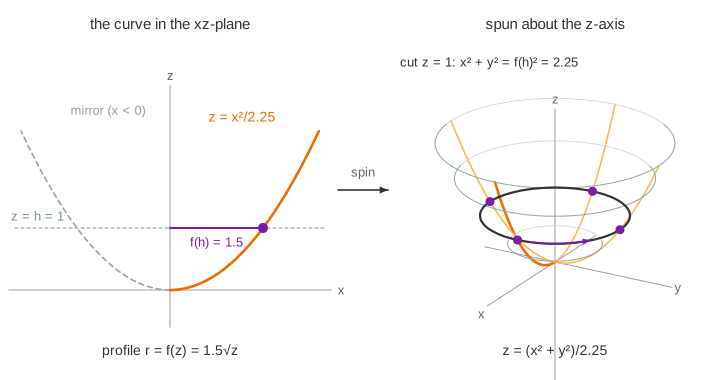
Only the distance from the axis matters, so fold the curve onto the side x ≥ 0 and write it as the profile r = f(z): the distance from the axis at height z. A curve and its mirror image in the z-axis give the same surface.
The rule: replace x² by x² + y²
A point (x, y, z) is at distance √(x2 + y2) from the z-axis. It lies on the surface exactly when the curve has a point at that distance and the same height: when (√(x2 + y2), z) is on the curve. So:
- Write the curve with x only as x2 (square it if needed: the line z = mx becomes z2 = m2x2).
- Replace x2 by x2 + y2. The result is the surface.
Example: the parabola z = x2/a2 gives z = (x2 + y2)/a2, the circular paraboloid. In cylindrical coordinates (r, θ, z) the same rule reads: the surface is the profile equation with x replaced by r, and θ does not appear. (Demo 1: spin a parabola into a paraboloid)
The cut z = h is a circle of radius f(h)
Put z = h: the points of the surface at that height are the ones at distance f(h) from the axis, the circle x2 + y2 = f(h)2. On the canvas it is the circle the purple point draws while the curve spins, and the 2D panel reads its radius off the profile. If the profile touches the axis at height h (f(h) = 0) the cut is a point; if the curve has no point at height h the cut is empty; if the profile has two distances at that height (the offset circle) the cut is two circles.
Eight curves, eight surfaces
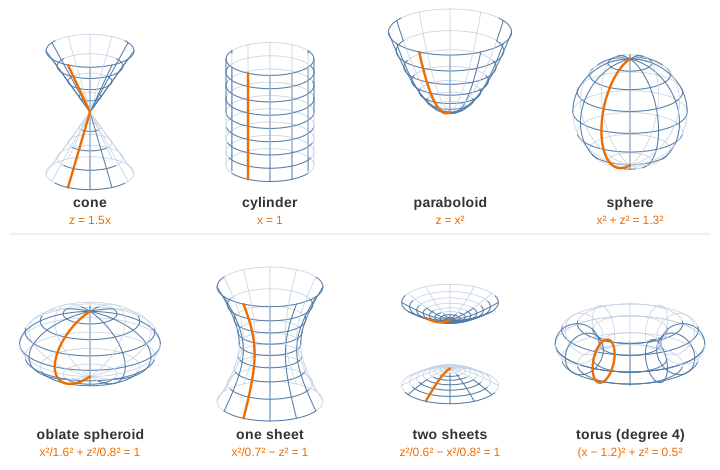
| curve in the xz-plane | profile r = f(z) | surface | name |
|---|---|---|---|
| line z = mx (through the axis) | |z|/m | z2 = m2(x2 + y2) | cone (two nappes) |
| line x = R (parallel to the axis) | R | x2 + y2 = R2 | cylinder |
| parabola z = x2/a2 | a√z | z = (x2 + y2)/a2 | circular paraboloid |
| circle x2 + z2 = R2 | √(R2 − z2) | x2 + y2 + z2 = R2 | sphere |
| ellipse x2/a2 + z2/c2 = 1 | a√(1 − z2/c2) | (x2 + y2)/a2 + z2/c2 = 1 | spheroid |
| hyperbola x2/a2 − z2/c2 = 1 | a√(1 + z2/c2) | (x2 + y2)/a2 − z2/c2 = 1 | hyperboloid of one sheet |
| hyperbola z2/c2 − x2/a2 = 1 | a√(z2/c2 − 1) | z2/c2 − (x2 + y2)/a2 = 1 | hyperboloid of two sheets |
| circle (x − R)2 + z2 = r2, r < R | R ± √(r2 − z2) | (√(x2 + y2) − R)2 + z2 = r2 | torus (degree 4) |
The page fixes a = 2 for the ellipse and c = 1 for the hyperbolas, so each curve has one number to change.
Lines: the cone and the cylinder
A line through the axis, z = mx, keeps the ratio height : distance = m, so it sweeps a double cone. Its two halves (x > 0 and x < 0) land on the same circles; folded onto x ≥ 0 the profile is r = |z|/m, and the square z2 = m2x2 gives z2 = m2(x2 + y2). A line parallel to the axis keeps the same distance R at every height and sweeps a cylinder, x2 + y2 = R2: z is missing because the curve allows any height. (Demo 2: line → cone, parallel line → cylinder)
Circle and ellipse: sphere and spheroid
A circle centred on the axis turns into a sphere. An ellipse turned about one of its axes is a spheroid, the ellipsoid with two equal semi-axes: spun about its short axis it is oblate (flat, like the Earth), about its long axis prolate (like a rugby ball). With x2/4 + z2/c2 = 1, c < 2 is oblate and c > 2 prolate. (Demo 3: circle → sphere, ellipse → spheroid)
A hyperbola about each of its axes
A hyperbola has two axes of symmetry. Spun about its conjugate axis (the one that does not meet the curve) each branch sweeps the same waisted tube: the hyperboloid of one sheet. Spun about its transverse axis (the one through both vertices) each branch makes its own cap: the hyperboloid of two sheets, with nothing for |z| < c. The canvas keeps the z-axis and turns the hyperbola instead: x2/a2 − z2 = 1 has z as its conjugate axis, z2 − x2/a2 = 1 has z as its transverse axis. At h = 0 the first cut is the waist circle of radius a, the second is empty. (Demo 4: hyperbola about each axis: one sheet vs two)
An offset circle: the torus is not a quadric
The circle (x − R)2 + z2 = r2 with r < R does not touch the axis. It is not symmetric in x, so x2 alone cannot describe it; use |x| = √(x2) for the half x ≥ 0 and replace |x| by √(x2 + y2):
(√(x2 + y2) − R)2 + z2 = r2.
To clear the root, expand and move it alone to one side, then square: (x2 + y2 + z2 + R2 − r2)2 = 4R2(x2 + y2). That has degree 4, so the torus is not a quadric surface. Each cut z = h with |h| < r is two circles, of radii R − √(r2 − h2) and R + √(r2 − h2). (Demo 5: offset circle → torus (degree 4, not a quadric))
Which quadrics are surfaces of revolution
A quadric in standard form is round about the z-axis when its x and y terms have the same coefficient (a = b): then x2 and y2 only appear as x2 + y2, and setting y = 0 gives back the curve. The circular cone, cylinder and paraboloid, the sphere, the spheroids and both hyperboloids with a = b are all on this page. The hyperbolic paraboloid z = x2/a2 − y2/b2 and the hyperbolic cylinder are never round: their x and y terms have opposite signs.
Facts at a glance
| property | value |
|---|---|
| curve in the xz-plane, spun about z | each point (x, 0, z) moves on a circle of radius |x| at height z |
| profile | r = f(z) ≥ 0, the curve folded onto x ≥ 0 |
| equation of the surface | the curve's equation with x2 replaced by x2 + y2 |
| cut z = h | the circle x2 + y2 = f(h)2 (a point if f(h) = 0) |
| cut by a plane through the axis | the curve and its mirror image |
| conic → quadric | a conic symmetric about the axis gives a quadric (degree 2) |
| circle off the axis | torus, degree 4 |
See also Quadric Surfaces for all nine standard forms, Elliptic Paraboloid (the paraboloid with a ≠ b), Hyperboloid of One Sheet, Ellipsoid (the spheroids are its round cases) and Polar Coordinates (r and θ in the plane, which become the cylindrical coordinates used here).
The torus is a quartic surface. Others: the quartic x⁴ + y⁴ − z⁴ = 1 looks like a hyperboloid but its cuts are squircles, the Kummer surface has 16 nodes, and Surfaces by Degree compares surfaces of degree 1 to 4.
What the page leaves out
Spinning about the x-axis or a tilted axis (the rule then replaces the other two coordinates), curves that cross the axis in other ways, and the horn and spindle tori (r ≥ R). The surface area and volume formulas of solids of revolution (Pappus's theorems, disc and shell integrals), and the parametric form (f(t) cos θ, f(t) sin θ, g(t)) used in computer graphics and lathe modelling.