The idea: a distance and a direction
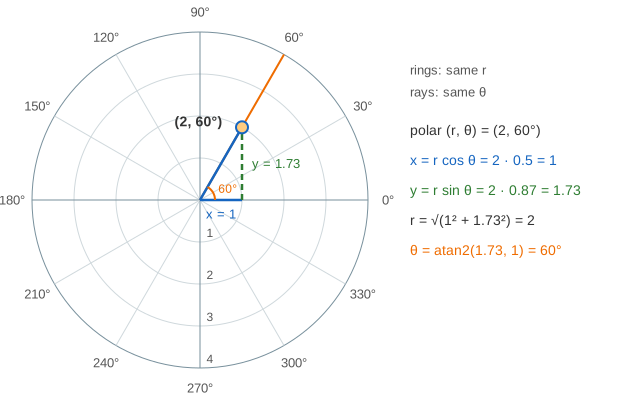
Cartesian coordinates (x, y) say "go across, then go up". Polar coordinates (r, θ) say "face the direction θ, then walk r". The centre is the pole, θ is measured counterclockwise from the 0° ray (the positive x-axis), and r is the distance from the pole. The polar grid is made of rings (all points with the same r) and rays (all points with the same θ).
Converting both ways
The arm of length r at angle θ is the long side of a right triangle, so its legs are
x = r cos θ, y = r sin θ.
For (2, 60°): x = 2 · 0.5 = 1 and y = 2 · 0.87 = 1.73. Going back, Pythagoras gives the length and the angle comes from the slope:
r = √(x² + y²), θ = atan2(y, x).
Why atan2 and not arctan(y/x)? The ratio y/x forgets the signs: (1, 1) and (−1, −1) both give 1, but they are 45° and 225°. atan2 looks at the signs of x and y separately and picks the right quadrant (Demo: plot and convert (2, 60°)).
| Quadrant | signs | example (x, y) | atan2(y, x) |
|---|---|---|---|
| I | x > 0, y > 0 | (1, 1.73) | 60° |
| II | x < 0, y > 0 | (−2.6, 1.5) | 150° |
| III | x < 0, y < 0 | (−1.41, −1.41) | 225° (or −135°) |
| IV | x > 0, y < 0 | (1.25, −2.17) | 300° (or −60°) |
Curves r = f(θ)
A polar equation gives a distance for each direction. To draw it, sweep θ and put a point at distance f(θ) along each ray; the page draws the arm for each θ so you can watch the curve being built.
- Circle r = 2: the same distance in every direction. In Cartesian form it is x² + y² = 4, which is harder to write and to plot.
- Spiral r = θ/2 (θ in radians): r grows steadily as the arm turns. After one turn (θ = 2π) r = π ≈ 3.14, after two turns 2π ≈ 6.28. Every turn adds the same π, so the coils are evenly spaced: an Archimedean spiral (Demo: spiral).
- Cardioid r = 1 + cos θ: r = 2 at 0°, 1 at 90°, and 0 at 180°, where the curve touches the pole. The result is a heart shape (Demo: cardioid).
Negative r flips the point
The equation may give a negative r. The rule is: face θ, then walk backwards. So (−2, 45°) is 2 units out on the opposite ray, at 45° + 180° = 225°: the same point as (2, 225°). Converting back with √ always gives r ≥ 0, and atan2 gives 225° (Demo: negative r).
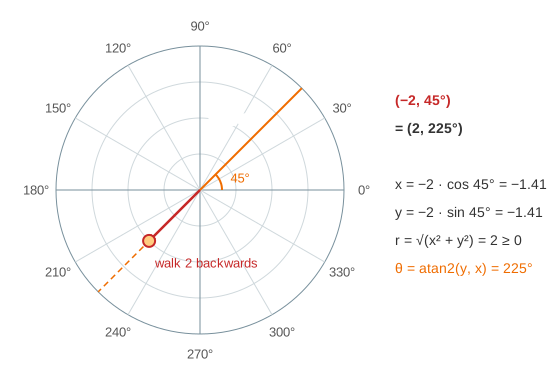
So a point has many polar names: (2, 60°), (2, 420°) and (−2, 240°) are all the same place, and the pole is (0, θ) for any θ. That is the price for the easy curves.
Roses: why cos 3θ has 3 petals and cos 2θ has 4
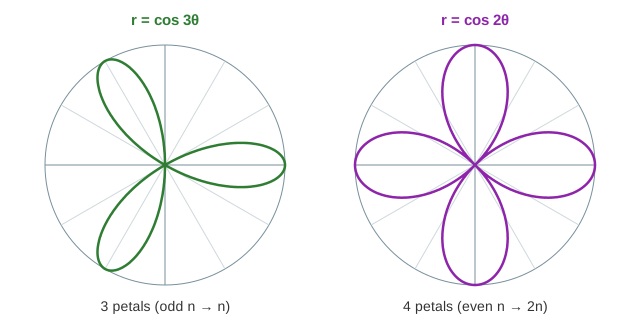
For r = cos nθ, each petal is drawn while cos nθ goes from 0 up to ±1 and back to 0, which takes 180°/n of θ. In one full turn there are 2n such lobes, and half of them have r < 0, so they are drawn on the opposite side. Whether they land on new petals depends on n:
- Odd n (cos 3θ): cos 3(θ + 180°) = −cos 3θ. Half a turn later the angle is opposite and r has the other sign, and the two flips cancel: the point is the same. The second half-turn retraces the first, so there are only 3 petals.
- Even n (cos 2θ): cos 2(θ + 180°) = +cos 2θ. Half a turn later the angle is opposite but r is not, so the point is new. Nothing is retraced: 4 petals.
In general r = cos nθ has n petals for odd n and 2n for even n (Demo: rose, 3 petals vs 4).
Where it is used
- Anything that turns or spreads from a centre: radar and sonar sweeps, antenna patterns, robot arms, orbits (Kepler's ellipse is simplest in polar form, r = p / (1 + e cos θ)).
- Complex numbers in polar form r·eiθ: multiplying means multiplying the r's and adding the θ's. See Complex Numbers.
- cos θ and sin θ themselves are the polar → Cartesian conversion with r = 1; see the Unit Circle and Trigonometry.
See also Changing Coordinates in 2D, which moves between Cartesian frames instead of between Cartesian and polar.
Conics with a focus at the origin have the polar equation r = ep/(1 + e cos θ): see Conics by Eccentricity: r = ep/(1 + e cos θ).
More curves drawn in polar coordinates: The Rose Curve r = cos kθ, The Maurer Rose, The Butterfly Curve, Spirograph: Hypotrochoids and Epitrochoids and The Superformula. The cardioid also appears as the envelope of the chords i → 2·i mod N in The Times-Table Circle.
What the page leaves out
Area in polar form (½∫r² dθ) and arc length, slopes of polar curves (dy/dx), other families such as limaçons r = a + b cos θ with an inner loop, lemniscates (see The Lemniscate of Bernoulli) and conic sections, and the 3D versions (cylindrical and spherical coordinates). Angles are shown in degrees; calculus uses radians (180° = π).