The idea: a bowl with one lowest point
The elliptic paraboloid is the surface
z = x2/a2 + y2/b2 (a, b > 0)
The right side is a sum of two squares, so it is never negative: the surface sits on or above the plane z = 0. It touches that plane at one point, the origin, called the vertex. From there it rises in every direction and never closes: an open bowl.
a and b stretch the bowl
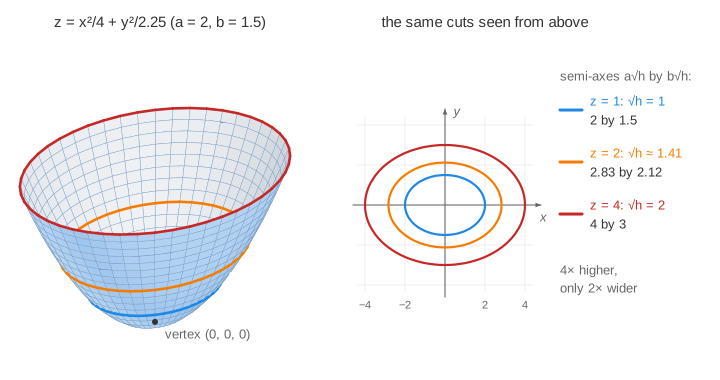
a is a scale along x and b a scale along y. At height z = 1 the bowl is the ellipse x2/a2 + y2/b2 = 1, which reaches x = ±a and y = ±b. A bigger a makes the bowl wider (and flatter) along x; a smaller a makes it narrow and steep. (Demo 1: a and b stretch the bowl)
Cuts z = h: nothing, a point, an ellipse
Put z = h into the equation: x2/a2 + y2/b2 = h.
- h < 0: a sum of squares can't be negative, so the plane misses the bowl.
- h = 0: only x = y = 0 works, the vertex.
- h > 0: divide by h to get x2/(a2h) + y2/(b2h) = 1, an ellipse with semi-axes a√h and b√h.
The size grows like √h, not like h. With a = 2, b = 1.5 the cut at z = 1 has semi-axes 2 and 1.5; at z = 4 it has 4 and 3. That is why the walls get steeper as you go up. All the ellipses have the same shape (the ratio a : b), only the size changes. (Demo 2: slide the cut z = h, width grows like √h)
Cuts x = h and y = h: one parabola, lifted
Put x = h instead: z = h2/a2 + y2/b2. In the plane x = h this is a parabola in y that opens up, with its vertex at (h, 0, h2/a2). The y part, y2/b2, does not depend on h, so every cut x = h is the same parabola z = y2/b2, only lifted by h2/a2. The cuts y = h are the parabolas z = x2/a2 + h2/b2. That is where the name comes from: elliptic cuts one way, parabolic cuts the other. (Demo 3: the cut x = h is a parabola) More about one parabola and its coefficients is on Parabola.
| cut | equation | curve |
|---|---|---|
| z = h, h < 0 | x2/a2 + y2/b2 = h | nothing |
| z = 0 | x = y = 0 | the vertex |
| z = h, h > 0 | x2/(a2h) + y2/(b2h) = 1 | ellipse, semi-axes a√h, b√h |
| x = h | z = h2/a2 + y2/b2 | parabola opening up |
| y = h | z = x2/a2 + h2/b2 | parabola opening up |
a = b: the circular paraboloid
With a = b the equation is z = (x2 + y2)/a2 = r2/a2, where r is the distance from the z-axis. It only depends on r, so every cut z = h is a circle of radius a√h and the surface is the parabola z = y2/a2 spun about the z-axis: a paraboloid of revolution. (Demo 4: a = b, the circular paraboloid)
The focus: parallel rays meet in one point
The parabola z = y2/a2 can be written y2 = 4pz with 4p = a2, so its focus is at height p = a2/4. Its reflection property: a ray coming down parallel to the axis bounces off the curve (angle in = angle out, measured from the normal) and passes through the focus. Spin the parabola around the z-axis and every slice through the axis has the same focus, so in the circular paraboloid all rays parallel to the z-axis meet at F = (0, 0, a2/4). (Demo 5: parallel rays meet at the focus)
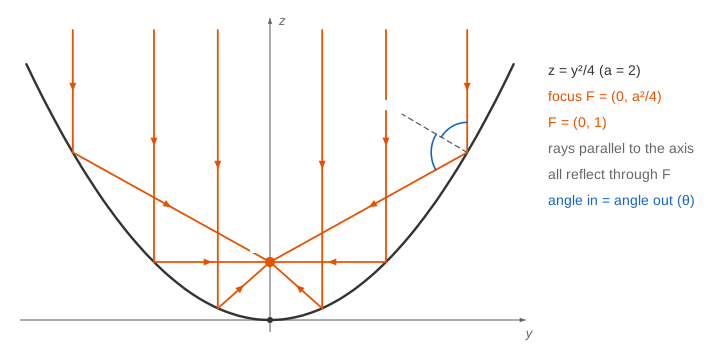
With a ≠ b the slice x = 0 has its focus at b2/4 and the slice y = 0 at a2/4, two different heights, so the rays no longer meet in one point. That is why dishes and mirrors are round.
Where it is used
- Satellite dishes and radio telescopes: signals from far away arrive parallel; the dish sends them all to the receiver at F.
- Headlights and torches: the same path run backwards. A bulb at F sends light out as a parallel beam.
- Solar cookers and furnaces: sunlight is focused on the pot at F.
- Reflecting telescopes: the main mirror is a paraboloid, so starlight focuses sharply.
- A spinning liquid: the surface of water in a turning bucket settles into a paraboloid.
Facts at a glance
| property | z = x2/a2 + y2/b2 |
|---|---|
| vertex | (0, 0, 0), the lowest point |
| axis | the z-axis |
| bounded? | no, it opens up forever; z ≥ 0 |
| pieces | one |
| general form | x2/a2 + y2/b2 − z = 0 (z only to the first power) |
| focus (a = b) | (0, 0, a2/4) |
See also Quadric Surfaces for all nine shapes, Hyperbolic Paraboloid (one sign flipped: the saddle) and Elliptic Cone (cuts that grow like h, not √h).
What the page leaves out
The bowl that opens down, z = −(x2/a2 + y2/b2) (the same surface turned over), bowls along the x- or y-axis, a shifted vertex z − k = (x − h)2/a2 + …, the tilted ones with an xy term, the curvature at the vertex and the area or volume of the bowl.