The idea: a quartic surface with 16 nodes
A smooth surface looks flat when you zoom in on any point. A node is a point where it does not: close up, the surface looks like a double cone, like the apex of the elliptic cone. A quadric surface (degree 2) has at most one such point. Higher degree allows more. In 1864 Ernst Kummer showed that a quartic surface (degree 4) has at most 16 nodes, and he found surfaces with exactly 16. They are the Kummer surfaces, and the page draws a one-parameter family of them.
What a node is
Write the surface as F(x, y, z) = 0. At an ordinary point the gradient ∇F is not zero, and it is the normal of the tangent plane. At a singular point both F = 0 and ∇F = 0, so there is no tangent plane (see Critical and Singular Points for the same idea on curves). Near such a point F starts with its second-order terms, a quadratic form. When that form is non-degenerate, the surface near the point is a cone: that is a node (also called an ordinary double point).
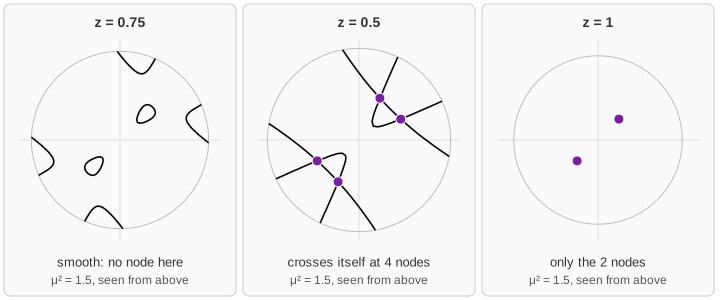
You can see a node in a cut. A plane through the apex of a cone cuts it in two crossing lines. In the same way, a plane through a node cuts the surface in a curve that crosses itself at the node. (Demo 3: a cut through 4 nodes crosses itself)
The Kummer family
Take a regular tetrahedron with vertices (1, 1, 1), (1, −1, −1), (−1, 1, −1), (−1, −1, 1). Its four face planes are p = 0, q = 0, r = 0, s = 0 with
p = 1 + x + y + z, q = 1 + x − y − z, r = 1 − x + y − z, s = 1 − x − y + z,
all equal to 1 at the centre. The Kummer family is
(x2 + y2 + z2 − μ2)2 − λ·p·q·r·s = 0, λ = (3μ2 − 1)/(3 − μ2).
The first term is a sphere of radius μ, squared; the second is the four planes multiplied together. Both have degree 4, so the surface is a quartic. The 12 edge nodes below are there for any λ; this value of λ is the one that adds 4 more. Wikipedia writes the same family with p = 1 − z − √2x, q = 1 − z + √2x, r = 1 + z + √2y, s = 1 + z − √2y; that is this one turned 45° about the z-axis. The turned form puts the tetrahedron's edges across the axes, so the surface's six horns point along ±x, ±y, ±z.
Where the 16 nodes are
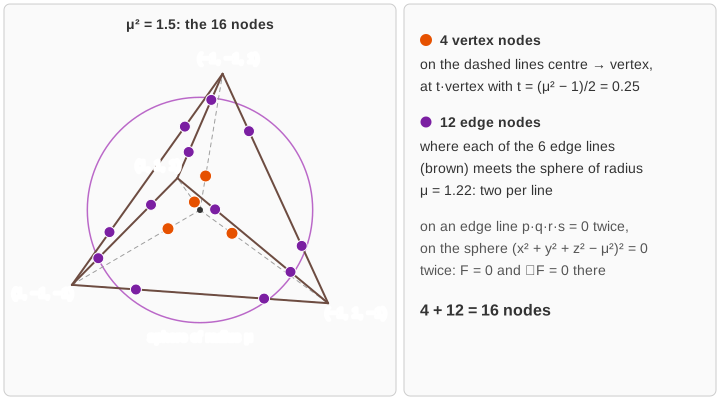
On an edge line of the tetrahedron two of p, q, r, s are 0, so the product p·q·r·s vanishes there to second order. Where that line also meets the sphere x2 + y2 + z2 = μ2, the squared first term vanishes to second order too. F and ∇F are both 0: a node. Each edge line is at distance 1 from the centre, so it meets the sphere in 2 points when μ2 > 1. Six edges, two each: 12 nodes. The other 4 lie on the lines from the centre to the vertices. (Demo 1: where the 16 nodes are)
| nodes | where (a = √((μ2 − 1)/2), t = (μ2 − 1)/2) | real when |
|---|---|---|
| 4 vertex nodes | t·(1, 1, 1), t·(1, −1, −1), t·(−1, 1, −1), t·(−1, −1, 1) | always |
| 12 edge nodes | 2 on each edge line, at distance μ from the centre: (±a, ±a, 1) with x = y, (1, ±a, ±a) with y = z, … | μ2 > 1 |
For μ2 = 1.5 this gives a = 0.5 and t = 0.25, so the nodes sit at heights z = ±0.25 (vertex nodes), ±0.5 (nodes on the four side edges) and ±1 (on the top and bottom edges).
μ² changes the shape
Pick μ2 in the menu and the surface morphs 0.1 at a time, with the shape before in grey.
| μ2 | λ | what you see |
|---|---|---|
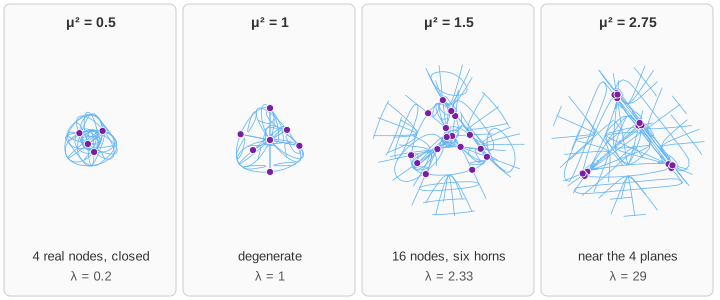
| below 1/3 | negative | a closed blob, 4 real nodes |
| 1/3 | 0 | degenerate: the sphere counted twice |
| 1/3 to 1 | 0 to 1 | a closed blob with 4 real nodes; the other 12 are complex (Demo 4) |
| 1 | 1 | degenerate: the 4 nodes meet at the centre, the 12 merge in pairs, the three axes lie on the surface as double lines (Demo 5) |
| 1 to 3 | above 1 | all 16 nodes real; six horns run off to infinity along the axes, so the page draws the part inside a ball of radius 2.25 |
| 3 | infinite | degenerate: the four face planes p·q·r·s = 0 (Demo 6 stops at 2.75) |
Cuts z = h are quartic curves
Put z = h into the equation and you get F(x, y, h) = 0, a curve of degree 4 in x and y (the 2D panel). Most heights give smooth curves: closed loops around the inner pieces and open arcs that run out of the ball along the horns. At a node height the curve crosses itself. At z = ±1 (for 1 < μ2 < 3) the cut inside the ball is just two points: the two nodes on the top or bottom edge, where the surface pinches. (Demo 2: slide the cut z = h from −2 to 2)
How the canvas draws an implicit surface
There is no formula z = f(x, y) for this surface, so the page slices it. Each slice is a plane; on a 48 × 48 grid the sign of F is checked at every corner, and where it changes along a grid edge the curve crosses it (marching squares). The crossings are joined into curves and spread evenly over a fixed set of points, so a change of μ2 just moves those points. Rings come from planes x = c, y = c, z = c, each used only around its own axis, and the lines along the horns from the nine symmetry planes through the centre.
Facts at a glance
| property | value |
|---|---|
| equation | (x2 + y2 + z2 − μ2)2 − λ·p·q·r·s = 0, λ = (3μ2 − 1)/(3 − μ2) |
| degree | 4 (quartic) |
| nodes | 16 = 4 + 12 for μ2 in (1, 3) or above 3; 4 real for μ2 < 1 |
| most nodes of a surface of degree 2, 3, 4 | 1 (cone), 4 (Cayley's cubic), 16 (Kummer) |
| symmetry | the symmetries of the regular tetrahedron (24) |
| bounded | for μ2 < 1; for 1 < μ2 < 3 six horns go to infinity |
See also Quadric Surfaces for degree 2, Surfaces of Revolution for the torus, another quartic (smooth, no nodes), and the pages on the cubic surfaces (Monkey Saddle, x3 + y3 + z2 = 1), Cayley's cubic with its 4 nodes, the quartic x4 + y4 − z4 = 1 and the overview Surfaces by Degree.
What the page leaves out
The complex points: over the complex numbers every Kummer surface has 16 nodes, and it is the quotient of an abelian surface (the Jacobian of a genus-2 curve) by x ↦ −x, whose 16 fixed points become the nodes. The 166 configuration: 16 planes (tropes) each touch the surface along a conic through 6 nodes, and each node lies on 6 of them. The range μ2 > 3, which also has 16 real nodes. Other Kummer surfaces that are not in this one-parameter family, and the record surfaces of higher degree (31 nodes for degree 5, Barth's sextic with 65).