The idea: the hyperboloid with fourth powers
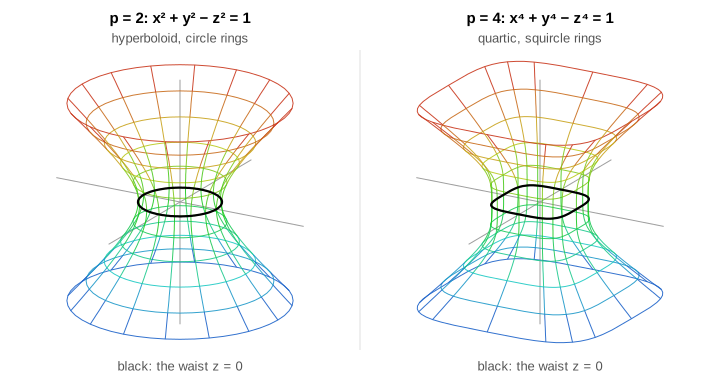
Take the hyperboloid of one sheet x2 + y2 − z2 = 1 and raise every letter to the fourth power instead of the second:
x4 + y4 − z4 = 1
The equation now has degree 4, so this is a quartic surface, one step beyond the quadrics. It still looks like a tube with a waist that opens up and down without end, but every cut across it is a rounded square instead of a circle, and it hugs its cone much more tightly.
The surface is one smooth piece. The gradient (4x3, 4y3, −4z3) is zero only at the origin, and the origin is not on the surface (0 ≠ 1), so there is no corner or pinch anywhere.
The waist: a squircle
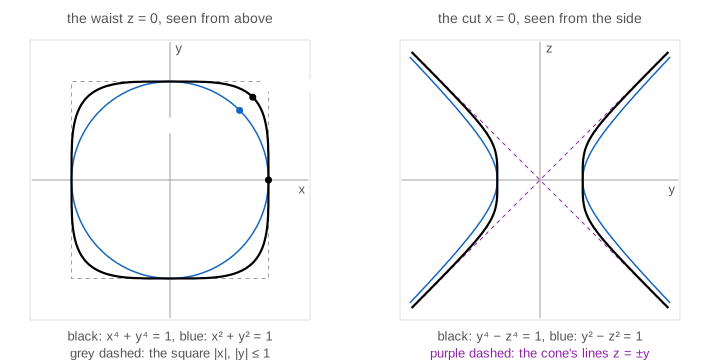
Put z = 0 and you get x4 + y4 = 1. On the axes it reaches 1, like the circle, but on the diagonal x = y it reaches 2−1/4 ≈ 0.84, where the circle only reaches 0.71 and the square reaches 1. It sits between the circle and the square: a squircle, the superellipse with exponent 4. Its sides are almost flat near the axes, because there y4 is tiny.
It is not round. Turning it by 30° changes it; only quarter turns and mirror images map it onto itself. So unlike the round hyperboloid this surface is not a surface of revolution. Turn the view three times (90°) and it looks the same again.
Cuts z = h: the same squircle, larger
Put z = h:
x4 + y4 = 1 + h4
The right side is at least 1, so every level cut is the waist squircle scaled by r = (1 + h4)1/4. It is never empty, the smallest is the waist, and h and −h give the same cut. At h = 2 the cut is x4 + y4 = 17, size r = 2.03. These cuts are the level curves of x4 + y4. The page draws each ring honestly with the superellipse formula
x = r·sgn(cos t)|cos t|1/2, y = r·sgn(sin t)|sin t|1/2
since then x4 + y4 = r4(cos2 t + sin2 t) = r4. (Demo 2: slide the cut z = h)
Cuts x = h and two straight lines
Put x = h instead:
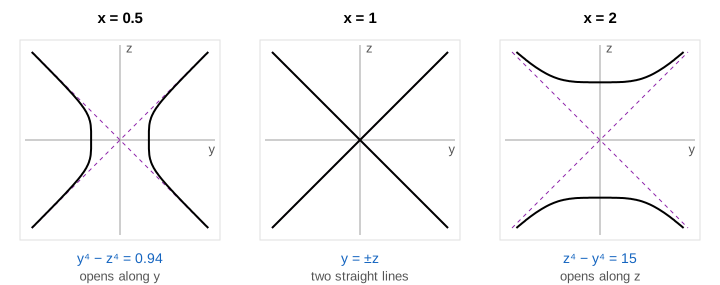
y4 − z4 = 1 − h4
This is the quartic version of the hyperbola cuts of the hyperboloid, and again the sign of the right side decides the shape:
| where the plane is | right side | the cut |
|---|---|---|
| |h| < 1 (through the waist) | > 0 | two branches opening along y |
| |h| = 1 (touching the waist) | 0 | two straight lines y = ±z |
| |h| > 1 (outside the waist) | < 0 | two branches opening along z |
At |h| = 1 the cut is y4 = z4, which means |y| = |z|: the two lines y = ±z. So the points (1, t, t) lie on the surface for every t (1 + t4 − t4 = 1), and so do the lines with x = −1 and, by symmetry, y = ±1. That makes 8 straight lines on a curved surface. For the quartic these are all the real lines it has; the hyperboloid has infinitely many, two through every point. (Demo 3: two straight lines at x = 1)
Hugging the cone x⁴ + y⁴ = z⁴
Put 0 instead of 1 on the right: x4 + y4 = z4 is a "cone" whose cuts are squircles of size |z|; it is made of straight lines through the origin, like the elliptic cone. The surface stays just outside it. At height z the surface's cut has size (1 + z4)1/4, so the gap is about 1/(4|z|3), against 1/(2|z|) for the hyperboloid:
| height z | gap, p = 2 (hyperboloid) | gap, p = 4 (quartic) |
|---|---|---|
| 1 | √2 − 1 ≈ 0.41 | 21/4 − 1 ≈ 0.19 |
| 2 | √5 − 2 ≈ 0.24 | 171/4 − 2 ≈ 0.03 |
| 3 | √10 − 3 ≈ 0.16 | 821/4 − 3 ≈ 0.009 |
A higher power makes the 1 matter less, faster. In the cut x = 0 you can see it: y4 − z4 = 1 is almost on its lines z = ±y by z = 2. (Demo 4: hugging the cone)
The exponent p: one family
The page draws the whole family |x|p + |y|p − |z|p = 1 and lets you pick p from 2 to 6. Every cut z = h is the superellipse |x|p + |y|p = 1 + |h|p, which reaches 2−1/p times its size on the diagonal.
| p | waist on the diagonal | the surface |
|---|---|---|
| 2 | 0.71 (circle) | the hyperboloid of one sheet, a quadric |
| 4 | 0.84 (squircle) | x4 + y4 − z4 = 1, a quartic |
| 6 | 0.89 | degree 6, squarer still |
| very large | → 1 (square) | tends to a square tube that flares into a square cone |
Only an even whole p gives a polynomial; for p = 2.5 or 3 the bars |…| are needed, or x3 would turn negative. The 8 straight lines are there for every p, since 1 + |t|p − |t|p = 1. (Demo 1: from hyperboloid to quartic, Demo 5: squarer with p = 6)
Facts
| what | for x4 + y4 − z4 = 1 |
|---|---|
| degree | 4 (a quartic surface) |
| waist (z = 0) | squircle x4 + y4 = 1: 1 on the axes, 0.84 on the diagonal |
| cut z = h | squircle of size (1 + h4)1/4; never empty |
| cut x = h | two branches along y for |h| < 1, the lines y = ±z at |h| = 1, two branches along z for |h| > 1 |
| straight lines | 8: x = ±1, y = ±z and y = ±1, x = ±z |
| far away | hugs x4 + y4 = z4; gap ≈ 1/(4|z|3) |
| pieces | one, smooth, not bounded |
| symmetry | the three coordinate planes, the planes x = ±y, quarter turns about the z-axis; not round |
See also Hyperboloid of One Sheet (the p = 2 member, with its two families of straight lines), Quadric Surfaces (all degree-2 shapes), Elliptic Cone and Level Curves. Other surfaces beyond the quadrics have their own pages: Monkey Saddle, Cubic Surface, Cayley's Nodal Cubic, Kummer Surface and Surfaces by Degree.
What the page leaves out
Stretched versions x4/a4 + y4/b4 − z4/c4 = 1, the "two sheets" cousin −x4 − y4 + z4 = 1, slanted cuts, curvature, and the complex and projective picture: written as x4 + y4 = z4 + w4 it is the Fermat quartic, a K3 surface with 48 complex lines, of which the 8 drawn here are the real ones.