The idea: shrink the right side to 0
Most quadrics are honest surfaces: ellipsoids, hyperboloids, paraboloids. But a quadric equation can also describe two planes, one plane counted twice, a line, a single point or nothing at all. These are the degenerate cases. The easiest way to meet them is to take a surface and slide its right side k down to 0 and past it.
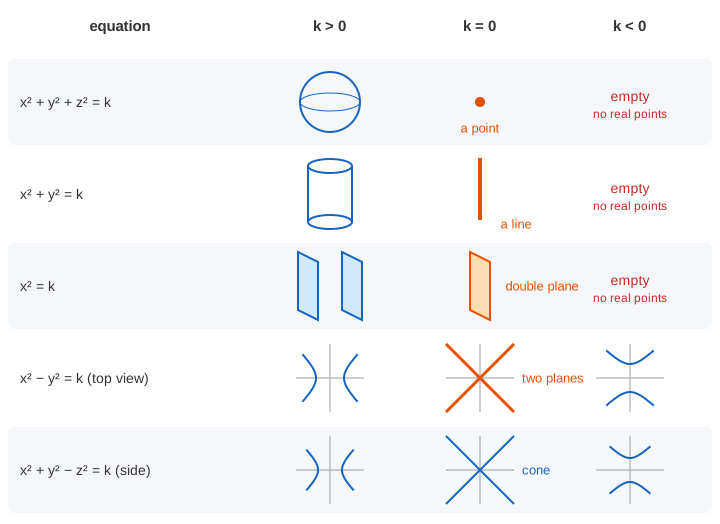
What happens at k = 0
| equation | k > 0 | k = 0 | k < 0 |
|---|---|---|---|
| x² + y² + z² = k | sphere, radius √k | a point | empty |
| x² + y² = k | cylinder | a line (the z-axis) | empty |
| x² = k | two planes x = ±√k | one double plane x = 0 | empty |
| x² − y² = k | hyperbolic cylinder | two planes y = ±x | the same, turned 90° |
| x² + y² − z² = k | one sheet | a cone | two sheets |
A sum of squares equal to 0 forces every square to be 0: x² + y² + z² = 0 leaves only the origin, and x² + y² = 0 leaves x = y = 0 with z free, a line. (Demo 1, Demo 2.) A difference of squares splits: x² − y² = (x − y)(x + y), and a product is 0 when either factor is, so the points are the two planes y = x and y = −x. (Demo 4.) Two planes x = ±√k slide together and meet as x = 0, twice. (Demo 3.)
The 4 × 4 matrix Q and det Q
Write Ax² + By² + Cz² + Dxy + Eyz + Fzx + Gx + Hy + Iz + J = 0 with a symmetric 4 × 4 matrix: the 3 × 3 matrix M of the square terms (as on Quadric Classification), a fourth row and column with G/2, H/2, I/2, and J in the corner. Then the equation is (x, y, z, 1) Q (x, y, z, 1)T = 0.
The quadric is degenerate when det Q = 0. On the page Q is diagonal, so det Q is just the product of the diagonal: for x² + y² = k it is 1 · 1 · 0 · (−k) = 0 for every k (a cylinder is already degenerate in this sense), and for x² + y² + z² = k it is −k, zero only at k = 0.
Two ranks sort the cases
det Q = 0 only says "degenerate". Which kind depends on two numbers: rank M (how many squares survive after the turn to principal axes) and rank Q (whether the constant survives too), and on whether the surviving signs agree.
| rank M | rank Q | real points | on the page |
|---|---|---|---|
| 3 | 4 | not degenerate: ellipsoid, hyperboloid, or empty | sphere, k ≠ 0 |
| 3 | 3 | a point (+ + +) or a cone (+ + −) | Demos 1 and 5 at k = 0 |
| 2 | 3 | a cylinder, or empty | x² + y² = k, x² − y² = k |
| 2 | 2 | a line (+ +) or two crossing planes (+ −) | Demos 2 and 4 at k = 0 |
| 1 | 2 | two parallel planes, or empty | x² = k, k ≠ 0 |
| 1 | 1 | one double plane | x² = 0 |
A linear term can also raise rank Q: z = x² + y² has rank M = 2 and rank Q = 4 (a paraboloid, not degenerate), and z = x² has rank M = 1, rank Q = 3 (a parabolic cylinder, degenerate).
Empty is not the same as degenerate
x² + y² + z² = −1 has no real points, yet det Q = 1 ≠ 0: it is an imaginary sphere, as good a quadric as a real one, just with no real points. x² + y² = −1 is also empty, but there det Q = 0: an imaginary cylinder. And x² + y² = 0 factors as (x + iy)(x − iy): two imaginary planes whose only real points are the line where they meet. (Demo 1 ends with det Q = 1; Demo 2 ends with det Q = 0.)
Spotting a plane pair in a general equation
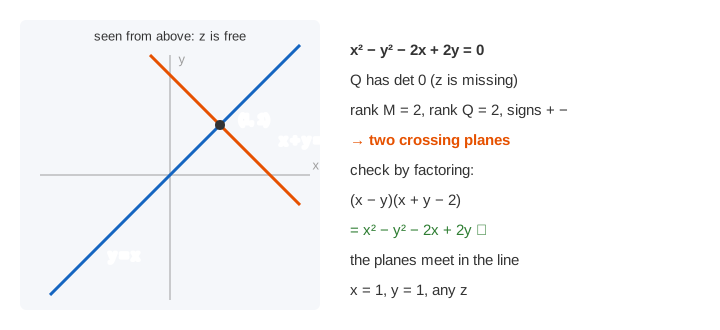
Degenerate quadrics do not always come in a tidy form. Take x² − y² − 2x + 2y = 0. z is missing, so det Q = 0; the 4 × 4 matrix has rank 2 and the squares have signs + and −, so the table says two crossing planes. Factoring confirms it:
See also Quadric Classification for turning a general quadric into its standard form, Quadric Surfaces for the non-degenerate shapes, and Conic Sections: What A, B, C, D, E, F Do for the same story one dimension down (a point, two lines, nothing).
What the page leaves out
Tilted and shifted degenerate quadrics (the page keeps Q diagonal; turn and slide them first as on Quadric Classification); the parabolic cylinder, which needs a linear term; how to compute rank Q by row reduction; and the projective view, where cones and cylinders are the same kind of object (a cylinder is a cone with its apex at infinity).