The idea: a tube with a waist
The hyperboloid of one sheet is the set of points (x, y, z) with
x2/a2 + y2/b2 − z2/c2 = 1
(a, b, c > 0). Two squares are added, one is taken away, and the right side is 1. It looks like an hourglass that never closes: a tube that is narrowest in the middle and opens up and down without end.
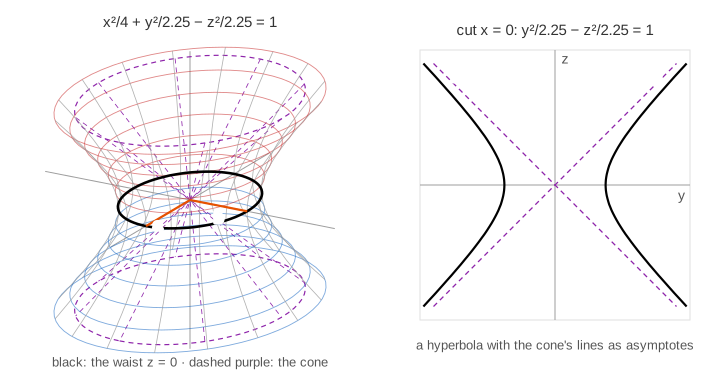
Its name comes from the side view: cut it with x = 0 and you get the hyperbola y2/b2 − z2/c2 = 1. "One sheet" because it is a single connected piece, unlike the hyperboloid of two sheets.
The waist and c
Put z = 0 and the equation becomes x2/a2 + y2/b2 = 1: an ellipse with semi-axes a and b. This is the waist (or throat). With a = b it is a circle and the surface is round, like a cooling tower.
c is the height scale. At height z the cut is the waist stretched by the factor √(1 + z2/c2). A small c makes that factor grow fast, so the surface flares out quickly; a large c keeps it close to 1, so the surface is almost a straight tube. (Demo 1: the waist and c)
Cuts z = h: always an ellipse
Put z = h:
x2/a2 + y2/b2 = 1 + h2/c2
The right side is at least 1 for every h, so every level cut is an ellipse with semi-axes a√(1 + h2/c2) and b√(1 + h2/c2). It is never empty, so there is no gap: the surface is one piece. The smallest cut is the waist at h = 0, and the cuts at h and −h are the same. (Demo 2: slide the cut z = h)
Cuts x = h: hyperbola, two lines, hyperbola
Put x = h instead:
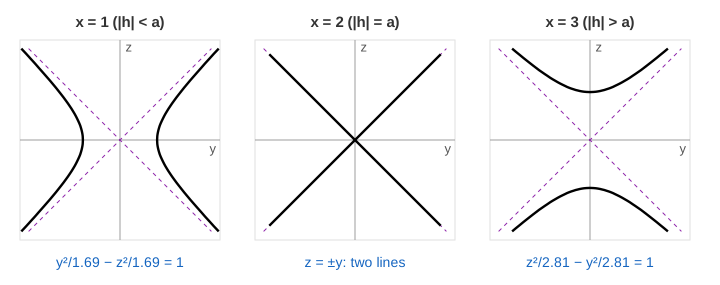
y2/b2 − z2/c2 = 1 − h2/a2
Now the sign of the right side decides the shape:
| where the plane is | right side | the cut |
|---|---|---|
| |h| < a (through the waist) | > 0 | a hyperbola opening along y (left and right) |
| |h| = a (touching the waist) | 0 | two straight lines z = ±(c/b)y crossing at (±a, 0, 0) |
| |h| > a (outside the waist) | < 0 | a hyperbola opening along z (up and down) |
As the plane slides out, the hyperbola gets narrower, pinches into two crossing lines when it just touches the waist, and then turns a quarter turn. The cut y = h does the same with b in place of a. (Demo 3: cut x = h through a)
The asymptotic cone
Put 0 instead of 1 on the right and you get the elliptic cone x2/a2 + y2/b2 = z2/c2. Far from the waist the squares are huge and the 1 hardly matters, so the surface gets closer and closer to the cone without touching it, the way a hyperbola approaches its asymptotes. The cut x = 0 shows it best: the hyperbola y2/b2 − z2/c2 = 1 and the cone's two lines z = ±(c/b)y, its asymptotes. A level cut of the surface is always a little larger than the cone's cut at the same height. (Demo 5: the asymptotic cone)
Straight lines on a curved surface
The surface is curved in every direction, yet it is full of straight lines. Take a point of the waist, (a cos θ, b sin θ, 0), and the line
(a(cos θ − t sin θ), b(sin θ + t cos θ), ct)
Then x2/a2 + y2/b2 = (cos θ − t sin θ)2 + (sin θ + t cos θ)2 = 1 + t2 and z2/c2 = t2, so the equation holds for every t: the whole line lies on the surface. Changing ct to −ct gives a second line through the same point, tilted the other way. These two families of rulings cover the surface, and through every point pass exactly two of them: it is doubly ruled. (Demo 4: straight lines on a curved surface)
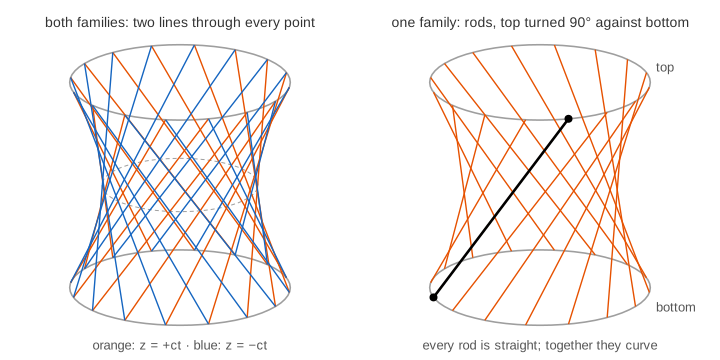
The two lines of the cut x = a are one line from each family: the plane x = a touches the waist at (a, 0, 0) and holds the two rulings through that point. This is why the hyperboloid is built so often: power-station cooling towers and Vladimir Shukhov's lattice towers (Shabolovka, Moscow, 1922) are made of straight beams or bars that are cheap to make, and the doubly curved shape is stiff. The hyperbolic paraboloid is the only other curved quadric that is doubly ruled.
Facts
| what | for x2/a2 + y2/b2 − z2/c2 = 1 |
|---|---|
| waist (z = 0) | ellipse, semi-axes a and b |
| cut z = h | ellipse, semi-axes a√(1 + h2/c2), b√(1 + h2/c2); never empty |
| cut x = h | hyperbola along y for |h| < a, two lines at |h| = a, hyperbola along z for |h| > a |
| cut y = h | the same with b: hyperbola along x, two lines at |h| = b, hyperbola along z |
| pieces | one; not bounded |
| asymptotic cone | x2/a2 + y2/b2 = z2/c2 |
| straight lines | two families; two lines through every point |
| symmetry | the three coordinate planes; round about the z-axis when a = b |
See also Quadric Surfaces (all nine shapes and the k-family that turns this surface into the cone and the two-sheet hyperboloid), Hyperboloid of Two Sheets, Elliptic Cone and Hyperbola for the curve in its side view.
Raise every letter to the fourth power and you get the quartic surface x⁴ + y⁴ − z⁴ = 1, whose cuts are rounded squares instead of circles.
What the page leaves out
Hyperboloids around the x- or y-axis (the minus sign on x2 or y2), shifted and turned ones, cuts by slanted planes (which also give parabolas), the proof that there are no other straight lines on it, its Gaussian curvature (negative everywhere, like a saddle) and the hyperboloid as a surface of revolution of a line around a skew axis.