The idea: a cone made of lines, cut into every conic
The elliptic cone is the surface
x2/a2 + y2/b2 − z2/c2 = 0
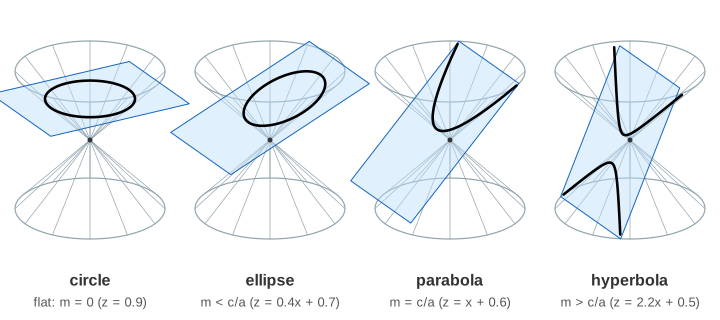
Two cups, the nappes, meet tip to tip at the apex, the origin. When a = b it is the round (circular) cone of school geometry. Slice it with a plane and you get a curve. Which curve depends only on how steep the plane is compared with the cone's side: this is where the names ellipse, parabola and hyperbola come from, the conic sections.
| fact | for x2/a2 + y2/b2 − z2/c2 = 0 |
|---|---|
| apex | the origin (0, 0, 0), the only point with z = 0 |
| flat cut z = h | an ellipse with semi-axes a|h|/c and b|h|/c (a circle when a = b) |
| cuts x = 0 and y = 0 | two lines: y = ±(b/c)z and x = ±(a/c)z |
| slope of the side in the x-z plane | c/a |
| made of | straight lines through the apex (a ruled surface) |
| bounded? | no; one piece made of two nappes that meet at the apex |
Flat cuts grow in a straight line
Put z = h into the equation: x2/a2 + y2/b2 = h2/c2. Divide by h2/c2 and it is an ellipse with semi-axes a|h|/c and b|h|/c. They are proportional to |h|: twice as high, twice as wide. At h = 0 only the apex is left. Compare the hyperboloid of one sheet, whose cuts never shrink below the neck, and the elliptic paraboloid, whose cuts grow like √h. (Demo 1: slide the cut z = h)
Straight lines through the apex
Every term of the equation has degree 2. So if a point P = (x, y, z) is on the cone, then for any number t the point tP gives t2(x2/a2 + y2/b2 − z2/c2) = t2 · 0 = 0. The whole line through P and the apex lies on the cone. These are the generating lines (generators); each one runs from the top nappe through the apex into the bottom one. In the x-z plane they are z = ±(c/a)x, so c/a is the slope of the cone's side. (Demo 2: straight lines through the apex)
Tilt the cut: the conic sections
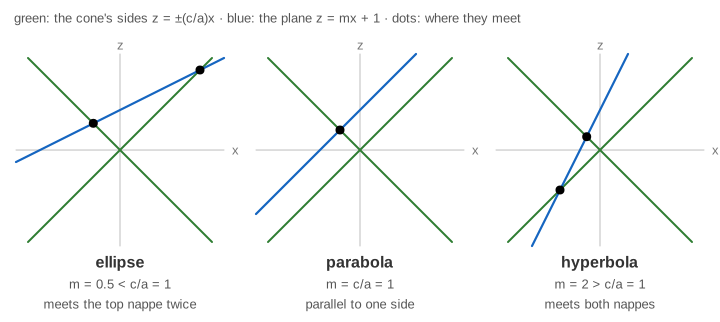
Now cut with the tilted plane z = mx + h. Measure in the plane itself: u along its slope and v = y, so a point of the plane is x = u cos α, y = v, z = u sin α + h with tan α = m. Putting this into the equation gives
A u2 − (2h sin α / c2) u + v2/b2 − h2/c2 = 0, A = (1/a2 − m2/c2) / (1 + m2)
The v2 term is always +. The sign of the u2 term A decides the curve, and A is positive exactly when m < c/a, when the plane is flatter than the side.
| tilt m | sign of A | cut (h ≠ 0) | where |
|---|---|---|---|
| m = 0 | + | ellipse, a circle when a = b | one nappe |
| 0 < m < c/a | + | ellipse | one nappe, closed |
| m = c/a | 0 | parabola | one nappe, open: the plane is parallel to a generating line |
| m > c/a | − | hyperbola | both nappes, one branch each |
For a round cone this is the classic picture of Apollonius. If γ is the angle of the side and α the angle of the plane (both from the horizontal), the curve's eccentricity is e = sin α / sin γ: 0 for the circle, below 1 for an ellipse, exactly 1 for the parabola and above 1 for a hyperbola. (Demo 3: tilt the cut: circle → ellipse → parabola → hyperbola) The 2D versions of these curves have their own pages: Ellipse, Parabola, Hyperbola and Conic Sections.
Cuts through the apex: degenerate conics
With h = 0 the equation is A u2 + v2/b2 = 0, and the same three cases collapse:
- A > 0 (flatter than the side): only u = v = 0, the point at the apex, a degenerate ellipse.
- A = 0 (parallel): v = 0, one line. The plane touches the cone along a whole generator.
- A < 0 (steeper): v = ±b√(−A) u, two lines crossing at the apex, a degenerate hyperbola.
(Demo 4: cuts through the apex: point, one line, two lines)
a, b, c reshape the cone
a and b stretch the cone along x and y: a ≠ b makes the flat cuts ellipses instead of circles. c stretches it along z: a larger c makes the side steeper. (Demo 5: a, b, c reshape the cone) For a plane tilted along x only the ratio c/a matters, so the same plane can give all three curves when c changes. (Demo 6: the side decides: change c under a tilted cut) A plane tilted along y would be compared with c/b instead.
See also Quadric Surfaces (the cone among all nine), Hyperboloid of One Sheet and Hyperboloid of Two Sheets (x2/a2 + y2/b2 − z2/c2 = ±1, which hug this cone far from the origin), and Elliptic Cylinder (the cone with its apex moved to infinity).
Near each of its four nodes, Cayley's nodal cubic looks exactly like this cone's apex, and so does the Kummer surface near each of its 16.
What the page leaves out
Planes tilted in other directions (z = mx + ny + h, or vertical planes), Dandelin spheres and the focus and directrix they reveal, oblique cones whose apex is not above the centre of the base, and the projective view in which ellipse, parabola and hyperbola are one curve.