The idea: one equation, four curves
Every ellipse, circle, parabola and hyperbola in the plane is the set of points (x, y) that make one second-degree equation true:
Ax² + Bxy + Cy² + Dx + Ey + F = 0Six numbers, and each has one job. The page starts with x² + 4y² − 4 = 0, an ellipse 2 wide and 1 high on each side of the origin. Pick a coefficient and a value, and the curve morphs while the old one stays behind in grey.
| coefficient | what it does |
|---|---|
| A | multiplies x²: stretches or squeezes along x (when B = 0) |
| B | multiplies xy: turns the curve, and is part of B² − 4AC |
| C | multiplies y²: stretches or squeezes along y; its sign against A's sets the type |
| D | multiplies x: shifts the curve sideways |
| E | multiplies y: shifts the curve up or down |
| F | the constant: the level, so the size, or a point, or nothing |
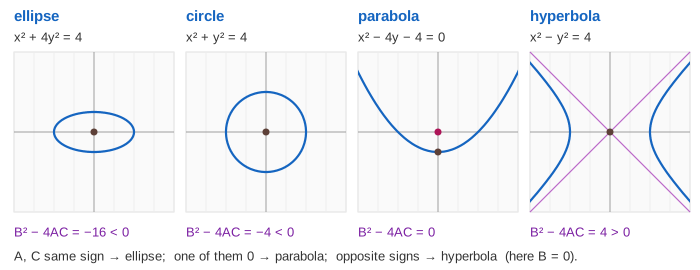
B² − 4AC decides the type
Only the three squared-degree terms decide what kind of curve it is. Their discriminant is
| B² − 4AC | type | standard form (from the centre or vertex) | more on |
|---|---|---|---|
| < 0 | ellipse (a circle when A = C and B = 0) | X²/a² + Y²/b² = 1 | Ellipse |
| = 0 | parabola | Y² = 4pX | Parabola |
| > 0 | hyperbola | X²/a² − Y²/b² = 1 | Hyperbola |
D, E and F never change the type: they move the curve and set its size. They can only make it degenerate (see below).
A and C: stretch along x and y
With B = 0 the equation is Ax² + Cy² = −F (plus D and E). A and C weigh x² against y²: x² + 4y² = 4 reaches x = ±2 but only y = ±1, because the 4 makes y count four times as much. Then B² − 4AC = −4AC, so:
- A and C with the same sign: an ellipse; A = C gives a circle.
- A and C with opposite signs: a hyperbola, x² − y² = 4 opens left and right.
- one of them 0: a parabola, x² − 4y − 4 = 0 is y = x²/4 − 1.
(Demo 1: A and C: circle, then hyperbola, Demo 2: C = 0 makes a parabola)
B turns the curve
The xy term tilts the curve. Turning the axes by an angle θ gives new coordinates x′, y′ in which the xy term is gone:
x = x′cos θ − y′sin θ      y = x′sin θ + y′cos θ
tan 2θ = B / (A − C)       (θ = 45° when A = C)

A′x′² + C′y′² + D′x′ + E′y′ + F = 0
A′ = A cos²θ + B cos θ sin θ + C sin²θ     C′ = A sin²θ − B cos θ sin θ + C cos²θ
D′ = D cos θ + E sin θ                     E′ = −D sin θ + E cos θ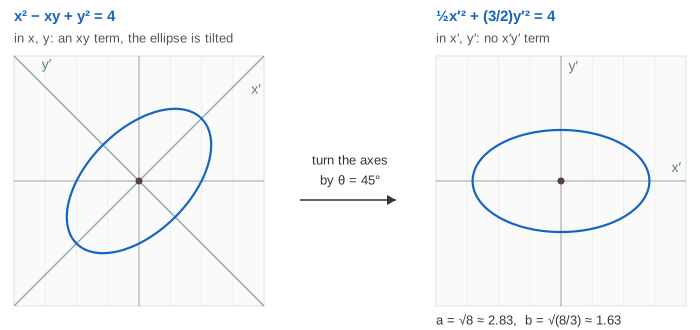
The turn changes A and C but keeps two things: A′ + C′ = A + C and B² − 4AC = −4A′C′. So turning never changes the type, while changing B does: with A = 1, C = 4, B² − 4AC = B² − 16 goes from −16 (ellipse) through 0 at B = 4 (parabola) to positive (hyperbola). (Demo 4: B turns a circle (A = C), Demo 5: B from 0 to 5 in steps of 0.1) The page draws the turned x′, y′ axes as light grey lines through the centre. Turning by a matrix is on Rotation and Scaling (2D); the axes are the eigenvectors of [[A, B/2], [B/2, C]] (Eigenvectors).
D and E: completing the square moves the centre
With B = 0, complete the square in x and in y:
x² + 4y² − 4x + 8y + 4 = 0
(x − 2)² − 4 + 4(y + 1)² − 4 + 4 = 0
(x − 2)² + 4(y + 1)² = 4
The centre moves to (−D/2A, −E/2C) = (2, −1). Completing the square also adds to the right-hand side, so D and E change the size too; here F = 4 makes the right-hand side 4 again, the same ellipse moved. With B ≠ 0 the page does the same in the turned frame with D′ and E′. (Demo 3: D and E move the centre)
F and the degenerate cases
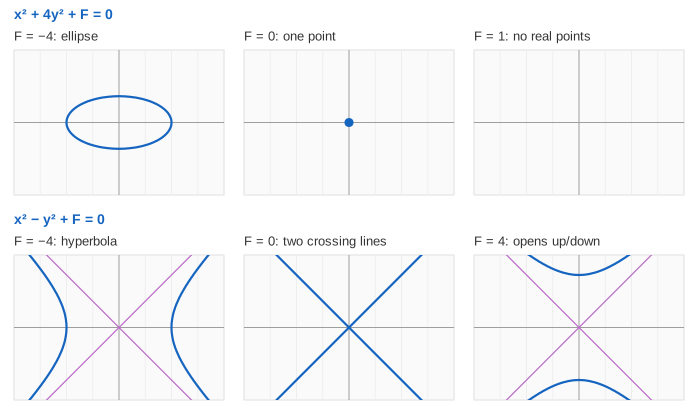
After turning and completing the squares, an ellipse or hyperbola is A′X² + C′Y² = K, with X, Y measured from the centre. F moves K: lowering F grows the curve, raising it shrinks it. When K reaches 0 the curve degenerates:
| B² − 4AC | det ≠ 0 | det = 0 (degenerate) |
|---|---|---|
| < 0 | an ellipse, or no real points (x² + 4y² + 1 = 0) | one point (x² + 4y² = 0) |
| = 0 | a parabola | two parallel lines (x² − 4 = 0), one line (x² = 0), or nothing |
| > 0 | a hyperbola | two crossing lines (x² − y² = 0) |
The test is the determinant of the 3×3 matrix of the equation:
      | A    B/2  D/2 |
det = | B/2  C    E/2 |        det = 0  ⇔  degenerate
      | D/2  E/2  F   |
For x² + 4y² − 4 = 0 it is 1·4·(−4) = −16. In the turned frame det = −A′C′K, so for an ellipse or hyperbola det = 0 exactly when K = 0. (Demo 6: F shrinks the ellipse to a point, Demo 7: F: hyperbola, crossing lines, conjugate) What a determinant measures is on Determinant.
Eccentricity, directrices and the polar equation of a conic are on Conics by Eccentricity: r = ep/(1 + e cos θ).
What the page leaves out
Cutting a cone with a plane (where the names come from), eccentricity and directrices, tangent lines, polar equations, conics in three dimensions (quadric surfaces), and curves that need a bigger window than x ∈ [−8, 8], y ∈ [−7, 7]. The one-curve-at-a-time view of each standard form is on the Ellipse, Parabola and Hyperbola pages; the parabola as a function graph is on What a, b and c Do to a Parabola.