The idea: two balls inside the cone
Cut a round cone with a plane that is flatter than the cone's side. The cut is a closed curve. To show it is an ellipse, and to find its two foci, Germinal Dandelin (1822) dropped two balls into the cone. The small one sits between the apex and the plane, the big one above the plane. Each ball is as large as it can be: it touches the cone all the way round along a circle, and it touches the plane at one point. These are the Dandelin spheres, and the two points where they touch the plane are the foci F₁ and F₂.
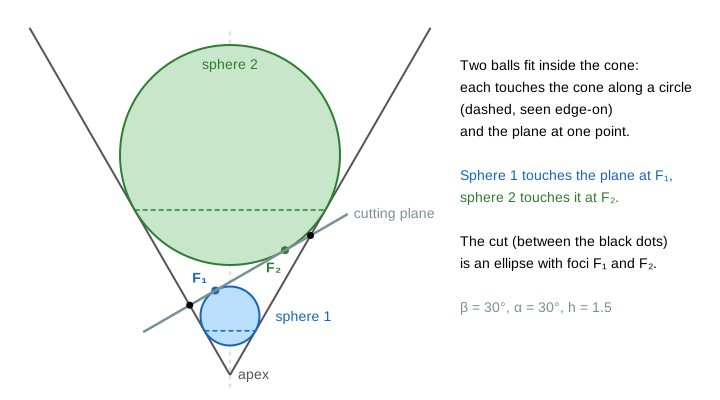
The page uses a cone with half-angle β = 30° (the side makes 60° with the horizontal) and a plane z = 1.5 + x tan α that meets the axis at height 1.5 and is tilted by α.
Two tangents from one point are equal
From a point P outside a ball, draw any segment that just touches the ball. All such tangent segments have the same length: √(|PC|² − r²), where C is the centre and r the radius, because the radius to the touch point is at a right angle to the tangent. This one fact does all the work.
The proof: PF₁ + PF₂ = Q₁Q₂
Take any point P on the cut, and the cone's straight line through the apex and P. That line touches sphere 1 at a point Q₁ on its touch circle, and sphere 2 at Q₂ on the other circle.
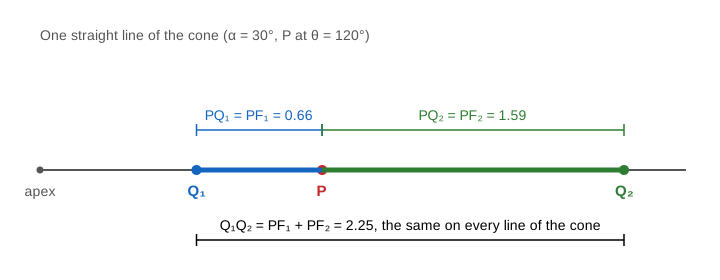
- P lies on the plane, and the plane touches sphere 1 at F₁. So PF₁ and PQ₁ are two tangents from P to sphere 1: PF₁ = PQ₁.
- In the same way PF₂ and PQ₂ are tangents to sphere 2: PF₂ = PQ₂.
- P lies between Q₁ and Q₂ on the same line, so PF₁ + PF₂ = PQ₁ + PQ₂ = Q₁Q₂.
- Q₁Q₂ is the piece of a cone line between two horizontal circles. Every cone line crosses them at the same slant distances from the apex, so Q₁Q₂ is the same for every P.
A constant sum of distances to two fixed points is exactly the definition of an ellipse, with those points as the foci. At α = 30° the sum is 2a = 2.25 and the foci are 1.30 apart. (Demo 1: the proof, step by step; Demo 2: walk P round the ellipse)
Where the spheres sit
A ball with centre (0, 0, z) on the axis touches the cone when its radius is r = |z| sin β, and touches the plane when its distance to the plane, |z − h| cos α, is also r. That gives two heights:
| sphere | centre height | at α = 30° |
|---|---|---|
| sphere 1 (below the plane) | z₁ = h cos α / (cos α + sin β) | 0.95, radius 0.48 |
| sphere 2 (above the plane) | z₂ = h cos α / (cos α − sin β) | 3.55, radius 1.77 |
The touch circle of a ball at height z is at slant distance z cos β from the apex along every cone line, so Q₁Q₂ = (z₂ − z₁) cos β = 2a. A flat plane (α = 0) puts both foci at the centre: a circle of radius 0.87. Tilting the plane moves the two balls apart along the axis and the foci apart in the plane. (Demo 3: tilt the plane)
Parabola and hyperbola
z₂ has cos α − sin β in the denominator. It blows up when α = 90° − β, when the plane is parallel to a side.
| tilt α | sphere 2 | cut | what stays constant |
|---|---|---|---|
| 0° | above, F₂ = F₁ | circle | PF₁ = radius |
| below 60° | above the plane | ellipse | PF₁ + PF₂ = 2a |
| 60° | none (infinitely far) | parabola | PF₁ = distance to the directrix |
| above 60° | in the bottom nappe | hyperbola | |PF₁ − PF₂| = 2a |
For the hyperbola the cone line from Q₁ to Q₂ runs through the apex, and P is outside the segment Q₁Q₂, so the tangent lengths subtract instead of adding. At α = 75° the difference is 1.84 on both branches. (Demo 4: parallel to the side; Demo 5: steeper, a hyperbola)
Eccentricity and the directrix
The plane of the touch circle of sphere 1 meets the cutting plane in a line, the directrix. For a point P on the cut, PF₁ = PQ₁ = (height of P above that circle) / cos β, while the distance from P to the directrix is the same height divided by sin α. So
PF₁ / (distance to the directrix) = sin α / cos β = e,
the eccentricity: 0 for the circle, 0.58 at α = 30°, exactly 1 for the parabola and 1.12 at α = 75°. This is the focus-directrix form of the conics on Conics by Eccentricity.
See also Elliptic Cone (every conic as a cut of a cone), Ellipse (PF₁ + PF₂ = 2a in the plane) and Parabola (focus and directrix).
What the page leaves out
Cones that are not round (an elliptic cone has no Dandelin spheres touching along circles), the directrix drawn on the canvas, the second directrix of the ellipse, planes through the apex (the degenerate conics), and the same argument for a cylinder, where two equal balls show that a slanted cut of a round cylinder is an ellipse.