The idea: two fields that keep each other going
A magnetic field that changes makes an electric field: that is Faraday's law, the coil and magnet of Faraday's Law. Maxwell added the reverse: an electric field that changes makes a magnetic field. Far from any charge the two can keep each other going and travel through empty space as a wave. In 1864 Maxwell worked out its speed from two constants measured with batteries and coils, found the speed of light, and concluded that light is such a wave.
For a wave travelling along x, the simplest one is
E = E₀ sin(kx − ωt) ŷ        B = B₀ sin(kx − ωt) ẑ

k = 2π/λ      ω = 2πf
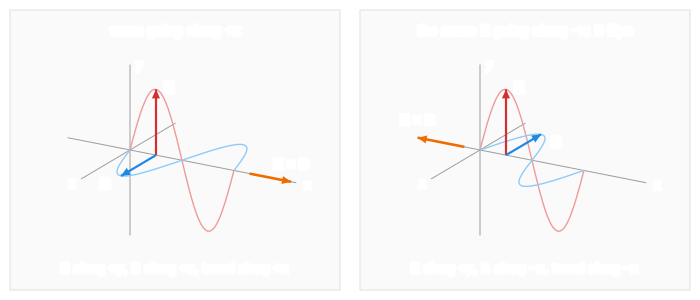
E points along y and B along z. Both are at right angles to the direction of travel, so the wave is transverse. They are also in step: both peak at the same place at the same moment. On the canvas E is red, B is blue, and the spokes join each curve to the x axis.
E₀ = c·B₀ and c = 1/√(μ₀ε₀)
Put the wave into Maxwell's equations and two conditions come out. Faraday's law gives E₀ = c·B₀, and the two together give the speed:
c = 1/√(μ₀ε₀)

μ₀ = 1.25664 × 10⁻⁶ N/A²     (magnetic constant)
ε₀ = 8.85419 × 10⁻¹² F/m     (electric constant)
c  = 299 792 458 m/s ≈ 3.00 × 10⁸ m/s
In SI units B is tiny next to E. A strong field of E₀ = 1000 V/m comes with B₀ = E₀/c = 3.34 µT, less than a tenth of the Earth's magnetic field. That is why the canvas draws c·B: at that scale the blue curve is as tall as the red one. Demo 2: radio or light, 1 or 1000 V/m changes E₀ and shows B₀ follow.
A snapshot in space, a sine in time
Freeze the time and the field along x is a sine with period λ, the wavelength. Stand at one place and the field there is a sine in time with period T = 1/f. In one period every crest moves forward exactly one wavelength, so the speed is
c = λ/T = λ·fDemo 1: the wave moves one λ per period T plays one period: every crest moves one λ to the right, the picture ends where it started, and the probe records one full cycle.
A probe a quarter wavelength further on sees the same signal a quarter period later: E(x + λ/4, t) = E(x, t − T/4). Demo 3: λ/4 further on moves the probe from 2λ to 2.25λ, and the curve in the time plot shifts right by T/4.
Which way it goes: E × B
The wave carries energy along S = E × B / μ₀, the Poynting vector, in watts per square metre. For the wave above, ŷ × ẑ = x̂: S points the way the wave travels. A wave going the other way is
E = E₀ sin(kx + ωt) ŷ B = −B₀ sin(kx + ωt) ẑE is the same, B has flipped, and E × B now points along −x. Demo 4: E × B points the way it goes reverses the wave: the orange arrow moves to the other end, and in the time plot c·Bz becomes the mirror image of Ey.
Averaged over a period, the intensity is
I = E₀² / (2μ₀c) = ½ c ε₀ E₀²For E₀ = 1000 V/m that is 1327 W/m², close to sunlight above the atmosphere (about 1361 W/m²).
One wave, many names: the spectrum
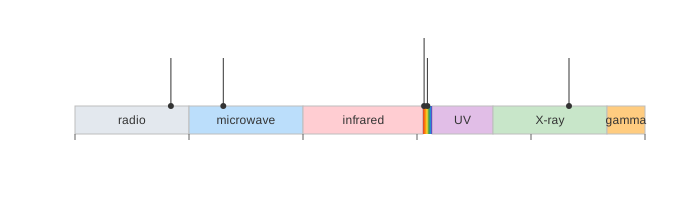
Radio, microwaves, light and X-rays are the same wave with different wavelengths. The canvas draws everything in units of λ, so the picture is the same for every source; only the numbers change.
| Source | λ | f | T |
|---|---|---|---|
| FM radio | 3.00 m | 100 MHz | 10.0 ns |
| Wi-Fi | 12.5 cm | 2.40 GHz | 417 ps |
| red laser | 650 nm | 461 THz | 2.17 fs |
| green laser | 532 nm | 564 THz | 1.77 fs |
| X-ray | 0.100 nm | 3.00 × 10¹⁸ Hz | 0.334 as |
Polarization: linear, circular, elliptical
The wave so far is linearly polarized along y: E only swings up and down. Add a second wave along the same x, with E along z and shifted by a phase φ:
E = E₀ sin ψ ŷ + a·E₀ sin(ψ + φ) ẑ ψ = kx − ωtIts B is along −y, so B still turns with E and stays at right angles to it. What E does depends on a and φ. The end-on panel shows it, looking back along −x at the probe: y up, z to the left.
| a | φ | Tip of E (end-on) | Demo |
|---|---|---|---|
| 0 | any | a vertical line: linear along y | 1 |
| 1 | 0° | a line at 45°: linear | 6 |
| 1 | 90° | a circle, counter-clockwise: circular, |E| = E₀ always | 5 |
| 0.5 | 90° | an ellipse twice as tall as wide | 7 |
| 1 | 270° | a circle, clockwise | 8 |
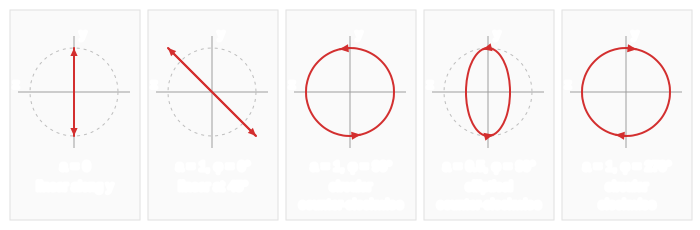
In circular polarization |E| never changes; only its direction turns, once per period, so in 3D the tip of E draws a helix. With φ = 90° E turns from y toward z. In the radio (IEEE) convention that is right-handed: point the right thumb along the travel and the fingers curl the way E turns. Optics books often use the opposite name, so check which convention a source uses. The end-on paths are the 1 : 1 Lissajous figures: line, ellipse and circle as the phase goes from 0° to 90°. To make, filter and convert polarized light with polarizers and quarter-wave plates, see Polarizers and Malus's Law.
Where such a wave comes from, charges sloshing up and down an antenna, and why it is strongest broadside: see A Dipole Antenna.
Because Maxwell's equations fix c = 1/√(μ₀ε₀) for every observer, clocks and rulers must change instead, as Special Relativity: the Light Clock and Spacetime shows with a light clock on a moving train.
To see what a magnetic field does to a moving charge, with circles of radius r = mv/(qB), cyclotrons and mass spectrometers, see A Charge in a Magnetic Field: the Lorentz Force.
The same light also arrives in lumps of energy hf: see The Photoelectric Effect, where one photon frees one electron from a metal.
Why hot hydrogen glows only at 656, 486, 434 and 410 nm is shown on The Bohr Atom and the Hydrogen Spectrum.
What the page leaves out
Where waves come from (accelerating charges, an antenna's current) and the near field close to them; waves that spread out from a source and get weaker with distance (the page has one plane wave); matter, where the speed is c/n, E₀ = (c/n)·B₀ and the wave can be absorbed; real light, which is many short waves with random phases (unpolarized until a filter picks one direction); and photons, the quantum picture in which the energy comes in lumps of E = h·f. The picture is not to scale: real fields are drawn in units of E₀ and λ.