The idea: two waves going opposite ways
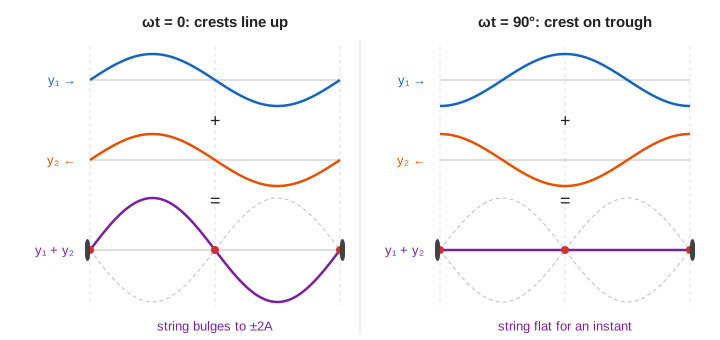
Pluck a guitar string and a wave runs along it, hits the fixed end, flips over and runs back. Soon there are two equal waves on the string, one going right and one going left:
y₁ = A·sin(kx − ωt)      going right
y₂ = A·sin(kx + ωt)      going left
y₁ + y₂ = 2A·sin(kx)·cos(ωt)
(the last line is the identity sin a + sin b = 2·sin((a + b)/2)·cos((a − b)/2)). The sum does not travel. Its shape sin(kx) stays in one place and only grows and shrinks with cos(ωt). That is a standing wave. On the page the top row is y₁, the middle row y₂ and the bottom row their sum, the string you see.
Nodes and antinodes
Where sin(kx) = 0 the string never moves, whatever the time: these points are the nodes. There the two travelling waves are always exactly opposite (look along a grey line through the three rows). Halfway between two nodes sin(kx) = ±1 and the string swings the most, between +2A and −2A: the antinodes. Nodes are half a wavelength apart, λ/2. Twice in every period, at ωt = 90° and 270°, the two waves cancel everywhere and the whole string is flat for an instant. It is not at rest then: that is when it moves fastest (Vibrate shows the twelve steps of one period).
Why only some wavelengths fit
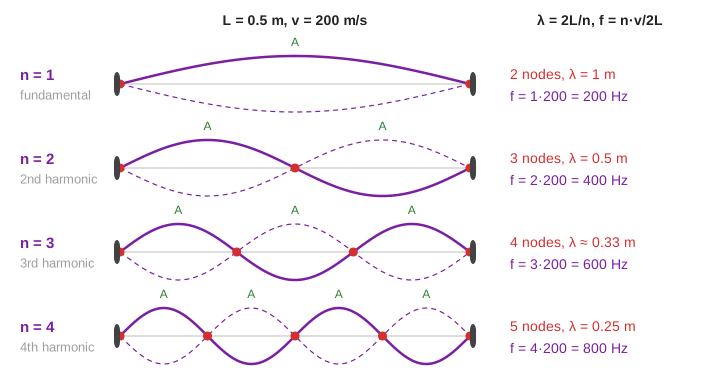
Both ends of a guitar string are held still, at the bridge and at the nut (or the fret). So both ends must be nodes. Nodes are λ/2 apart, so a whole number n of half-wavelengths must fit into the length L:
L = n·λ/2 so λₙ = 2L/n, n = 1, 2, 3, …Each n is a harmonic (or mode). Harmonic n has n + 1 nodes (the two ends included) and n antinodes. n = 1, one hump, is the fundamental (Demo 1); n = 2 adds a node in the middle (Demo 2); n = 3 has four nodes (Demo 3).
Wave speed and frequency
How fast a wave runs along a string depends on two things: the tension T that pulls it straight again, and the linear density μ, its mass per metre, that resists speeding up:
v = √(T/μ) fₙ = v/λₙ = n·v/(2L) = n·f₁With T = 80 N and μ = 2 g/m = 0.002 kg/m, v = √40 000 = 200 m/s. On a 0.5 m string f₁ = 200/(2·0.5) = 200 Hz, close to the note G3. All the other harmonics are whole multiples of f₁: 400, 600, 800 Hz, …
| change | what happens to f | on the page |
|---|---|---|
| n → n + 1 | one more half-wavelength, f = n·f₁ goes up by f₁ | Demos 2, 3: 400, 600 Hz |
| T × 2 | v × √2, so f × √2 ≈ 1.41 | Demo 4: 200 → 282.84 Hz |
| L ÷ 2 | λ ÷ 2, so f × 2: one octave up | Demo 5: 200 → 400 Hz |
| μ × 4 | v ÷ 2, so f ÷ 2: one octave down | Demo 6: 200 → 100 Hz |
| L ÷ 2 and T ÷ 4 | × 2 and ÷ 2 cancel: the same note | Demo 7: 200 Hz |
How a guitar uses it
Turning a tuning peg changes T: tighter is higher. Pressing a fret makes the vibrating length L shorter: the 12th fret is halfway along, so it plays the same note one octave up (Demo 5). The six strings have about the same length and tension, so the low strings are made heavier (bigger μ, often wound with wire) to sound lower (Demo 6). Because f goes with √T, quadrupling the tension would be needed for an octave, which would snap a string, so a heavier string does that job instead.
Overtones: why a guitar is not a tuning fork
A real pluck does not make one harmonic. The plucked shape is a sum of many harmonics at once, each with its own amplitude, all sounding together: 200, 400, 600 Hz, … The ear hears the lowest, f₁, as the pitch and the mix of the others as the timbre. Plucking near the bridge gives more high harmonics (a brighter sound); touching the string lightly at its middle kills every odd harmonic and leaves the 2nd, 4th, … (a guitarist's "harmonic"). Demo 8 shows the 6th harmonic of a short string: 2400 Hz with 7 nodes only 4.2 cm apart.
See also
Two waves adding up, crest on crest or crest on trough, is the same superposition as in Wave Interference, where two sources make nodal lines in a ripple tank. Each point of the vibrating string moves up and down in simple harmonic motion, like the mass in Spring Oscillator.
Any shape of a plucked string is a sum of these harmonics; how the coefficients are found is in Fourier Series, Harmonic by Harmonic.
A string wave is transverse; the sound it sends into the air is longitudinal, with compressions and rarefactions: see Transverse and Longitudinal Waves.
What the page leaves out
Air columns and open ends: a pipe closed at one end has a node at the closed end and an antinode at the open end, so λ = 4L/n with only odd n (1, 3, 5, …) fits; a pipe open at both ends behaves like the string. Also left out: damping (the sound dies away), the stiffness of a real string (its high harmonics come out slightly sharp), large amplitudes (the tension then changes as the string stretches), how a pluck is split into harmonics (Fourier series), and the guitar body that makes the sound loud. The drawn amplitude is not to scale: a real string moves a few millimetres.