The idea: a charge changes the space around it
Put an electric charge somewhere and every other charge nearby feels a push or a pull. Instead of saying "charge A pushes charge B", physics says charge A makes an electric field E at every point around it, and any charge placed at a point feels a force from the field there. The field is an arrow at each point: how strong, and which way.
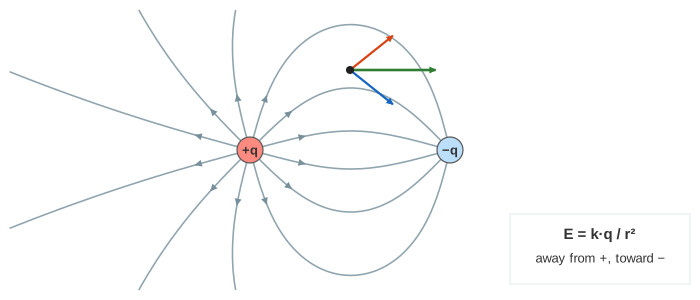
The canvas shows a 36 cm × 30 cm patch of space with one or two point charges on the x axis. Measure E puts a probe at O, P or Q and draws each charge's field there and their sum. Draw Field Lines traces the lines that follow E. The panel on the right shows the numbers.
Coulomb's law and the field of one charge
Two point charges q₁ and q₂ a distance r apart push or pull each other with a force F = k·q₁·q₂ / r² (Coulomb's law), with k = 8.99×10⁹ N·m²/C². Like charges repel, unlike charges attract. Divide the force on a small test charge q₀ by q₀ and you get the field of the other charge, which no longer depends on the test charge:
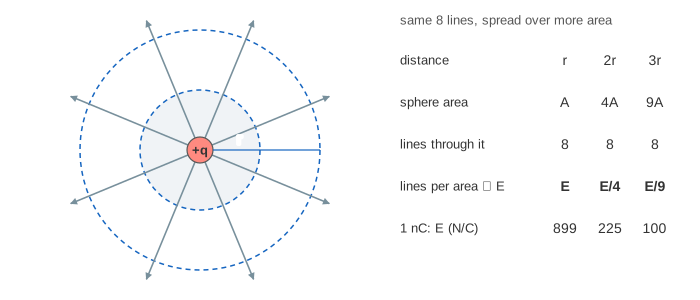
E = F / q₀ = k·q / r² (N/C, pointing away from + and toward −)For q = 1 nC at r = 10 cm, E = 8.99×10⁹ × 10⁻⁹ / 0.1² = 899 N/C. At 20 cm it is 225 N/C: twice as far, a quarter of the field (Demo: one + charge, E falls as 1/r²). Around a − charge the arrows turn round and point at the charge (Demo: a − charge, E points inward). A test charge of +1 nC at 899 N/C feels F = qE = 0.90 µN.
Why the inverse square
Picture the field lines leaving the charge evenly in all directions. A sphere of radius r around it has area 4πr², and every line crosses it. At 2r the same lines are spread over 4 times the area, so they are a quarter as dense, and the field is a quarter as strong. This picture is exactly Gauss's law: the field's flux through any closed surface depends only on the charge inside.
Superposition: fields add as arrows
With several charges, each one makes its field as if the others were not there, and the field at a point is the vector sum. On the canvas the second arrow slides so its tail sits on the tip of the first; the sum runs from the probe to the end of the chain. At P (0, 8) in the dipole, each charge is 10 cm away, so E₁ = E₂ = 899 N/C. Their up-and-down parts cancel and their sideways parts add: E = 1079 N/C pointing from the + side to the − side (Demo: dipole, lines run from + to −).
Two equal + charges do the opposite. Midway between them E₁ and E₂ are equal and opposite, so E = 0: a null point, where a test charge feels no force. Above the middle, at P, the sideways parts cancel and the field points straight up at 1438 N/C (Demo: two + charges, E = 0 in the middle).
| Charges | Probe | E₁ (N/C) | E₂ (N/C) | Sum E (N/C) |
|---|---|---|---|---|
| +1 nC alone | O, r = 10 cm | 899 | – | 899, along +x |
| +1 nC alone | Q, r = 20 cm | 225 | – | 225, along +x |
| Dipole +1, −1 | P (0, 8) | 899 | 899 | 1079, along +x |
| Two +1 | O (0, 0) | 2497 | 2497 | 0, null point |
| Two +1 | P (0, 8) | 899 | 899 | 1438, along +y |
| +2 and −1 | P (0, 8) | 1798 | 899 | 1771, 24° above +x |
Field lines
A field line is a curve whose direction at every point is the direction of E. Michael Faraday drew them to picture the field. They follow a few rules:
- They start on + charges and end on − charges, or go off to (or come in from) infinity.
- The number of lines is proportional to the charge: the canvas uses 8 lines per nC.
- They are dense where the field is strong and spread out where it is weak.
- They never cross: at each point E has only one direction. At a null point E has no direction, and no line passes through it.
- A field line is not the path a charge takes; a charge that starts at rest speeds up along the line, but once moving it can drift off it.
The page traces each line in small steps along E (a Runge–Kutta step that shrinks near the charges). In the dipole all 8 lines from the + charge end on the − charge; the outer ones loop far outside the view first. With +2 nC and −1 nC, 16 lines leave the +2 nC charge but the −1 nC charge can only take 8: the other 8 go off to infinity, as if the pair were one +1 nC charge seen from far away (Demo: +2 and −1 nC, half the lines escape). That pair also has a null point, at x ≈ 35 cm, outside the view.
Where it shows up
| Where | What the field does |
|---|---|
| Capacitor | + and − plates face each other; the lines between them are straight and evenly spaced, so E is uniform |
| Water molecule, polar molecules | A small dipole: the field lines run from the H side to the O side |
| Lightning rod, sharp points | Lines crowd onto a sharp tip, so E is strongest there and the air breaks down first |
| Inkjet printers, electrostatic precipitators | Charged drops or dust are steered by F = qE |
See also Maxwell's Equations for Gauss's law, the flux of E through a closed surface, A Dipole Antenna for what happens when the charges of a dipole move back and forth, and Faraday's Law for the other way to make an electric field: a changing magnetic field.
What the page leaves out
The page is flat: the charges and probe all lie in one plane, though the numbers are the real 3D ones. Field lines are drawn in that plane only, so their spacing on the screen is a 2D slice and not a true measure of the 3D density. It does not show the electric potential V = kq/r and equipotential lines, charges that move, conductors and induced charge, continuous charge (a rod, a plate), or the field inside matter (dielectrics). The arrow length is shrunk for the strongest fields so they fit.
See where this page fits on the Physics & Circuits mind map.