The idea: a polarizer keeps one direction of E
Light is an electric field E that swings at right angles to the beam (see Electromagnetic Waves). In a lamp or the Sun, countless atoms send short bursts with no common direction, so the direction of E changes at random from moment to moment: the light is unpolarized.
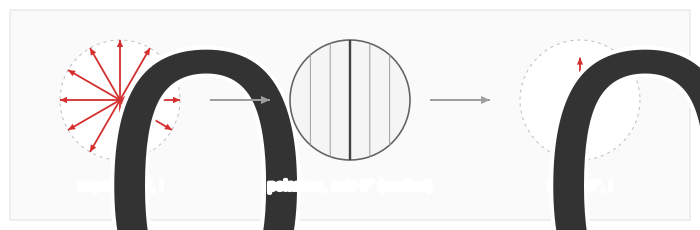
A polarizer has a transmission axis. It lets through the part of E along that axis and absorbs the part across it. On average half the intensity of unpolarized light gets through, and what comes out is linearly polarized along the axis, whatever angle the polarizer is turned to. Demo 1: unpolarized light through a polarizer turns it from 0° to 90° and the intensity stays at I₀/2.
Malus's law: I = I_in·cos²θ
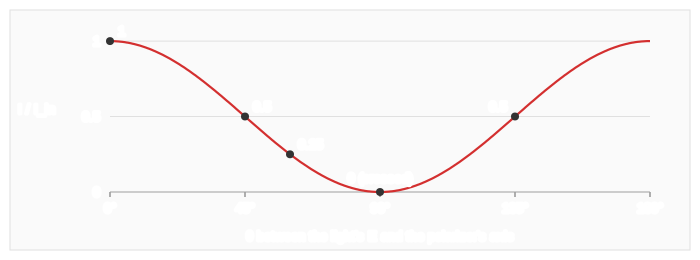
Now send linearly polarized light into a polarizer whose axis is at angle θ to the light's E. The part of E along the axis is E·cos θ. Intensity goes with the square of the field, so
I = I_in · cos²θÉtienne-Louis Malus found this in 1809. At θ = 0° everything passes; at 45° half; at 60° a quarter; at 90° nothing. Demo 2: Malus's law turns the second polarizer from 0° to 90° in 15° steps, and the screen dims from ½ to 0.
Crossed polarizers and a third one in between
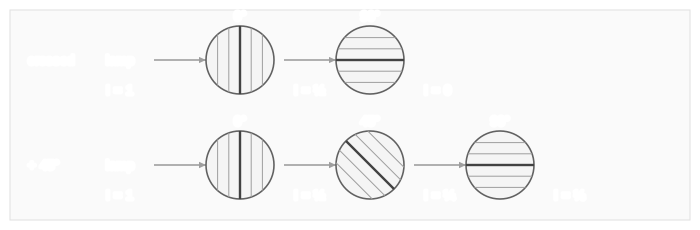
Two polarizers at 90° to each other are crossed: the first makes the light vertical, the second only passes horizontal, and nothing reaches the screen (Demo 3). Now slide a third polarizer at 45° between them (Demo 4). Light comes through again, because each polarizer resets the direction of E to its own axis:
| After | Polarization | Intensity | Rule |
|---|---|---|---|
| the lamp | unpolarized | 1 | |
| polarizer 0° | linear 0° | ½ | half of unpolarized |
| polarizer 45° | linear 45° | ¼ | ½ · cos²45° |
| polarizer 90° | linear 90° | ⅛ | ¼ · cos²45° |
Wave plates: a quarter period of delay
A wave plate is a clear crystal in which light polarized along one axis (the fast axis) travels a little faster than light along the other (the slow axis). It absorbs nothing, so the intensity is kept. A quarter-wave plate is just thick enough that the slow part comes out a quarter period (T/4) late.
Linear light at 45° to the axes has equal parts along both. After the plate one part peaks when the other is zero, and E turns in a circle: the light is circular (Demo 5). It works backwards too: circular light comes out linear at ±45° (Demo 8). Two quarter-wave plates make a half-wave plate, a half period of delay, which mirrors the polarization about the fast axis: 45° comes out at −45° (135°), as Demo 7 shows with a polarizer behind it.
linear 45°    J = (1, 1)/√2   ──λ/4, fast axis 0°──▶   J = (1, i)/√2    circular
circular      J = (1, i)/√2   ──λ/4, fast axis 0°──▶   J = (1, −1)/√2   linear 135°
The vectors are Jones vectors: the (complex) amplitudes of Ey and Ez. Multiplying a part by i is the quarter-period delay. Circular light through a polarizer alone gives I/2 at every angle, just like unpolarized light (Demo 6); a quarter-wave plate in front tells the two apart, because it turns circular light into linear light that a polarizer can block completely.
Where you meet it
| Where | What the polarizer does |
|---|---|
| Polarized sunglasses | Glare off water and roads is mostly horizontal; a vertical axis blocks it |
| LCD screens | Crossed polarizers with liquid crystal between them that turns the light, or not, pixel by pixel |
| 3D cinema glasses | Opposite circular polarizations for the two eyes (a λ/4 plate plus a polarizer in each lens) |
| Camera filters | Darken a blue sky and remove reflections from windows |
| Stress testing | Plastic under stress acts like a wave plate; between crossed polarizers it shows coloured fringes |
What the page leaves out
Real polarizers pass a little of the wrong direction and absorb some of the right one; the page treats them as ideal. A wave plate is a quarter wave only at one wavelength, so with white light the result depends on colour. Partly polarized light (a mix of polarized and unpolarized, like the blue sky), polarization by reflection at Brewster's angle and by scattering, half-wave plates as one element, and the Stokes parameters and Mueller matrices used for partly polarized light are left out.