The idea: light knocks electrons out of a metal
Shine light on a clean metal plate in a vacuum and electrons jump out of it. A second plate, the collector, catches them, and a meter in the wire between the plates shows a current. This is the photoelectric effect. The surprise was in the details: whether electrons come out depends on the colour of the light, not on how bright it is. In 1905 Einstein explained it by saying that light comes in lumps of energy, later called photons.
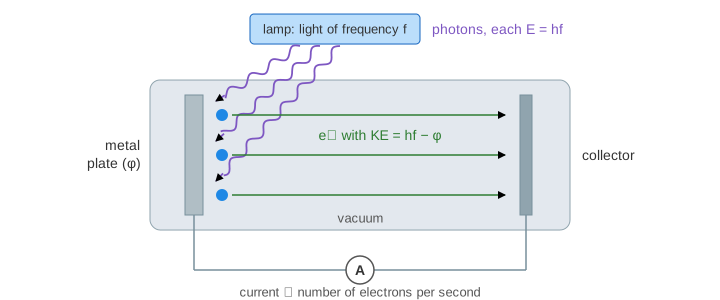
Photons: E = hf
Light of frequency f is made of photons that each carry the energy
E = hf = hc/λ, h = 6.626 × 10⁻³⁴ J·s = 4.136 × 10⁻¹⁵ eV·s, hc = 1240 eV·nmThe electron-volt (eV) is the energy an electron gains across 1 volt, 1.602 × 10⁻¹⁹ J. A photon of the page's four lights carries:
| light | λ | f (× 10¹⁴ Hz) | hf |
|---|---|---|---|
| red | 650 nm | 4.61 | 1.91 eV |
| green | 530 nm | 5.66 | 2.34 eV |
| violet | 400 nm | 7.49 | 3.10 eV |
| UV | 250 nm | 11.99 | 4.96 eV |
A photon is absorbed whole, by one electron, or not at all. The electron cannot collect energy from two photons (at ordinary brightness).
The work function and the threshold
Electrons are bound inside a metal. The least energy that frees the most loosely bound one is the work function φ: 2.28 eV for sodium, 4.33 eV for zinc. Energy is conserved, so an electron that absorbs a photon leaves with at most
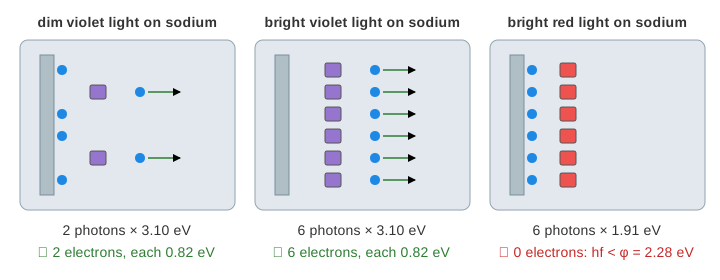
KE_max = hf − φViolet light on sodium: 3.10 − 2.28 = 0.82 eV, so the electron flies off at about 5.4 × 10⁵ m/s (Demo: violet light on sodium). If hf < φ the photon cannot free anyone and its energy only warms the metal. The edge is the threshold frequency f₀ = φ/h: 5.51 × 10¹⁴ Hz (544 nm) for sodium, so red light frees nothing (Demo: red light on sodium). Zinc needs f₀ = 10.47 × 10¹⁴ Hz (286 nm), which only ultraviolet reaches (Demo: zinc needs UV). The energy diagram on the canvas draws this: the photon's arrow hf either passes the vacuum level, and the part above it is KE, or stops short.
Brighter vs bluer
A brighter lamp of the same colour sends more photons per second, each with the same hf. More photons free more electrons, so the current goes up, but every electron still has the same KE. A bluer lamp sends photons with more energy each, so the electrons come out faster (Demos: brighter violet; bluer light, faster electrons).
What the wave picture predicted
Light is also an electromagnetic wave (see Electromagnetic Waves), and in a wave the energy grows with the amplitude, that is with the brightness. That picture made three predictions, and the experiment broke all three:
| question | wave picture | photons (what happens) |
|---|---|---|
| brighter light | faster electrons | more electrons, same KE |
| dim red light | electrons after enough waiting | none, ever, below f₀ |
| delay after switching on | seconds or more to soak up energy | none (under 10⁻⁹ s) |
| KE against f | no link | a straight line, slope h |
Einstein's line and measuring h
KE_max = hf − φ is a straight line in f. Its slope is h, the same for every metal; the metal only moves it, by crossing zero at f₀ and, extended back, hitting −φ at f = 0 (Demo: KE against f). To measure KE in a lab you make the collector negative: the stopping voltage V_s at which the current just drops to zero gives KE_max = eV_s, 0.82 V for violet light on sodium. Millikan measured V_s against f for several metals in 1916, found parallel straight lines and got h within 1% of today's value. Einstein's Nobel Prize (1921) was for this, not for relativity.
The same effect runs camera sensors and solar cells (there the electron is freed inside a semiconductor, see Diodes and Rectifiers for the p-n junction) and photomultiplier tubes that count single photons. That light also diffracts like a wave (Diffraction) and electrons behave as waves too (Quantum Tunneling) is the other half of wave-particle duality.
What the page leaves out
In a real metal electrons sit at many energies below the top, so electrons leave with every KE from 0 up to KE_max; the page lets every photon hit a top electron. Most photons are reflected or absorbed without freeing anyone (the quantum efficiency is far below 1). The collector voltage, the current-voltage curve, surface effects on φ, photon momentum, two-photon absorption with lasers, and the Compton effect are left out.
See where this page fits on the Physics & Circuits mind map.