The idea: waves add up
Drop two stones into a pond. Each one sends out rings of waves. Where the rings cross, the water does not pick one wave or the other: its height is the sum of the two. This is the superposition of waves, and what it does is called wave interference.
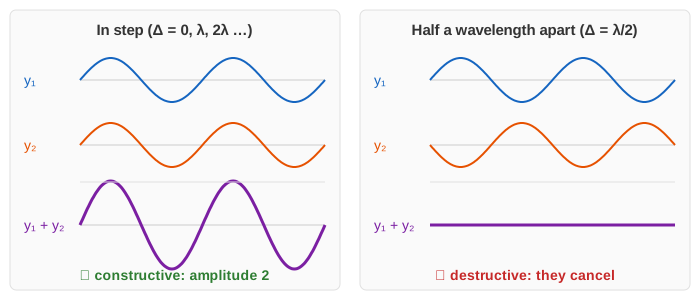
- Crest meets crest (or trough meets trough): the swings add up. This is constructive interference.
- Crest meets trough: the swings cancel. This is destructive interference.
The canvas shows a ripple tank from above. Two point sources, S₁ and S₂, make waves with the same wavelength λ = 2 cm, frequency and amplitude. The circles are the crests. A screen on the right records how strongly the water swings at each point, and the three graphs show what happens at one probe point P on that screen.
Path difference and phase difference
The wave from S₁ travels r₁ to reach P, and the wave from S₂ travels r₂. The path difference is
Δ = r₂ − r₁Every wavelength of extra path puts the wave one full cycle (2π) behind. So the phase difference between the two waves at P is
δ = 2π · Δ/λ + Δφwhere Δφ is how far S₂ starts behind S₁ (0 when the sources are in step). Only Δ compared with λ matters:
| path difference Δ | phase difference δ | at P | amplitude | intensity |
|---|---|---|---|---|
| 0, λ, 2λ, … | 0, 2π, 4π, … | ✓ crest meets crest | A₁ + A₂ = 2 | 4I₀ |
| λ/4 | π/2 | partly in step | √2 ≈ 1.41 | 2I₀ |
| λ/2, 3λ/2, … | π, 3π, … | ✗ crest meets trough | |A₁ − A₂| = 0 | 0 |
(Demo 1: central maximum, Demo 2: first dark fringe, Demo 3: first bright fringe.) In Demo 2 the blue and orange graphs are mirror images and their purple sum is a flat line: the water at P does not move at all, although both waves reach it.
Amplitude and intensity
Draw each wave as an arrow of length A that turns once per period. The arrows of the two waves are δ apart, and the swing at P is as long as their sum:
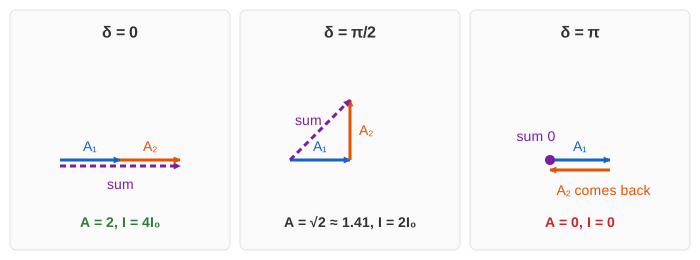
A_P = √(A₁² + A₂² + 2·A₁·A₂·cos δ)
I   = A_P²         (I₀ = the intensity of one source alone)
The intensity (the energy the wave carries) goes with the amplitude squared. With equal sources it is I = 4I₀·cos²(δ/2). So the maximum intensity is 4I₀, not 2I₀, and the minimum intensity is 0. No energy is made or lost: it is moved from the dark places to the bright ones, and the average over the screen is still I₀ + I₀ = 2I₀.
If the sources are not equally strong, a node never goes fully dark. With A₂ = 0.5 the swing at a node is 1 − 0.5 = 0.5, so the minimum is 0.25 I₀ and the maximum (1.5)² = 2.25 I₀: a ratio of 9, much less contrast (Demo 7: unequal amplitudes).
Nodes, antinodes and the interference pattern
All points with the same path difference lie on one curve: a hyperbola with the two sources as its foci. That gives the interference pattern:
- antinodal lines where Δ = mλ: the water swings hardest, each point is an antinode;
- nodal lines where Δ = (m + ½)λ: the water stays still, each point is a node.
The path difference can never be more than d, the distance between the sources, so there is one antinodal line for every whole number m with |m|·λ < d. With λ = 2 cm and d = 8 cm that is m = −3 … 3, seven lines, with eight nodal lines between and beside them. Watch the crests while you press Play: the circles move outwards, but the nodal and antinodal lines stay where they are.
Fringes on a screen
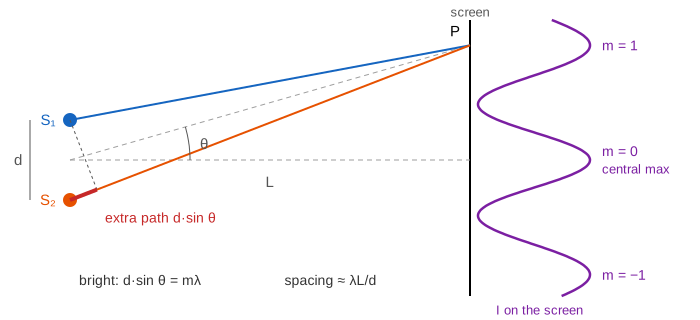
Each line that hits the screen makes a bright or dark band there: the interference fringes. Far away the two paths are nearly parallel and the path difference is Δ ≈ d·sin θ, so
bright fringe:  d · sin θ = mλ          m = 0, ±1, ±2, …
dark fringe:    d · sin θ = (m + ½)λ
spacing on a screen at distance L:  ≈ λL / d
m = 0 is the central maximum, straight across from the middle of the two sources, where both paths are the same length. The spacing tells you what to change:
| change | lines | fringes |
|---|---|---|
| shorter wavelength λ | more | closer together |
| sources farther apart (bigger d) | more | closer together |
| screen farther away (bigger L) | same | farther apart |
(Demo 4: shorter wavelength, more fringes goes from λ = 4 cm, three antinodal lines, to λ = 1 cm, fifteen.) A fixed point on the screen can flip from bright to dark when only λ changes: its path difference of 2 cm is one whole wavelength at λ = 2 cm but half of one at λ = 4 cm (Demo 5: same point, new wavelength).
Starting S₂ half a cycle late (Δφ = π) adds π to every phase difference, so every node becomes an antinode and the other way round. The middle line, where Δ = 0, is now dark (Demo 6: sources in antiphase). Noise-cancelling headphones work this way: they play the noise again, half a cycle late.
Coherent sources
The pattern only stands still when the phase difference at each point stays the same. That needs coherent sources: the same frequency and a fixed phase difference between them. Give S₂ a frequency 1.25 times that of S₁ and δ grows by π/2 every period. The lines drift, P swells and dies away every 4 periods (beats), and averaged over time every point of the screen gets I₀ + I₀ = 2I₀: the fringes are gone (Demo 8: not coherent). Two light bulbs never make fringes for the same reason: their light changes phase millions of times a second. That is why Young split light from one source into two slits.
The waves themselves are sines and cosines; what each number in a·sin(bx + c) + d does is on Sine Waves and Cosine Waves, and the turning arrow is the point going round on the unit circle. Adding many waves of different frequencies is the Fourier series; one wave that dies away is Damped Oscillation.
Where it shows up
- Young's double slit: light through two narrow slits makes bright and dark bands; the spacing λL/d gave the first measurement of the wavelength of light.
- Noise-cancelling headphones: a microphone hears the noise and the speaker adds the same wave half a cycle late.
- Soap bubbles and oil films: light reflected from the top and the bottom of a thin film interferes, and each colour is bright at a different thickness.
- Wi-Fi dead spots and antenna arrays: signals from two antennas, or a direct and a reflected path, cancel in some places; phased-array antennas steer a beam by choosing Δφ.
Two waves of the same frequency travelling in opposite directions along a string make a standing wave with fixed nodes and antinodes: see Standing Waves on a String.
When the source moves, its crests bunch up ahead and spread out behind, and the pitch a listener hears changes: see The Doppler Effect: Why a Passing Siren Changes Pitch.
Ray diagrams treat light as straight lines bent by a lens: see Lens Ray Diagrams.
What the page leaves out
Waves getting weaker as they spread out (here every ring keeps amplitude 1, so a node is exactly 0 everywhere), the single-slit diffraction envelope that real slits add, reflections and standing waves, polarization, waves of different speeds (dispersion), and 3-D. The tank is 27 cm long with the screen at its right edge, and time moves in steps of T/8.