The idea: the surface is F = 0, and ∇F points out of it
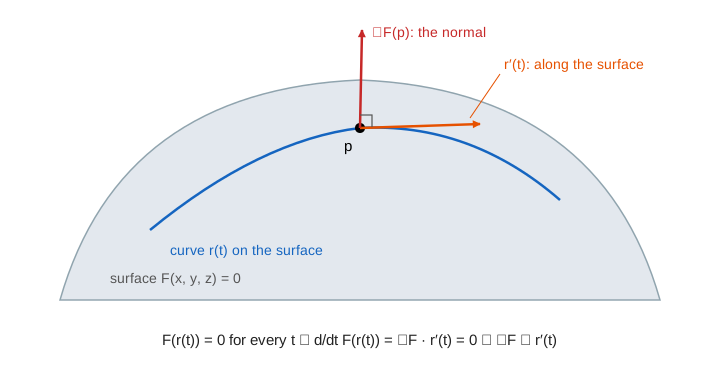
Move everything in the equation of a quadric to one side and call it F: the ellipsoid x2/9 + y2/9 + z2/4 = 1 becomes F = x2/9 + y2/9 + z2/4 − 1 = 0. The surface is a level surface of F: the points where F is exactly 0. The gradient ∇F = (Fx, Fy, Fz) collects the three partial derivatives. At a point p of the surface, ∇F(p) is perpendicular to the surface: it is the normal.
Why ∇F is normal
Take any curve r(t) that stays in the surface and passes through p. Along it F(r(t)) = 0 for every t, so its derivative is 0 too. By the chain rule that derivative is ∇F · r′(t). So ∇F(p) · r′(t) = 0: the gradient is perpendicular to the velocity of every curve in the surface, that is, to every tangent direction. The page draws two such directions t1, t2 in orange and shows t · n = 0 for both. (Demo 1: ellipsoid: ∇F is the normal, then the plane)
The tangent plane: ∇F(p) · (x − p) = 0
The tangent plane is the plane through p that holds all the tangent directions. A point x = (x, y, z) is on it when x − p is one of those directions, i.e. when x − p ⟂ ∇F(p):
Fx(p)(x − x0) + Fy(p)(y − y0) + Fz(p)(z − z0) = 0
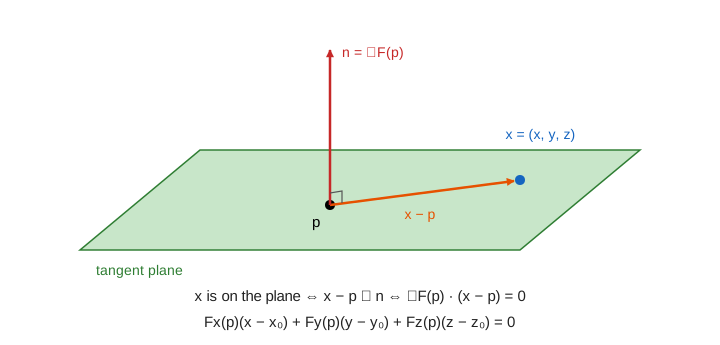
Example: at p = (1, 2, 4/3) on the ellipsoid, ∇F = (2x/9, 2y/9, z/2) gives ∇F(p) = (2/9, 4/9, 2/3). Any multiple points the same way, so use n = (1, 2, 3). The plane is (x − 1) + 2(y − 2) + 3(z − 4/3) = 0, or x + 2y + 3z = 9. For an ellipsoid x2/a2 + y2/b2 + z2/c2 = 1 this always simplifies to x·x0/a2 + y·y0/b2 + z·z0/c2 = 1. Walk p around the ellipsoid and the normal turns with the surface; note it does not point away from the centre unless the ellipsoid is a sphere. (Demo 2: walk round the ellipsoid: the normal follows)
| p on x²/9 + y²/9 + z²/4 = 1 | ∇F(p) | tangent plane |
|---|---|---|
| (1, 2, 4/3) | (2/9, 4/9, 2/3) | x + 2y + 3z = 9 |
| (2, 2, 2/3) | (4/9, 4/9, 1/3) | 4x + 4y + 3z = 18 |
| (3, 0, 0) | (2/3, 0, 0) | x = 3 |
| (0, 0, 2) | (0, 0, 1) | z = 2 |
| (0, 9/5, 8/5) | (0, 2/5, 4/5) | y + 2z = 5 |
Graphs z = f(x, y): ∇F = (fx, fy, −1)
A paraboloid or saddle is a graph z = f(x, y). Write it as F = f(x, y) − z = 0. Then ∇F = (fx, fy, −1), and the plane becomes the familiar z − z0 = fx(x − x0) + fy(y − y0). On z = x2/4 + y2/4 at p = (2, 0, 1): ∇F = (1, 0, −1) and the plane is x − z = 1, i.e. z = x − 1. The gradient form is the general one; the graph form is the special case. (Demo 3: paraboloid z = f(x, y): ∇F = (fx, fy, −1))
The plane can cut the surface
On the ellipsoid and the bowl the tangent plane stays on one side. On the saddle z = x2/4 − y2/4 it does not: at p = (2, 0, 1) the plane x − z = 1 meets the saddle in two straight lines through p, with directions (1, 1, 1) and (1, −1, 1). The saddle is doubly ruled, and the two lines through a point are exactly where its tangent plane cuts it. (Demo 4: saddle: the plane cuts it in two lines)
∇F = 0: no tangent plane
On the cone x2 + y2 = z2, ∇F = (2x, 2y, −2z). At the apex (0, 0, 0) all three are 0. A zero vector has no direction, so there is no normal and no tangent plane: the apex is a singular point, a sharp tip. Anywhere else, e.g. p = (6/5, 8/5, 2), the plane 3x + 4y − 5z = 0 passes through the apex and touches the cone along the whole line through p and the apex. (Demo 5: cone: no plane at the apex, a line elsewhere)
| surface | F | ∇F |
|---|---|---|
| ellipsoid | x²/9 + y²/9 + z²/4 − 1 | (2x/9, 2y/9, z/2) |
| paraboloid | x²/4 + y²/4 − z | (x/2, y/2, −1) |
| saddle | x²/4 − y²/4 − z | (x/2, −y/2, −1) |
| cone | x² + y² − z² | (2x, 2y, −2z) |
See also
Quadric Surfaces shows the whole family, and Plane Equation explains a plane from its normal (A, B, C). In 2D the same idea gives the normal to a level curve: see Level Curves. Points where ∇f = 0 are studied on Critical & Singular Points; the derivative step is the chain rule.
What the page leaves out
Hyperboloids and cylinders (they work the same way), the normal line p + t·∇F(p), the unit normal and its orientation, tangent planes found by linear approximation of f(x, y) without the gradient, curvature, and surfaces given in parametric form r(u, v), where the normal is ru × rv.
See where this page fits on the Quadric Surfaces mind map.