The idea: two equations, one curve
One equation F(x, y, z) = 0 in space is a surface. Two equations at once, F = 0 and G = 0, keep only the points on both surfaces. That is usually a curve: the intersection curve of the two surfaces. When both are quadrics, the curve has degree at most 4.
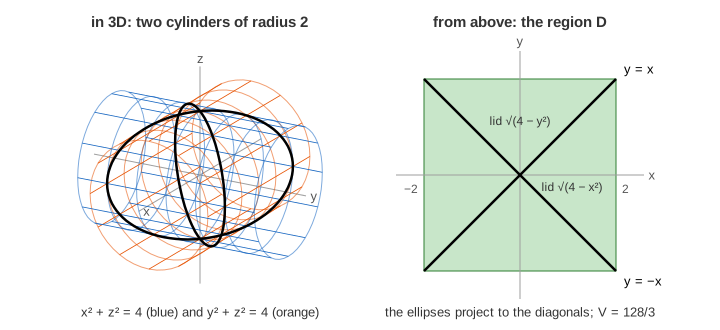
To find the curve, eliminate a variable: subtract the equations, or solve one for something and put it into the other. What is left describes the curve, or the plane or cylinder it lies on. (Demo 1: two cylinders meet in two ellipses)
Two cylinders: two ellipses (Steinmetz)
x2 + z2 = 4 is a cylinder along the y-axis, y2 + z2 = 4 one along the x-axis. Subtract: x2 − y2 = 0, that is (x − y)(x + y) = 0. Every common point lies in the plane y = x or the plane y = −x. Each plane cuts a cylinder in an ellipse, so the curve is two ellipses (2 cos t, ±2 cos t, 2 sin t), with semi-axes 2√2 (along the diagonal) and 2. They cross at (0, 0, ±2). The solid inside both cylinders is the Steinmetz solid (bicylinder).
Sphere and cylinder: Viviani's figure eight
Take the sphere x2 + y2 + z2 = 4 and the thin cylinder (x − 1)2 + y2 = 1, which passes through the centre of the sphere and touches it from inside at (2, 0, 0). The cylinder says x2 + y2 = 2x; put that into the sphere and z2 = 4 − 2x. With x = 1 + cos t this is z = 2 sin(t/2), and going round the cylinder twice (t from 0 to 4π) draws Viviani's curve: a figure eight with a double point at (2, 0, 0). (Demo 3: sphere and cylinder)
Sphere and cone: one circle
The sphere x2 + y2 + z2 = 8 and the cone z = √(x2 + y2): on the cone x2 + y2 = z2, so the sphere becomes 2z2 = 8 and z = 2. The curve is the circle x2 + y2 = 4 at height 2. The solid above the cone and inside the sphere is the ice cream cone. (Demo 4: sphere and cone)
Two paraboloids: one circle
z = (x2 + y2)/2 − 2 opens up, z = 2 − (x2 + y2)/2 opens down. Both give z, so set them equal: x2 + y2 = 4, and then z = 0. The curve is a circle in the plane z = 0. (Demo 5: two paraboloids)
Why the curve matters for triple integrals
A volume between two surfaces is V = ∬D (lid − floor) dA. The region D is the shadow of the solid on the xy-plane, and its edge is usually the shadow of the intersection curve: that is where the lid comes down to meet the floor. In polar coordinates the curve gives the limits for r and θ.
The curve also tells you where the lid switches. In the Steinmetz solid the lid is √(4 − x2) where |y| ≤ |x| and √(4 − y2) where |x| ≤ |y|: it changes along the diagonals, the shadow of the two ellipses. So D splits into pieces, and by symmetry V = 16 ∫02 ∫0x √(4 − x2) dy dx = 16 · 8/3 = 128/3. (Demo 2: the Steinmetz solid)
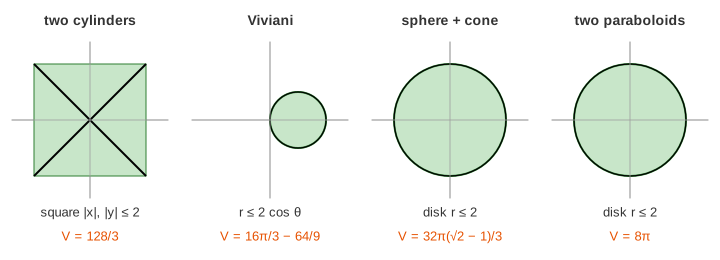
| pair | eliminate | curve | region D | volume |
|---|---|---|---|---|
| x2 + z2 = 4, y2 + z2 = 4 | x2 = y2 | two ellipses | square |x|, |y| ≤ 2 | 128/3 ≈ 42.67 |
| x2 + y2 + z2 = 4, (x − 1)2 + y2 = 1 | z2 = 4 − 2x | figure eight | r ≤ 2 cos θ | 16π/3 − 64/9 ≈ 9.64 |
| x2 + y2 + z2 = 8, z = √(x2 + y2) | z = 2 | one circle | r ≤ 2 | 32π(√2 − 1)/3 ≈ 13.88 |
| z = r2/2 − 2, z = 2 − r2/2 | r2 = 4 | one circle | r ≤ 2 | 8π ≈ 25.13 |
See also
The surfaces one at a time: Elliptic Cylinder, Ellipsoid (the sphere is a = b = c), Elliptic Cone and Elliptic Paraboloid. All nine together: Quadric Surfaces.
What the page leaves out
Pairs that meet in nothing or touch at one point, the general theory (two quadrics meet in a curve of degree 4, which can split into conics or lines), cylinders of different radii (the curve no longer lies in planes), the surface area of the Steinmetz solid, and the triple integrals in cylindrical or spherical coordinates written out in full.