The idea: a quadric with no squares
Take the general quadric Ax2 + By2 + Cz2 + Dxy + Eyz + Fzx + Gx + Hy + Iz + J = 0 and set every second-degree coefficient to 0. What is left is linear, and it is written
Ax + By + Cz + D = 0, with A, B, C not all 0.
Its points form a plane, the flat, degenerate member of the quadric family. Four numbers describe it, but they do two different jobs: (A, B, C) sets which way the plane faces, and D sets how far it is from the origin.
(A, B, C) is the normal vector
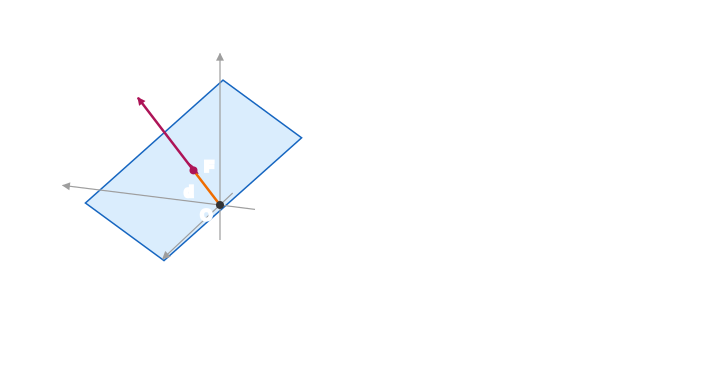
Write the left side as a dot product: Ax + By + Cz = n · p with n = (A, B, C) and p = (x, y, z). Take two points p and q of the plane. Both give n · p = −D, so n · (q − p) = 0: n is at a right angle to every direction that lies in the plane. That makes n the normal vector. Change A, B or C and the normal turns, so the plane turns with it. (Demo 2: A, B, C turn the normal) The canvas draws n as an arrow starting on the plane.
D slides the plane: distance and foot point
Keep A, B, C and change D: the normal does not change, so the new plane is parallel to the old one. It has slid along n. (Demo 1: D slides the plane along the normal) The point of the plane nearest the origin is on the line through O along n, p = t·n. Putting it in the equation gives t|n|2 + D = 0, so
| what | formula | for x + y + 2z − 2 = 0 |
|---|---|---|
| foot point F | −D·n / |n|2 | (2/6)(1, 1, 2) = (1/3, 1/3, 2/3) |
| distance from O | |D| / √(A2 + B2 + C2) | 2/√6 ≈ 0.82 |
| D = 0 | distance 0 | the plane goes through the origin |
The same idea gives the distance from any point p0: |n · p0 + D| / |n|.
Intercepts and the intercept form
On the x-axis y = z = 0, so Ax + D = 0 and the plane crosses it at x = −D/A. In the same way it crosses the y-axis at −D/B and the z-axis at −D/C. If A = 0 there is no x-intercept: Ax + D = 0 has no solution (or every x, when D = 0 too), and the plane is parallel to the x-axis. (Demo 3: intercepts and x/p + y/q + z/r = 1)
When D ≠ 0 and the intercepts are p, q, r, divide the equation by −D:
x/p + y/q + z/r = 1
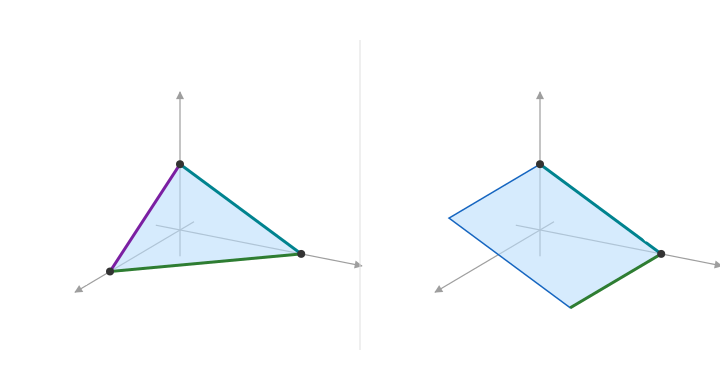
For x + y + 2z − 2 = 0 that is x/2 + y/2 + z/1 = 1. Drawing a plane by hand starts here: mark the three intercepts and join them.
Traces and the cut z = h
A trace is where the plane meets a coordinate plane. Put z = 0, y = 0 or x = 0 into the equation:
| trace | equation | for x + y + 2z − 2 = 0 |
|---|---|---|
| with z = 0 (green) | Ax + By + D = 0 | x + y = 2 |
| with y = 0 (purple) | Ax + Cz + D = 0 | x + 2z = 2 |
| with x = 0 (teal) | By + Cz + D = 0 | y + 2z = 2 |
Each one is a line through two intercepts. Cutting at any height z = h gives Ax + By = −D − Ch: the same left side as the trace z = 0, only another right side. So all cuts z = h are parallel lines, the plane's contour lines, and they move evenly as h grows. (Demo 6: the cut z = h slides a parallel line) If A = B = 0 the left side is empty: the cut is the whole plane when h = −D/C and nothing otherwise.
Special planes: C = 0, A = B = 0, D = 0
| case | equation | the plane |
|---|---|---|
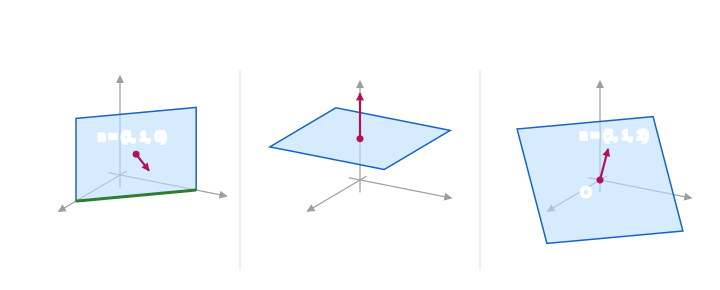
| C = 0 | Ax + By + D = 0 | vertical, parallel to the z-axis: z is free, so the trace line is pushed straight up (a "cylinder" over a line) |
| A = B = 0 | z = −D/C | horizontal; its normal points straight up |
| B = C = 0 | x = −D/A | parallel to the yz-plane |
| D = 0 | Ax + By + Cz = 0 | through the origin; all intercepts are 0 |
A missing variable means the plane is parallel to that axis, just as a missing z makes the elliptic cylinder a tube along the z-axis. (Demo 4: special planes: C = 0, A = B = 0, D = 0)
Same plane, scaled equation
Multiply all four numbers by k ≠ 0: kAx + kBy + kCz + kD = k · 0 = 0, so exactly the same points satisfy it. 2x + 2y + 2z − 2 = 0 is the plane x + y + z − 1 = 0. The normal gets k times longer, and for k < 0 it points the other way, but the distance |kD| / |kn| does not change. (Demo 5: 2·(A, B, C, D) is the same plane) That is why a plane is often written with a unit normal, |n| = 1: then D itself is the signed distance.
See also Quadric Surfaces, Elliptic Cylinder, Hyperbolic Paraboloid (a curved surface that still contains straight lines), Vectors and Dot Product and Changing Coordinates in 3D.
What the page leaves out
The plane through three points (take n as the cross product of two edges), the point-normal form n · (p − p0) = 0, the angle between two planes (the angle between their normals), the line where two planes meet, the two half-spaces Ax + By + Cz + D > 0 and < 0, and parametric planes p0 + s·u + t·v.