The idea: one focus, one line, one ratio
Fix a point F (the focus) and a line (the directrix), p away from F. Pick a number e ≥ 0, the eccentricity. The points P whose distance to F is e times their distance to the line form a curve, and that curve is always a conic:
|PF| = e · |PD| (D = the nearest point of the directrix)e alone decides which conic: a circle, an ellipse, a parabola or a hyperbola. Put F at the origin and the rule becomes one short polar equation, which the page draws:
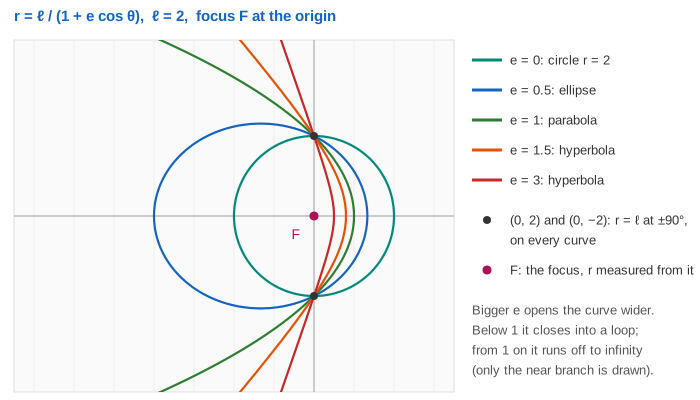
r = ep / (1 + e cos(θ − θ₀)) = ℓ / (1 + e cos(θ − θ₀)), ℓ = e·p| number | what it does |
|---|---|
| e | the eccentricity: the shape. 0 circle, below 1 ellipse, 1 parabola, above 1 hyperbola |
| ℓ = e·p | the semi-latus rectum: r at 90° from the axis. It only scales the curve |
| θ₀ | the turn: the direction of the closest point to F (r min) |
The page keeps ℓ, not p, as its size number. With p fixed, e = 0 would give r = 0·p = 0, a single point; with ℓ fixed, e = 0 is the circle r = ℓ, and the directrix x = p = ℓ/e comes in from infinity as e grows. The facts table always shows both: p = ℓ/e and ℓ = e·p. (Demo 1: e from 0 to 2 in steps of 0.1)
|PF| = e · |PD|: the focus–directrix rule
For a point P on the curve, |PF| is the red segment to the focus and |PD| the green one, straight across to the directrix. Their ratio is the same number e at every point of the curve.
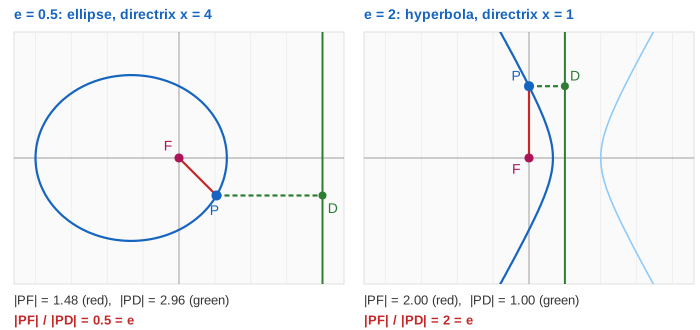
For e = 1 the two distances are equal, which is the usual definition of a parabola (Parabola: focus and directrix). For a circle there is no directrix: e = 0 is the limit where p = ℓ/e runs off to infinity and every point is ℓ from F. (Demo 2: |PF| = e·|PD| for every point)
From the rule to the polar equation
Put F at the origin and the directrix at x = p (θ₀ = 0). A point at distance r and angle θ has |PF| = r, and its distance to the line is p − r cos θ. The rule gives
r = e (p − r cos θ)
r + e r cos θ = e p
r = ep / (1 + e cos θ)
θ is measured at the focus, not at the centre, so this is the form planets use: the Sun sits at F. Turning the axis by θ₀ replaces θ with θ − θ₀. Polar coordinates themselves are on Polar Coordinates.
- θ = θ₀: the closest point, r min = ℓ/(1 + e) (the perihelion of an orbit).
- θ = θ₀ ± 90°: r = ℓ. These two points are the ends of the latus rectum; ℓ is half its length.
- θ = θ₀ + 180°: r max = ℓ/(1 − e) for e < 1 (the aphelion); for e ≥ 1 there is none.
e decides the type
| e | type | a, b | Cartesian form (θ₀ = 0) | more on |
|---|---|---|---|---|
| 0 | circle | a = b = ℓ | x² + y² = ℓ² | Ellipse |
| 0 < e < 1 | ellipse | a = ℓ/(1 − e²), b = ℓ/√(1 − e²) | (x + ae)²/a² + y²/b² = 1 | Ellipse |
| 1 | parabola | vertex ℓ/2 from F | y² = −2ℓ(x − ℓ/2) | Parabola |
| e > 1 | hyperbola | a = ℓ/(e² − 1), b = ℓ/√(e² − 1) | (x − ae)²/a² − y²/b² = 1 | Hyperbola |
For the ellipse and the hyperbola the centre is ae from F and the second focus 2ae from F, so e = c/a, the same e as on the Ellipse and Hyperbola pages, and ℓ = b²/a. As e climbs towards 1 the ellipse grows without bound: at e = 0.9 with ℓ = 2, a ≈ 10.5 and r max = 20, far past the window, and at e = 1 the far end is gone. The general second-degree equation, where the test is B² − 4AC instead, is on Conic Sections: What A, B, C, D, E, F Do.
e > 1: the near branch and r < 0
For e > 1, 1 + e cos φ (φ = θ − θ₀) is negative for directions near φ = 180°. There r would be negative: a negative r draws the point on the opposite side of F, and those points form the other branch of the hyperbola, the one round the second focus. The page draws the branch with r > 0 (the near branch, round F) in blue and the r < 0 branch pale. The near branch runs off to infinity in the two directions where the denominator is 0:
1 + e cos φ = 0 → cos φ = −1/e (e = 2: φ = ±120°)The asymptotes are parallel to these directions and cross at the centre. A body on the near branch is turned by 2·asin(1/e): 112.9° for 'Oumuamua's e ≈ 1.2. (Demo 3: a hyperbolic flyby ('Oumuamua))
ℓ scales, θ₀ turns
Multiplying ℓ by k multiplies every r by k: the same curve, k times bigger, with F fixed. So two conics with the same e have the same shape; all parabolas (e = 1) are the same shape at different sizes. (Demo 6: ℓ only scales: parabolas) θ₀ turns the whole picture about F: curve, directrix, centre and second focus. (Demo 4: θ₀ turns the curve)
Real orbits
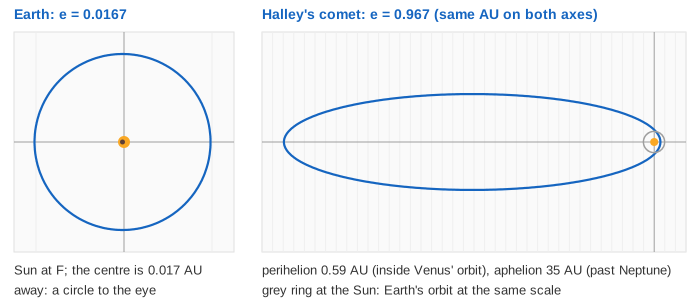
Kepler's first law: a planet moves on an ellipse with the Sun at one focus. Newton showed that any body moving under the Sun's gravity alone follows r = ℓ/(1 + e cos(θ − θ₀)), with e set by its energy: bound orbits have e < 1, an escaping body e ≥ 1.
| body | e | r min (perihelion) | r max (aphelion) |
|---|---|---|---|
| Earth | 0.0167 | 0.983 AU | 1.017 AU |
| Mercury | 0.206 | 0.307 AU | 0.467 AU |
| Halley's comet | 0.967 | 0.59 AU | 35 AU |
| 'Oumuamua (2017) | 1.20 | 0.256 AU | none: hyperbolic |
The page draws each at a stated scale (1 unit = 0.25 AU for Earth and 'Oumuamua, 5 AU for Halley), so the numbers in the facts table are plot units. (Demo 5: real orbits: Earth, then Halley's comet)
What the page leaves out
The second directrix of an ellipse and a hyperbola (on the other side, round the second focus), cutting a cone with a plane, time along an orbit (Kepler's second and third laws: equal areas in equal times), orbits that are not round the origin, and curves bigger than the window x ∈ [−8, 8], y ∈ [−7, 7]: the page shows only the part inside it. The standard forms one at a time are on the Ellipse, Parabola and Hyperbola pages.