The idea: across or along
A wave is a pattern that moves through a medium while the medium itself stays put. What tells waves apart is the direction the pieces of the medium move:
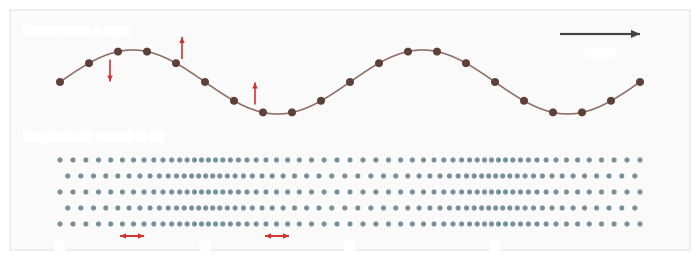
- Transverse: the pieces move across the direction the wave travels. Shake a rope: each bit goes up and down while the hump runs along it. Light is transverse too (see Electromagnetic Waves).
- Longitudinal: the pieces move along the direction of travel. Sound in air is this kind: air particles are pushed forward and back, bunching into compressions (C, high pressure) and spreading into rarefactions (R, low pressure).
What travels: the pattern, not the medium
Follow the red pieces on the canvas. Each one swings about its home and, after one period T, is exactly where it started (Demo 3 plays two periods). The crest of the rope and the compression in the air have meanwhile moved one wavelength to the right. A wave carries energy and information, not material: the air from a loudspeaker does not blow across the room to your ear.
One formula, two pictures
Both waves follow the same rule. The displacement of the piece whose home is at x is
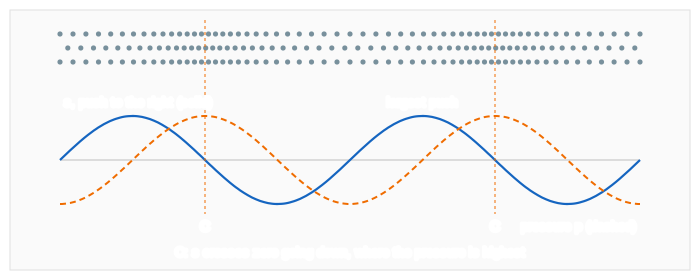
s(x, t) = A · sin(kx − ωt) k = 2π/λ, ω = 2πfFor the rope s is up and down, so the graph of s looks like the rope itself. For sound s is a push along x, so the graph is not a picture of anything: it plots how far each air particle has been pushed to the right. The air is squeezed most where the particles behind are pushed forward and those ahead are pushed back, which is where s crosses zero going down. So the pressure, p ∝ −∂s/∂x, peaks a quarter of a wavelength away from the biggest push (Demo 4).
Speed, frequency and wavelength: v = f λ
In one period the pattern moves one wavelength, so v = λ/T = f·λ. The speed is set by the medium: sound in air at 20 °C travels at 343 m/s whatever the pitch. A higher note just has shorter waves (Demos 5, 6 and 8).
| Sound | f | λ in air |
|---|---|---|
| Lowest note people hear | 20 Hz | 17 m |
| Low hum (the page's 171.5 Hz) | 171.5 Hz | 2 m |
| Concert A | 440 Hz | 78 cm |
| High whistle (the page's 1372 Hz) | 1372 Hz | 25 cm |
| Highest people hear | 20 000 Hz | 1.7 cm |
Sound is faster in water (about 1480 m/s) and steel (about 5900 m/s): stiffer media push back harder.
Water waves: both at once
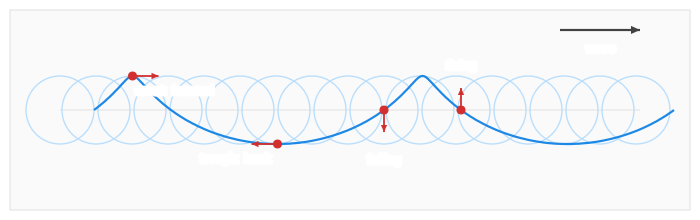
A bit of water at the surface moves up and down and forward and back, so it goes round a circle: forward at a crest, back in a trough (Demo 7). The surface joined through those circles has sharp crests and flat troughs. That is why a floating bottle bobs in place and only drifts slowly.
Where you meet them
| Wave | Kind |
|---|---|
| Sound in air and water, ultrasound | longitudinal |
| A shaken rope, a guitar string (Standing Waves) | transverse |
| Light, radio, X-rays | transverse (no medium needed) |
| Earthquake P waves (arrive first) and S waves (arrive second, cannot cross the liquid outer core) | longitudinal and transverse |
| A slinky pushed or shaken | either, depending on how you move it |
| Ocean waves | both: particles go round circles |
What the page leaves out
The amplitudes are drawn far too big: in loud speech the air moves less than a micrometre. The page also leaves out how the medium sets the speed (v = √(T/μ) on a string, v = √(B/ρ) in a fluid), the loss of energy with distance, waves in two and three dimensions, and the way water particles' circles shrink with depth and become ellipses in shallow water.