The idea: two speeds in one wave
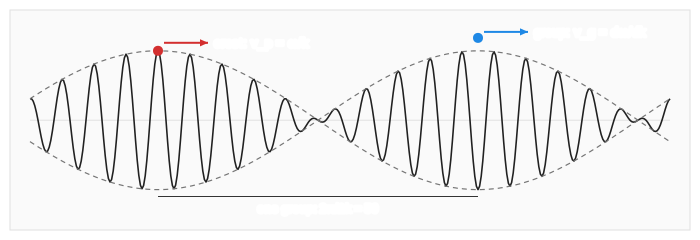
Add two waves whose wavelengths are almost the same. Where their crests line up the sum is twice as big; a little farther on one has slipped half a wavelength behind the other and they cancel. The sum is a fast wave, the carrier, inside slow lumps, the groups, outlined by an envelope (the dashed curve on the canvas). In sound you hear this as beats: two close notes swell and fade.
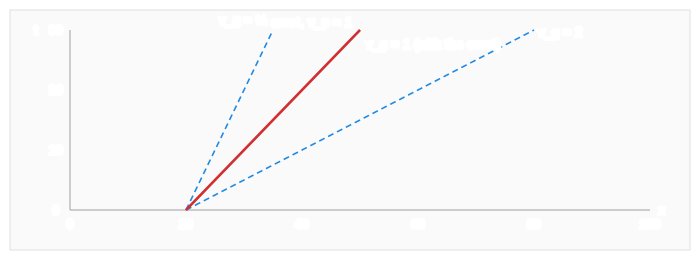
Crests and groups need not move at the same speed. A crest moves at the phase velocity v_p = ω/k. A group moves at the group velocity v_g = dω/dk, and that is the speed at which the energy, and any message, travels. The red dot on the canvas rides one crest and the blue dot rides one group.
Where the formula comes from
Write the two waves with k₁,₂ = k̄ ∓ Δk/2 and ω₁,₂ = ω̄ ∓ Δω/2. The sum-to-product identity gives
cos(k₁x − ω₁t) + cos(k₂x − ω₂t) = 2 cos(Δk·x/2 − Δω·t/2) · cos(k̄x − ω̄t)
                                  └──── envelope ────┘   └── carrier ──┘
The carrier's crests are where k̄x − ω̄t is constant, so they move at ω̄/k̄. The envelope's peaks are where Δk·x − Δω·t is constant, so they move at Δω/Δk. For two waves very close together that ratio becomes the derivative dω/dk.
Dispersion: when the speed depends on the wavelength
The rule that gives ω for each k is the dispersion relation. If every wavelength moves at the same speed, ω = v·k and v_g = v_p: crests stay put inside their groups (Demo 1). Otherwise the medium is dispersive and the two speeds differ. For ω ∝ kᵖ, v_g = p·v_p:
| Waves | ω(k) | v_g / v_p | What you see |
|---|---|---|---|
| light in vacuum, sound in air | ω = c·k | 1 | groups and crests together |
| deep-water waves | ω = √(g·k) | ½ | crests run forward through the groups (Demo 2) |
| ripples (surface tension) | ω = √(σk³/ρ) | 3/2 | groups overtake their crests (Demo 3) |
| a free quantum particle | ω = ħk²/2m | 2 | the packet moves at the particle's speed ħk/m (Demo 4) |
Wave packets and spreading
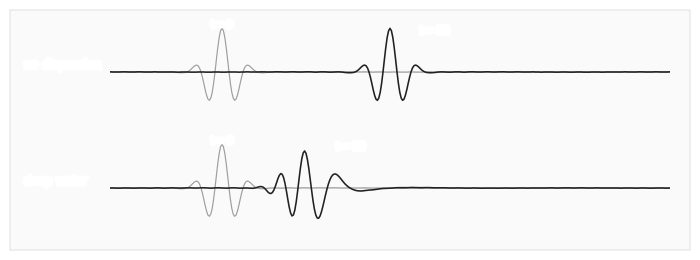
Forty-one waves with a spread of wavelengths around 5 are in step only in one place, so they add up to a single lump: a wave packet (choose 41 waves). It moves at the group velocity. Without dispersion every component moves at the same speed, so the packet keeps its shape exactly (Demo 5). With dispersion the components drift apart: the packet spreads out and gets lower as it goes (Demo 6). A narrower packet needs a wider spread of wavelengths, so it spreads faster.
Where you meet it
| Where | What the two speeds do |
|---|---|
| Swell from a far storm | Long waves arrive first; groups travel at half the crest speed |
| A boat's wake | Crests appear at the back of the wave group and vanish at the front |
| Optical fibres | Different colours have different group velocities, so short pulses spread and limit the data rate |
| Electrons and other particles | A particle is a wave packet; its speed is the group velocity |
| Tuning two strings by ear | The beats slow down and stop as the two notes match |
What the page leaves out
Real dispersion relations are not exact powers of k (deep and shallow water, glass near an absorption line), so v_g/v_p changes with the wavelength; near absorption the group velocity can even look faster than light without any signal being faster. The page uses dimensionless units, one carrier wavelength, two or forty-one components, and shows the marked group's path at the group velocity of the middle wavelength.