The idea: each cell is a row times a column
To multiply A by B, take row i of A and column j of B, pair their entries in order (first with first, second with second, …), multiply each pair and add the products. That sum is the entry C[i][j] of the product C = AB. It is the dot product of a row and a column:
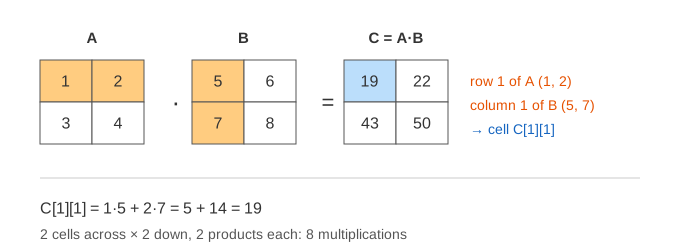
On the canvas the row and the column turn orange, the target cell of C turns blue, and each product appears on its entry of A and then flies into the term row. The sum flies into C (Demo: 2×2 product, cell by cell). For [1 2; 3 4]·[5 6; 7 8] the four cells are 1·5 + 2·7 = 19, 1·6 + 2·8 = 22, 3·5 + 4·7 = 43 and 3·6 + 4·8 = 50.
The shape rule: (m×n) · (n×p) = m×p
A row of A has as many entries as A has columns (n). A column of B has as many entries as B has rows. They can only be paired up if those two numbers are equal, so the inner sizes must match. The result takes the outer sizes: one cell for every row of A and every column of B.
| A | B | A·B |
|---|---|---|
| 2×2 | 2×2 | 2×2 |
| 2×3 | 3×2 | 2×2: each cell adds 3 products (Demo: 2×3 · 3×2) |
| 2×3 | 2×2 | undefined: 3 ≠ 2 (Demo: shape mismatch) |
| 3×2 | 2×3 | 3×3: the other order of the 2×3 · 3×2 pair is bigger |
| n×n | n×1 (a vector) | n×1: a matrix times a vector |
In the mismatch demo, row 1 of A = (1, 0, 2) has three entries but column 1 of B = (1, 3) has two, so the 2 has nothing to multiply with. Note that B·A = (2×2)·(2×3) is fine there: whether a product exists can depend on the order.
Counting the work: n³
Every cell of C needs n multiplications (and n − 1 additions), and there are m·p cells, so the schoolbook method does m·n·p multiplications. The canvas counts them: 8 for 2×2 · 2×2, 12 for 2×3 · 3×2. For two square n×n matrices that is n³: 1 000 × 1 000 matrices take a billion multiply-adds, and doubling n means eight times the work. Strassen’s trick does a 2×2 block product with 7 multiplications instead of 8, which gives about n2.81; in practice libraries keep the n³ method and make it fast with cache blocking and SIMD.
A·B means: apply B, then A
A 2×2 matrix moves the points of the plane: its first column is where (1, 0) lands, its second column is where (0, 1) lands. Applying B to a point x and then A to the result gives A(Bx). Matrix multiplication is defined exactly so that this is one matrix:
So the matrix written next to x, the right-hand one, acts first. Press Transform to see the unit square with an F move to Bx and then to A(Bx) (Demo: composition = apply B, then A). The columns of AB are where the corners (1, 0) and (0, 1) end up.
AB ≠ BA: order matters
Take a 90° rotation R = [0 −1; 1 0] and a shear S = [1 1; 0 1]. Shearing first and then rotating gives RS = [0 −1; 1 1]. Rotating first and then shearing gives SR = [1 −1; 1 0]. Different matrices, different pictures (Demo: AB ≠ BA: the grey copy keeps the first result).
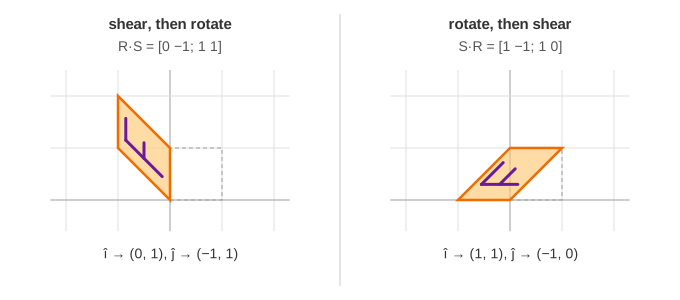
Some pairs do commute: two rotations, two scalings, any matrix with the identity or with its own inverse. But in general, swapping the order changes the result, and with non-square matrices one order may not even be defined.
Identity and inverse
The identity I = [1 0; 0 1] keeps (1, 0) and (0, 1) in place, so it moves nothing: AI = IA = A, the way 1 works for numbers. The inverse A−1 undoes A: AA−1 = A−1A = I. For A = [2 1; 1 1], A−1 = [1 −1; −1 2]; on the canvas A−1 moves the shape and A moves it straight back home (Demo: identity and inverse). An inverse exists only when det A ≠ 0 (here 2·1 − 1·1 = 1), see Determinant.
Where it shows up
- Graphics: rotate, scale and shear are matrices, and a chain of them is multiplied into one matrix before it is applied to thousands of vertices (Rotation and Scaling in 2D).
- Neural networks: a layer computes W·x + b, a matrix times a vector; a batch of inputs makes it a matrix times a matrix (Neural Network: the Forward Pass).
- Attention: the scores are QKT and the output is softmax(…)·V, two matrix products (Self-Attention).
See also 2D Vectors and the Dot Product (each cell is one dot product) and Gaussian Elimination (solving Ax = b instead of computing Ax).
Multiplying a whole chain? The order matters: see Matrix Chain Multiplication (p·q·r per product, best parenthesization by dynamic programming).
What the page leaves out
Matrices stay small with whole-number entries. The page does not show the column view (each column of AB is A times a column of B), block matrices, associativity (AB)C = A(BC) and how the chosen order changes the cost of a chain, Strassen’s algorithm, cache blocking and GPUs, or floating-point rounding.