The idea: a complex number is a point
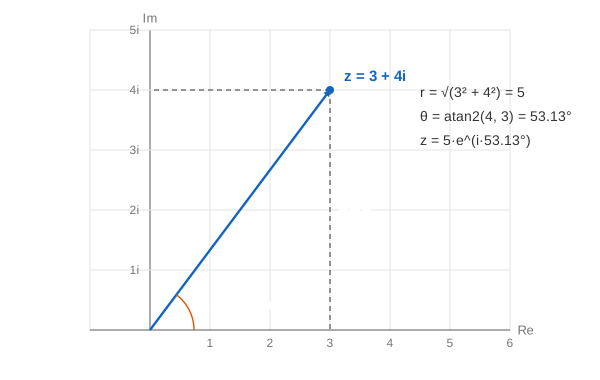
A complex number z = a + bi has a real part a and an imaginary part b, where i is a number with i² = −1. Draw it as the point (a, b) on the complex plane: real part across, imaginary part up. Or draw it as an arrow from 0 to that point. The arrow has a length, the modulus r = |z| = √(a² + b²), and an angle from the positive real axis, the argument θ.
Addition is vector addition
To add, add the real parts and the imaginary parts: (3 + 4i) + (1 + 2i) = 4 + 6i. On the plane that is adding two arrows head to tail: slide a copy of w so its tail sits on the tip of z, and its tip lands on z + w, the far corner of the parallelogram on z and w. Subtraction z − w is the arrow from w to z (Demo: add (3 + 4i) + (1 + 2i)).
Multiplication rotates and scales
Multiply out like any two brackets and use i² = −1:
(3 + 4i)(1 + 2i) = 3 + 6i + 4i + 8i² = 3 + 10i − 8 = −5 + 10i.
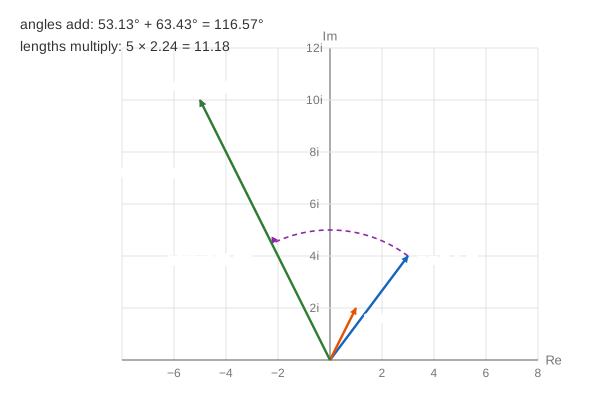
The same product has a picture. The moduli multiply and the angles add: |3 + 4i| = 5, |1 + 2i| = √5 ≈ 2.24, and 5 × 2.24 = 11.18 = |−5 + 10i|. The angles are 53.13° and 63.43°, and 53.13° + 63.43° = 116.57°, the angle of −5 + 10i. So multiplying by w rotates by arg w and scales by |w| (Demo: multiply (3 + 4i)(1 + 2i)).
| Operation | Rectangular a + bi | Polar r·eiθ |
|---|---|---|
| z + w | add parts: (a + c) + (b + d)i | no simple rule |
| z · w | (ac − bd) + (ad + bc)i | r₁r₂·ei(θ₁ + θ₂) |
| zⁿ | expand n brackets | rⁿ·einθ |
Multiplying by i is a quarter turn
i has length 1 and angle 90°, so multiplying by i keeps the length and turns by 90°: (a + bi)·i = −b + ai. Start at 1 and keep multiplying: 1 → i → −1 → −i → 1. Two quarter turns are a half turn, and half a turn from 1 points at −1. That is the picture behind i² = −1: no real number squares to −1, but a rotation done twice can reverse a direction (Demo: powers of i).
Polar form and Euler's formula
A number with modulus r and angle θ is r(cos θ + i sin θ). Euler's formula says this is the exponential:
eiθ = cos θ + i sin θ
As θ grows, eiθ runs round the unit circle: cos θ along the real axis, sin θ up. So every complex number can be written in polar form z = r·eiθ, and the multiplication rule is just the exponent rule eiα·eiβ = ei(α + β). Angles are in radians: half a turn is θ = π, which gives eiπ = −1, or eiπ + 1 = 0. A full turn gives e2πi = 1 (Demo: Euler's formula).
Roots of unity: a regular polygon
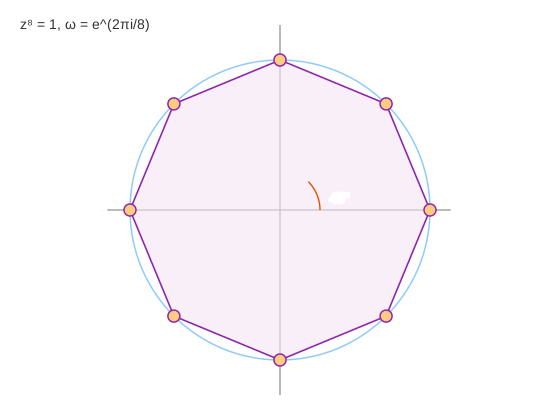
The equation zⁿ = 1 has exactly n complex solutions, the nth roots of unity. With ω = e2πi/n they are ω⁰ = 1, ω¹, ω², …, ωn−1: all on the unit circle, 360°/n apart. Each multiplication by ω turns one step, and n steps make a full turn, so (ωk)ⁿ = e2πik = 1. Joined in order they form a regular n-gon, and by symmetry they add up to 0 (Demo: the 8th roots of unity).
Where it is used
- The Fast Fourier Transform multiplies by roots of unity, the twiddle factors ωk = e−2πik/n. The FFT works because ω² for n points is ω for n/2 points: halving the circle halves the problem.
- Multiplying by eiθ is the 2D rotation by θ. Written as a matrix it is [[cos θ, −sin θ], [sin θ, cos θ]], the matrix in Rotate and Scale in 2D; multiplying by r·eiθ rotates and scales at once.
- AC circuits, signal processing and quantum mechanics write waves as eiωt, so a phase shift is a multiplication.
See also Vectors and the Dot Product (the same head-to-tail addition) and Taylor Series (where the series for ex, cos and sin explain Euler's formula).
See also quadratic equations, where a negative discriminant gives a conjugate pair of complex roots such as −1 ± 2i. The point e^(iθ) = cos θ + i sin θ is the point P on the unit circle; see The Unit Circle: sin, cos, tan for how its coordinates unroll into the sine and cosine graphs.
Square a complex number and add c, again and again: whether that orbit stays bounded decides The Mandelbrot Set, and for a fixed c it draws Julia sets.
What the page leaves out
Division (divide the moduli, subtract the angles), the conjugate a − bi and |z|² = z·conj(z), and why Euler's formula holds (compare the power series of ex, cos and sin). Roots of numbers other than 1, the many values of log z, and complex functions such as z² as maps of the plane are not drawn. The page uses degrees for the numbers; mathematics normally uses radians (180° = π).