The idea: BFS with a deque
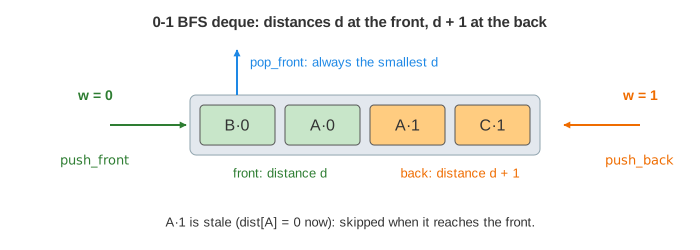
Breadth-first search finds shortest paths when every edge costs 1: a plain queue hands out vertices in order of distance. Dijkstra's algorithm handles any weights that are not negative, but it needs a heap. When every weight is 0 or 1 there is a middle way, 0-1 BFS: keep a deque (a double-ended queue). A vertex reached over a 0-edge is exactly as far as the vertex it came from, so it goes to the front. A vertex reached over a 1-edge is one step further, so it goes to the back.
The algorithm
dist[s] = 0, dist[v] = ∞ for every other v
deque = [(s, 0)]
while deque not empty:
    (u, d) = pop_front(deque)
    if d > dist[u]: continue              # stale copy, skip
    for each edge u→v with weight w (0 or 1):
        if dist[u] + w < dist[v]:
            dist[v] = dist[u] + w
            parent[v] = u
            if w == 0: push_front(deque, (v, dist[v]))
            else:      push_back(deque, (v, dist[v]))
On the sample graph the answer is dist[T] = 1 along S → B → A → D → T, which uses
four edges but only one of weight 1 (Demo: 0-1 BFS with a deque). S first pushes A·1 to the
back and B·0 to the front. B is popped next and finds A for 0, so A·0 goes to the front.
Stale entries
A vertex can be in the deque twice. Above, A·1 is still in the deque when A·0 is pushed in front of
it. The deque never searches for an old copy to remove it. Instead each entry carries the distance it
was pushed with, and when an entry is popped with d > dist[v] it is
stale and skipped. A vertex is improved at most twice in total (once to some d + 1,
once to d), so the deque never holds more than 2V entries.
Why the front is always the closest
The deque keeps an invariant: read from front to back, its distances are sorted and there are at most two of them, d and d + 1. Popping the front takes a vertex at d. Its 0-edges add vertices at d, which belong at the front. Its 1-edges add vertices at d + 1, which belong at the back. Both pushes keep the order. So vertices come out in order of distance, exactly the order Dijkstra would settle them in, and a vertex popped (not stale) has its final distance. The deque is doing the heap's job for free.
Two ways to get it wrong
Plain BFS ignores the weights. It fixes a vertex the first time it sees it, which is
along the path with the fewest edges. From S it sees A over the 1-edge first, then D through A, then
T: dist[T] = 2 along S → A → D → T, three edges (Demo: plain BFS counts edges).
The edge B→A = 0 comes too late.
A queue that pushes 0-edges to the back too breaks the invariant. S pushes A·1 and then B·0, both at the back, so the queue reads A·1, B·0: not sorted. A is popped and treated as final at 1 before B gets the chance to offer 0 (Demo: 0-edges to the back too). The answer is again 2.
| Method | Data structure | Weights | Time | Sample graph |
|---|---|---|---|---|
| Plain BFS | queue | all 1 | O(V + E) | T = 2 ✗ |
| Queue, 0 at the back | queue | — | O(V + E) | T = 2 ✗ |
| 0-1 BFS | deque | 0 or 1 | O(V + E) | T = 1 ✓ |
| Dijkstra | binary heap | any w ≥ 0 | O((V + E) log V) | T = 1 ✓ |
With every weight 1 nothing is ever pushed to the front, and 0-1 BFS does exactly what plain BFS
does: both find dist[T] = 3 (Demo: all weights 1). 0-1 BFS is BFS with one extra
rule for 0-edges.
Where 0/1 weights come from
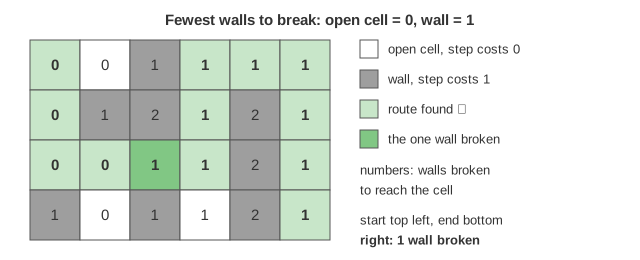
Many problems have moves that are free and moves that cost one unit. In a grid, walking into an open cell is free and walking into a wall cell means breaking it: 0-1 BFS gives the fewest walls to break. Other examples: free roads and toll roads, keeping a direction (0) or turning (1), and following an edge the right way (0) or reversing it (1) to make a path exist. See grid pathfinding for BFS and A* on grids.
Cost
Every vertex is finished once and every edge relaxed at most once from a finished vertex, and each deque operation is O(1), so 0-1 BFS runs in O(V + E), against O((V + E) log V) for Dijkstra with a binary heap. The same trick grows to small integer weights 0 … k: Dial's algorithm keeps k + 1 buckets instead of two ends. For negative weights neither works: use Bellman-Ford, or the one-pass method for shortest paths in a DAG.
The deque here is usually a circular buffer; Deque shows how push_front and push_back stay O(1).
What the page leaves out
Dial's bucket queue step by step; undirected graphs (each edge is two directed edges); the grid problem on the canvas (only in the figure above); a version that marks vertices visited instead of checking stale distances; and how a deque is stored (a ring buffer or blocks of arrays).
See where this page fits on the Graph Algorithms mind map.