The idea: one matrix, two ways to fill it
Both algorithms solve the all-pairs shortest path problem: for a directed weighted graph, fill a V × V matrix D where D[i][j] is the length of the shortest path from i to j. This page runs Floyd-Warshall on the left and Johnson's algorithm on the right, on the same graph, at the same time. Every step does V² operations on each side, so the side that needs less work finishes first. The bars under the lanes count every operation.
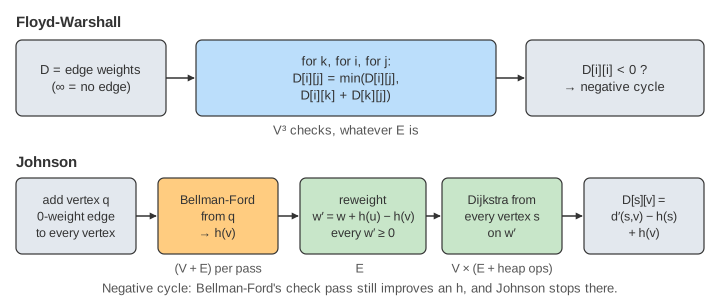
Floyd-Warshall: try every vertex as a detour
D starts as the edge weights: 0 on the diagonal, the weight of i→j if that edge exists, ∞ otherwise. Then one vertex k at a time is allowed as a stop on the way.
for k in vertices:
    for i in vertices:
        for j in vertices:
            if D[i][k] + D[k][j] < D[i][j]:
                D[i][j] = D[i][k] + D[k][j]
After round k, D[i][j] is the shortest path that only stops at the vertices up to k. After the last round every stop is allowed, so the matrix is final. On the canvas, row k and column k are blue (they are the only cells the round reads), and the cells that got shorter are orange. The loop does exactly V³ checks. It does not look at the edges at all after the first matrix, so a graph with 7 edges costs the same as one with 30.
Johnson: reweight, then Dijkstra from every vertex
Dijkstra from every vertex would be fast on a sparse graph, but Dijkstra can be wrong when a weight is negative (see Dijkstra vs Bellman-Ford). Johnson first changes the weights so that none is negative, without changing which paths are shortest.
- Add a new vertex
qwith a 0-weight edge to every vertex. - Run Bellman-Ford from
q. The resulth(v)is the potential of each vertex (thehcolumn on the canvas). It is0or negative. - Reweight every edge:
w′(u, v) = w(u, v) + h(u) − h(v). The labels in the right lane turn green. - Run Dijkstra from every vertex
sonw′and convert back:D[s][v] = d′(s, v) − h(s) + h(v). Each run fills one row of the matrix.
The operations counted on the right are the Bellman-Ford relaxations (V + E per pass), one per reweighted edge, and per Dijkstra run one per out-edge relaxation and one per heap operation (push, decrease-key, pop).
Why reweighting keeps the shortest paths
Add up w′ along any path s = v0 → v1 → … → vk = t. Each inner h appears once with + and once with −, so the sum telescopes: w′(path) = w(path) + h(s) − h(t). Every path from s to t moves by the same amount, so the shortest one stays the shortest.
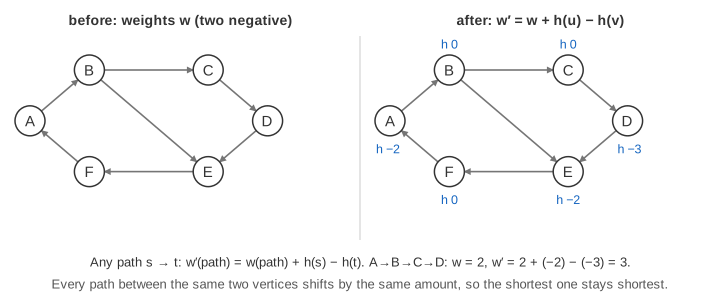
No w′ is negative because Bellman-Ford's answer obeys the triangle inequality: h(v) ≤ h(u) + w(u, v) for every edge, which is exactly w′(u, v) ≥ 0. Edges on a shortest path from q get w′ = 0, as most edges in the figure do.
Adding the same constant to every edge does not work: a path with more edges gets more of the constant, so the order of the paths changes.
Dense vs sparse: counting the work
| Demo | V, E | Floyd-Warshall | Johnson (BF + reweight + relax + heap) | Fewer |
|---|---|---|---|---|
| 1 dense, all ≥ 0 | 5, 13 | 125 + 5 = 130 | 36 + 13 + 65 + 52 = 166 | Floyd |
| 2 sparse, all ≥ 0 | 6, 7 | 216 + 6 = 222 | 26 + 7 + 42 + 72 = 147 | Johnson |
| 3 sparse, negative edges | 6, 7 | 222 | 26 + 7 + 42 + 75 = 150 | Johnson |
| 4 negative cycle | 6, 7 | 222 | 91 (7 Bellman-Ford passes of 13) | both detect it |
| 5 dense, negative edges | 5, 13 | 130 | 36 + 13 + 65 + 58 = 172 | Floyd |
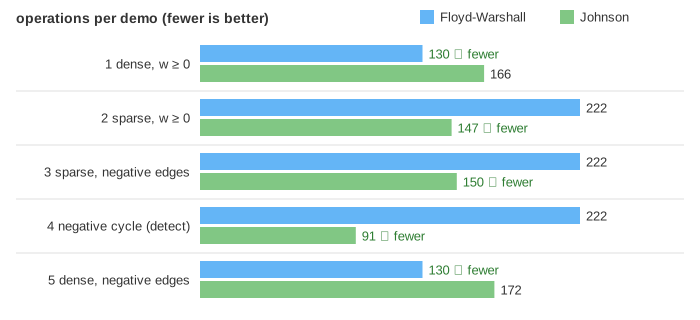
In general Floyd-Warshall is Θ(V³). Johnson is O(V·E) for Bellman-Ford plus V Dijkstra runs: O(V·E log V) with a binary heap, O(V·E + V² log V) with a Fibonacci heap. When E is close to V², Johnson is no better than V³ and pays for the heap and the extra phases. When E is about V (road maps, most real networks), Johnson is close to V² log V, far below V³.
Negative edges change nothing for Floyd (Demo 1 and Demo 5 both cost 130). For Johnson they only make the potentials non-zero; the heap work changes a little because the Dijkstra runs see different weights.
Negative cycles
In Demo 4 the ring A→B→C→D→E→F→A weighs −1, so there are no shortest paths. Both algorithms notice, in different ways:
- Floyd-Warshall finishes all
V³checks and then reads the diagonal.D[i][i] < 0means a path fromiback to itself with negative weight. Every vertex on the ring turns red. - Johnson's Bellman-Ford keeps changing
hforVpasses, so it runs a check pass. Anhthat can still drop proves a negative cycle, and Johnson stops before any Dijkstra run, after 91 operations.
When to pick which
| Floyd-Warshall | Johnson | |
|---|---|---|
| Time | Θ(V³) | O(V·E log V) (binary heap) |
| Extra memory | the matrix only | adjacency lists, h, a heap |
| Negative edges | fine | fine (after reweighting) |
| Negative cycle | found at the end (diagonal) | found by Bellman-Ford, before Dijkstra |
| Code | 5 lines | Bellman-Ford + Dijkstra + a heap |
| Best for | dense or small graphs, matrix input | large sparse graphs |
With no negative edges, Johnson's first two phases can be skipped: run Dijkstra from every vertex directly. Pick a graph from the graph menu and press Run Both to race on it.
What the page leaves out
- The real cost of a heap operation is
log V, not 1; the page counts each push, decrease-key and pop as one operation, and the priority queue is a scan, not a drawn heap. - Path reconstruction: a next-hop matrix for Floyd and a parent array per Dijkstra run.
- Floyd's cache-friendly inner loop and its easy parallel and blocked versions, which make it faster in practice than an operation count suggests.
- Early stops: Floyd can skip row
iwhenD[i][k] = ∞, and can stop as soon as a diagonal entry turns negative. - Undirected graphs, where one negative edge already forms a negative cycle.