The idea: sin(a + b) from two stacked triangles
A common mistake is to write sin(a + b) = sin a + sin b. Try a = b = 45°: the left side is sin 90° = 1, the right side is 1.414. The real rule, the angle addition identity, is
sin(a + b) = sin a · cos b + cos a · sin b
cos(a + b) = cos a · cos b − sin a · sin b
Both come out of one picture. Draw a segment OP of length 1 at the angle a + b. Its end P has height sin(a + b) and x-coordinate cos(a + b), as on the unit circle. Now split the angle: a right triangle with angle b stands on top of a right triangle with angle a, and a rectangle closes the picture around them.
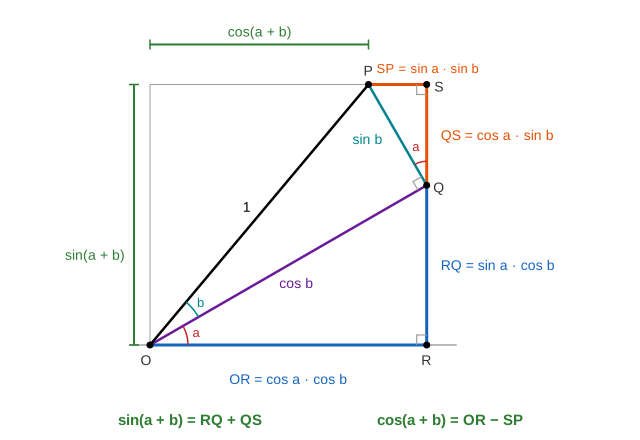
Press Prove to build it one triangle at a time; the Numbers panel measures every side.
Three right triangles
Every side comes from one rule: in a right triangle with hypotenuse h and angle θ, the side next to θ is h · cos θ and the side across is h · sin θ.
| Triangle | Hypotenuse | Angle | Side next to it | Side across |
|---|---|---|---|---|
| OQP (middle) | OP = 1 | b at O | OQ = cos b | QP = sin b |
| ORQ (bottom) | OQ = cos b | a at O | OR = cos a · cos b | RQ = sin a · cos b |
| QSP (top) | QP = sin b | a at Q | QS = cos a · sin b | SP = sin a · sin b |
Why the angle at Q is a
The angle a at O sits between the x-axis and OQ. At Q, the side QS is vertical, so it is at 90° to the x-axis, and QP is at 90° to OQ by construction. Turn both sides of an angle by 90° and the angle between them stays the same, so the angle between QS and QP is a again. This is the one step of the proof that is not just reading off a triangle.
Heights add: the sine formula
P's height is sin(a + b), and that is also the height of the rectangle. The right edge of the rectangle runs from R up to S and is cut at Q into two pieces, one from each small triangle:
sin(a + b) = RQ + QS = sin a · cos b + cos a · sin b
With a = 30°, b = 20°: 0.5 · 0.940 + 0.866 · 0.342 = 0.470 + 0.296 = 0.766 = sin 50°. (Demo: a = 30°, b = 20°)
Widths subtract: the cosine formula
P's x is cos(a + b). The bottom OR reaches all the way to below S, but along the top edge P stops short of S by SP. So
cos(a + b) = OR − SP = cos a · cos b − sin a · sin b
That is why the cosine formula has a minus sign and the sine formula a plus: the two pieces of the right edge stack, but the top piece of the upper triangle points back to the left.
When a + b reaches and passes 90°
At a = b = 45°, P sits right above O: SP = sin² 45° = 0.5 = OR, so cos 90° = 0 and the whole height is 0.5 + 0.5 = 1. (Demo: a + b = 90°) With a = 60°, b = 45° the top piece SP = 0.612 is longer than OR = 0.354, P lands left of O, and cos 105° = −0.259 comes out negative on its own. The picture needs no change: the same three triangles prove the formula for any a and b between 0° and 90°. (Demo: a + b past 90°, cos goes negative)
Double angles: put b = a
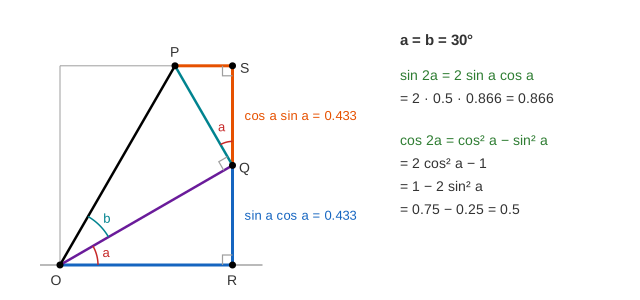
With b = a the two pieces of the right edge are both sin a · cos a, so the formulas turn into the double-angle identities:
sin 2a = 2 sin a cos a
cos 2a = cos² a − sin² a = 2 cos² a − 1 = 1 − 2 sin² a
The last two forms use sin² a + cos² a = 1. (Demo: double angle, a = b = 30°: sin 60° = 2 · 0.5 · 0.866 = 0.866, cos 60° = 0.75 − 0.25 = 0.5.)
Differences and tan(a + b)
Replace b by −b. Cosine is even and sine is odd (cos(−b) = cos b, sin(−b) = −sin b), so
sin(a − b) = sin a · cos b − cos a · sin b
cos(a − b) = cos a · cos b + sin a · sin b
Divide the sine formula by the cosine formula, then top and bottom by cos a · cos b: tan(a + b) = (tan a + tan b) / (1 − tan a · tan b). The same pair of formulas is what a rotation matrix does when you turn by a and then by b, and what multiplying two complex numbers on the unit circle does: eia · eib = ei(a+b).
See also Proofs Without Words for other identities read off a picture.
What the page leaves out
The picture only works for a, b between 0° and 90°; the formulas hold for every angle, which the rotation or complex-number proof shows in one line. The page also leaves out the half-angle and triple-angle formulas, the product-to-sum formulas (sin a · cos b = ½[sin(a + b) + sin(a − b)]), and how these identities give the derivative of sin x.
See where this page fits on the Trigonometry & Geometry mind map.