The idea: a product is an area
An a × b rectangle has area ab, and an a × a square has area a². So an algebra identity such as (a + b)² = a² + 2ab + b² can be read as a claim about shapes: these pieces cover the same region. An inequality becomes one region fits inside another. A picture that makes such a claim obvious is called a proof without words. The page draws whole-number sizes as unit cells, so every area can be counted and every move keeps the count.
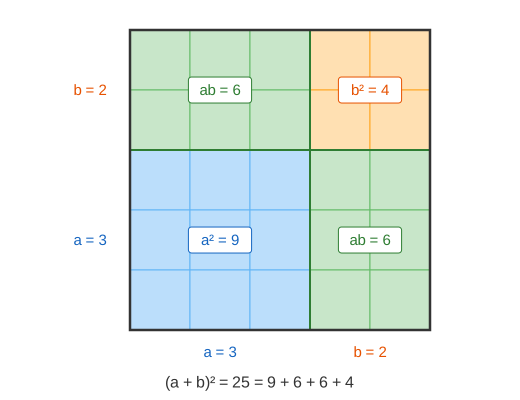
Square of a sum and of a difference
Split each side of an (a + b) square at a. The cuts make four pieces: a² in one corner, b² in the opposite one, and two a × b rectangles in the other two. That is (a + b)² = a² + 2ab + b², and the two rectangles are why (a + b)² is not a² + b² (Demo: square of a sum).
For (a − b)², start from a² and cut off a strip b wide and a strip b tall, each of area ab. The two strips share a b × b corner, so subtracting 2ab removes that corner twice; adding b² back fixes it. What is left is the (a − b) square (Demo: square of a difference).
| identity | picture | numbers on the page |
|---|---|---|
| (a + b)² = a² + 2ab + b² | four pieces fill the big square | a = 3, b = 2: 25 = 9 + 6 + 6 + 4 |
| (a − b)² = a² − 2ab + b² | two strips off, corner back | a = 5, b = 2: 9 = 25 − 10 − 10 + 4 |
| a² − b² = (a + b)(a − b) | L shape cut and moved | a = 5, b = 2: 21 = 7 × 3 |
Difference of squares: cut and move
Take a b × b corner out of a². The rest is an L shape of area a² − b². Cut the L into a strip a × (a − b) and a piece (a − b) × b. Turn the piece a quarter turn and put it at the end of the strip: both are a − b tall, so they make one rectangle (a + b) × (a − b). Cutting and moving never changes area, so a² − b² = (a + b)(a − b) (Demo: difference of squares).
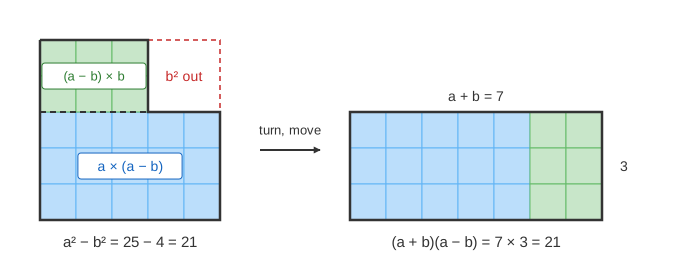
This is the trick behind mental arithmetic like 47 × 53 = 50² − 3² = 2491, and behind factoring x² − 9 = (x + 3)(x − 3).
Sums as areas
Odd numbers make squares. Wrap a k − 1 square in an L of one row, one column and a corner: that adds (k − 1) + (k − 1) + 1 = 2k − 1 cells and makes a k square. Doing it n times gives 1 + 3 + 5 + … + (2n − 1) = n². For n = 5: 1 + 3 + 5 + 7 + 9 = 25 (Demo: odd numbers make squares).
Two staircases make a rectangle. Columns of 1, 2, …, n cells form a staircase. A copy turned upside down fits on top of it, and every column then holds n + 1 cells. So two staircases are an n × (n + 1) rectangle, and 1 + 2 + … + n = n(n + 1)/2, the triangular numbers 1, 3, 6, 10, 15, … (Demo: 1 + 2 + … + n). It is the same idea as Gauss pairing 1 with 100, 2 with 99, and so on. The same count, n(n − 1)/2, is the number of comparisons in a simple sort such as bubble sort (see comparison sorts).
AM ≥ GM, two ways
Put four a × b rectangles inside an (a + b) square, each a quarter turn from the last, like a pinwheel. They fill the square except for a hole in the middle, a square of side a − b:
Taking square roots and halving gives (a + b)/2 ≥ √(ab): the arithmetic mean is at least the geometric mean. Equality needs an empty hole, so a = b. For 4 and 1: 25 = 16 + 9, and 2.5 ≥ 2. For 3 and 3 the four squares fill the frame: 36 = 36 (Demo: AM ≥ GM). A practical reading: among rectangles with the same perimeter, the square has the largest area.
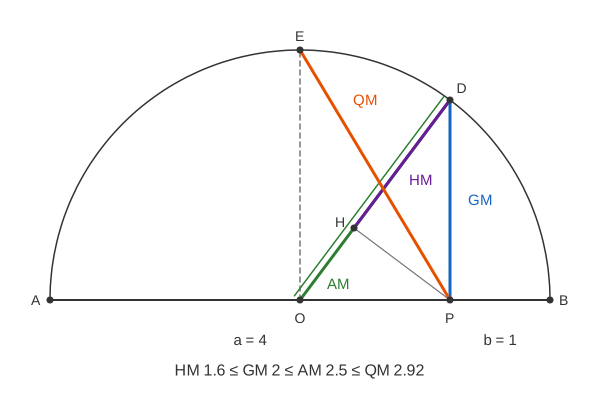
One semicircle shows four means at once. Put a diameter of length a + b on a line, split at P into a and b, with centre O:
| mean | formula | segment | 4 and 1 |
|---|---|---|---|
| harmonic HM | 2ab/(a + b) | DH, H = foot of P on OD | 1.6 |
| geometric GM | √(ab) | PD, straight up from P | 2 |
| arithmetic AM | (a + b)/2 | OD, a radius | 2.5 |
| quadratic QM | √((a² + b²)/2) | PE, E = top of the circle | ≈ 2.92 |
Why: angle ADB stands on a diameter, so it is a right angle and PD² = AP · PB = ab. In right triangle OPD, PD is a leg and OD the hypotenuse, so GM ≤ AM. In right triangle DHP, DH is a leg and DP the hypotenuse, so HM ≤ GM. In right triangle POE, OE is a leg and PE the hypotenuse, so AM ≤ QM. Slide P to O and the four segments become the same radius: the means are equal only when a = b (Demo: four means in a semicircle). The right-triangle facts come from the Pythagorean theorem. The harmonic mean is the average speed over two equal distances; the quadratic mean (root mean square) is what an AC voltmeter reports.
sin x < x < tan x
In the unit circle, take an angle x between 0 and π/2 radians at the centre O, with A = (1, 0), B on the circle and T where the ray meets the tangent line at A. Three regions sit inside each other:
| region | area | x = 45° |
|---|---|---|
| triangle OAB (height sin x) | ½ sin x | 0.354 |
| sector OAB (arc length x) | ½ x | 0.393 |
| triangle OAT (height tan x) | ½ tan x | 0.5 |
So sin x < x < tan x. Dividing by sin x and flipping gives cos x < sin x / x < 1, and since cos x → 1 as x → 0, sin x / x → 1 (squeezed between them; see limits). That limit is what makes the derivative of sin x equal cos x (Demo: sin x < x < tan x). The sector's area is ½ x only when x is in radians, which is one reason calculus uses radians.
Two more, in one sentence each
The triangle inequality |u + v| ≤ |u| + |v| says a straight side of a triangle is never longer than the other two together. The Cauchy–Schwarz inequality |u · v| ≤ |u||v| says |cos θ| ≤ 1 for the angle between two vectors. Both are on the vectors and dot product page.
More geometry with pictures: why the angle on a diameter is 90° (circle theorems), four lines that always meet in one point (triangle centres), a proof by building one edge at a time (Euler's formula V − E + F = 2), and an endless sum that is an area, ½ + ¼ + ⅛ + … = 1 (geometric series).
To turn a picture such as the staircase into a proof for every n, see Proof by Induction: a base case and an inductive step knock over an endless row of dominoes.
The angle addition formulas have a picture proof too: see Angle Addition Identities, where two right triangles stacked in a rectangle give sin(a + b) and cos(a + b).
What the page leaves out
The page only draws whole-number sizes; for any positive real a and b the pictures are the same without the grid. It leaves out the sum of cubes 1³ + 2³ + … + n³ = (1 + 2 + … + n)² (another square built from L-shaped layers), three-dimensional identities such as (a + b)³ drawn as eight blocks of a cube, AM ≥ GM for more than two numbers and weighted means, Jensen's inequality, and proofs by induction, which turn these pictures into proofs for every n.