The idea: the inscribed angle is half the central angle
Two points A and B on a circle cut it into two arcs. Join A and B to the centre O: the angle ∠AOB is the central angle, and it is the size of the arc AB. Now pick a point P on the other arc and join it to A and B: ∠APB is an inscribed angle. The inscribed angle theorem says it is always half the central angle on the same arc:
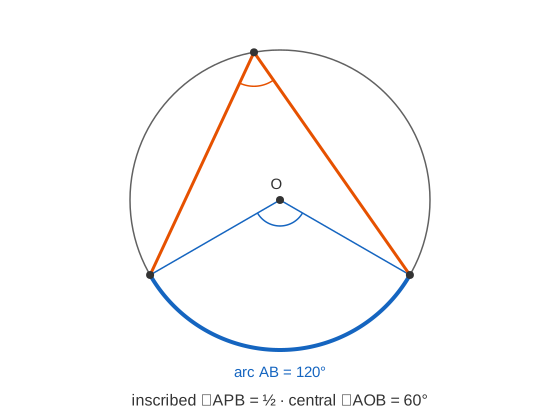
On the page the circle has radius 1 and every point is given by its angle in degrees, so all numbers are exact. Arc AB can be 60°, 90°, 120° or 180°, and P can sit at 30°, 60°, 90°, 120° or 150°. Pick a theorem, an arc and a place for P and press Run; press Run again with a new P and P moves while every angle is measured again.
Why it is half: the diameter through P
Draw the diameter from P through O to the far point Q. OP, OA and OB are all radii, so triangles OPA and OPB are isosceles: triangle OPA has two equal base angles x, and triangle OPB two equal base angles y. The angle ∠AOQ is the outside angle of triangle OPA at O, and an outside angle equals the two far angles together, so ∠AOQ = 2x. In the same way ∠BOQ = 2y.
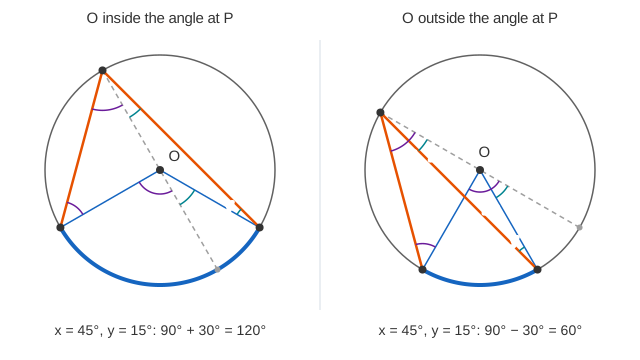
| where O is | ∠APB | ∠AOB | numbers on the page |
|---|---|---|---|
| inside the angle at P | x + y | 2x + 2y | arc 120°, P at 120°: x = 45°, y = 15°, 90 + 30 = 120 = 2 × 60 |
| outside the angle at P | x − y | 2x − 2y | arc 60°, P at 150°: x = 45°, y = 15°, 90 − 30 = 60 = 2 × 30 |
Either way ∠AOB = 2 · ∠APB (Demo: inscribed angle is half the central angle, Demo: centre outside the angle). When Q lands exactly on A or B, one triangle disappears and the other alone gives the result.
Angles on the same arc are equal
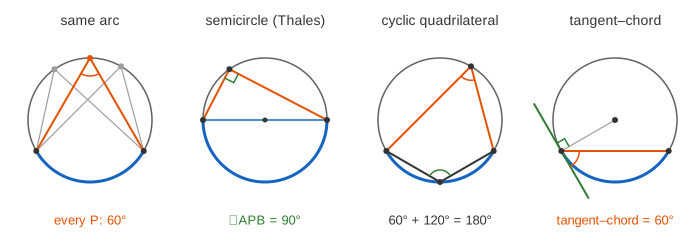
The proof never used where P is, only that it is on the other arc. So every point of that arc sees AB under the same angle: move P from 30° to 150° and ∠APB stays 60° for arc 120° (Demo: same arc, same angle). The grey chords left behind make the familiar "bow-tie" picture. A point on the arc AB itself sees it under the other angle, 180° minus this one (see cyclic quadrilaterals below).
The angle in a semicircle is 90° (Thales)
When AB is a diameter, the central angle is a straight angle, 180°, so every inscribed angle on it is 90°. This is Thales' theorem. Directly: OA = OP = OB, so the base angles are x, x and y, y; the triangle's angles add up to 2x + 2y = 180°, so ∠APB = x + y = 90° (Demo: angle in a semicircle). Turned around: the hypotenuse of a right triangle is a diameter of the circle through its corners, which ties this page to the Pythagorean theorem. With vectors it says (P − A) · (P − B) = 0 for every P on the circle (see vectors and the dot product). The four-means semicircle on Proofs Without Words uses the same right angle.
Cyclic quadrilaterals
Four points on one circle make a cyclic quadrilateral. Its opposite angles add to 180°: the angle at P looks at arc AB, the angle at D looks at the rest of the circle, and the two arcs add to 360°, so their halves add to 180°. The page puts D at 270°, in the middle of arc AB:
| arc 120° | ∠P | ∠D | ∠A | ∠B |
|---|---|---|---|---|
| P at 60° | 60° | 120° | 75° | 105° |
| P at 120° | 60° | 120° | 105° | 75° |
Moving P changes the angles at A and B, but each pair still adds to 180°, and all four to 360° (Demo: cyclic quadrilateral). The converse is also true: if opposite angles add to 180°, the four points lie on one circle.
Tangent ⟂ radius, and the tangent–chord angle
A tangent touches the circle at one point and is perpendicular to the radius there. Slide P towards A along its arc: ∠APB stays the same, while the chord PA gets shorter and turns. When P reaches A, the chord has become the tangent at A, and the inscribed angle has become the angle between the tangent and the chord AB. So the tangent–chord angle also equals half the arc (the alternate segment theorem). Check for arc 120°: triangle OAB has apex 120°, so ∠OAB = 30°, and 90° − 30° = 60° (Demo: tangent–chord angle).
Angles at the centre are measured the same way as on the unit circle: a central angle of θ radians cuts off an arc of length θ.
What the page leaves out
The page keeps arc AB at 180° or less, so it does not draw a reflex central angle (an arc over 180° and an obtuse inscribed angle on the short arc); the cyclic quadrilateral shows that case through D. It leaves out intersecting chords and the power of a point (AX · XB = CX · XD for chords crossing at X, and the tangent version XT² = XA · XB), the angle between two crossing chords (half the sum of the arcs) and between two secants from outside (half the difference), equal chords and equal angles, Ptolemy's theorem for cyclic quadrilaterals, and how to construct the circle through three points.