The idea: measure a curve with straight pieces
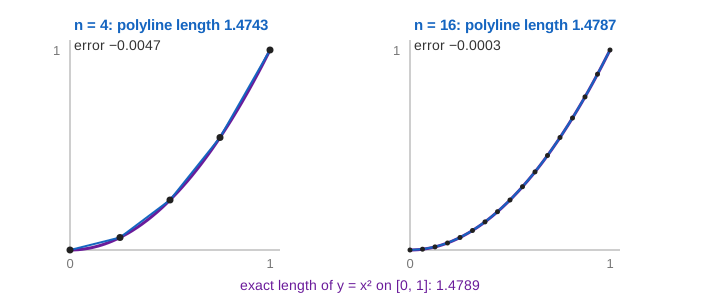
A ruler can only measure straight lines. To measure a curve y = f(x) from x = a to x = b, put n + 1 points on it at equal steps Δx = (b − a)/n, join each point to the next with a straight piece (a chord), and add the pieces. The result is the length of a polyline. As n grows the polyline hugs the curve, and its length closes in on the arc length L.
One piece is a hypotenuse
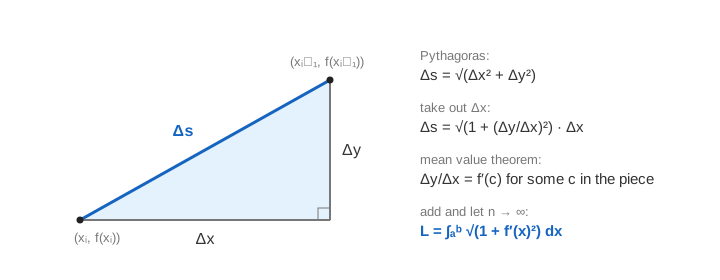
Each piece goes Δx across and Δy = f(xi+1) − f(xi) up or down, so it is the hypotenuse of a right triangle. Pythagoras gives its length: Δs = √(Δx² + Δy²). The zoom box on the canvas draws this triangle for the piece that was just added, with Δx, Δy and Δs. (Demo: x² on [0, 1], chords n = 1 → 16)
From the sum to the integral
Take Δx out of the square root: Δs = √(1 + (Δy/Δx)²) · Δx. By the Mean Value Theorem, the slope Δy/Δx of a chord equals f′(c) at some point c inside the piece. So the polyline length is a Riemann sum of the function √(1 + f′(x)²), and as n → ∞ it becomes the integral
L = ∫ab √(1 + f′(x)²) dx.
The factor √(1 + f′²) says how much longer a piece is than its Δx. On a flat part (f′ = 0) it is 1. On a slope of 1 it is √2 ≈ 1.41. Where the curve is steep it is large. Compare the strips of Riemann Sums, which add height × Δx; here each strip adds stretch × Δx.
How fast the polyline converges
A straight line is the shortest path between two points, so a chord is never longer than the bit of curve it cuts off. The polyline is always a little too short, and it gets longer each time n doubles. The table on the canvas shows how many times smaller the error got (÷):
| Curve | Exact L | n = 4 | n = 16 | Error ÷ per doubling |
|---|---|---|---|---|
| x² on [0, 1] | (2√5 + asinh 2)/4 ≈ 1.4789 | 1.4743 | 1.4787 | ≈ 4 (error ∝ 1/n²) |
| sin x on [0, π] | ≈ 3.8202 | 3.7901 | 3.8183 | ≈ 4 |
| semicircle √(1 − x²) | π ≈ 3.1416 | 3.0353 | 3.1285 | ≈ 2.83 = 21.5 |
A smooth curve loses about the same small amount on every piece, roughly Δx³ times the bend, so the total error falls like 1/n². The semicircle is vertical at x = ±1: f′ is infinite there and √(1 + f′²) blows up. The integral is still finite (it is π), but the two end pieces stay steep and long, and the error only shrinks like 1/n1.5. (Demo: semicircle → π, infinite slope at the ends)
The staircase paradox
Why hypotenuses and not something simpler? Try a staircase: for each piece go across Δx, then straight up or down |Δy|. With more steps the staircase looks more and more like the curve, but its length never moves. On x² from (0, 0) to (1, 1) the steps add up to 1 across + 1 up = 2 for every n, while the curve is 1.4789 long. On the semicircle the staircase is 2 across + 1 up + 1 down = 4, which is the old joke "π = 4". (Demo: staircase paradox, always 2; Demo: π = 4? staircase on the semicircle)
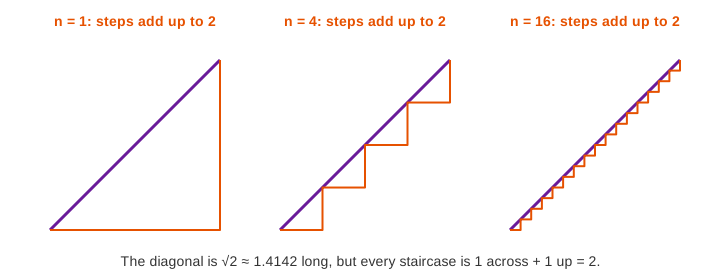
Each step is longer than its own hypotenuse by a fixed fraction that depends only on the slope, not on the step size. Making the steps smaller makes more of them, so the extra never goes away. Only pieces that point the same way as the curve, the chords, converge to its length.
Closed forms are rare
The integrand √(1 + f′²) has a square root of a sum, and most of these integrals have no formula in elementary functions. Textbook examples are picked so it works out: y = x3/2 on [0, 4] gives √(1 + 9x/4) and L = (8/27)(10√10 − 1) ≈ 9.0734. The parabola needs asinh. One arch of sin x needs an elliptic integral, so in practice its length 3.8202 comes from a numerical method, which is exactly what the polyline is. (Demo: sin x on [0, π], no closed form)
The same strips build volumes (π f(x)² Δx) on Volumes by Slicing, and areas on the Fundamental Theorem of Calculus page.
Archimedes measured the circle the same way, with polygons inside and outside it: see Archimedes' π.
A classic arc-length result: one arch of the cycloid is exactly 8r long.
What the page leaves out
Curves given by parameters, L = ∫ √(x′(t)² + y′(t)²) dt, and in polar form, L = ∫ √(r² + r′²) dθ; curves in space; the arc-length function s(x) and reparametrizing by arc length; surface area of a solid of revolution, 2π f(x) √(1 + f′²) dx; curves that have no finite length at all, such as the Koch snowflake; and floating-point rounding when n is huge.