The idea: differentiate the link with time
In a related rates problem two or more quantities change together, and an equation, the link, holds between them at every moment. You know how fast one of them changes and want how fast another one changes. Because the link holds at every moment, its two sides change at the same rate: differentiate the whole equation with respect to time t, and the rates come out tied together.
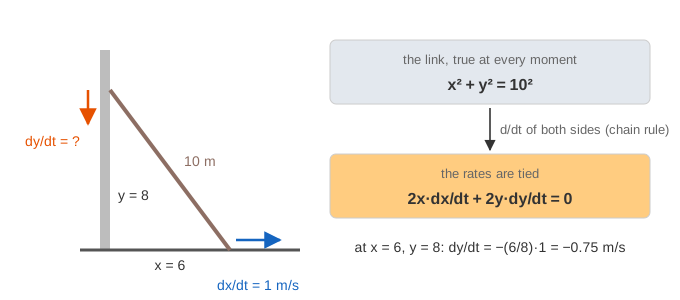
The recipe in five steps
- Name the given rate and the wanted rate (the blue and orange lines in the panel).
- Write the link: an equation true at every moment, from geometry (Pythagoras, a volume formula, similar triangles).
- Differentiate both sides with respect to t. Every changing quantity is a function of t, so each term needs the chain rule: d/dt(x²) = 2x·dx/dt, d/dt(r³) = 3r²·dr/dt. Constants give 0.
- Plug in the values at the moment asked about.
- Solve for the wanted rate, and check the sign and the unit.
The page adds a sixth step, a check: move the clock on by Δt = 0.001 and divide the change by Δt. That difference quotient agrees with the solved rate to about 3 digits, as local linearity says it should.
The sliding ladder
A 10 m ladder leans on a wall. Its foot is x = 6 m out and slides away at dx/dt = 1 m/s. The link is x² + y² = 10², so 2x·dx/dt + 2y·dy/dt = 0 and dy/dt = −(x/y)·dx/dt. At x = 6, y = 8: dy/dt = −6/8 = −0.75 m/s. The minus sign says y is shrinking: the top falls. (Demo: ladder, how fast does the top fall at x = 6 m?)
The balloon
Air goes into a spherical balloon at dV/dt = 100 cm³/s. The link is V = (4/3)πr³, so dV/dt = 4πr²·dr/dt. At r = 5 cm, dr/dt = 100 / (4π·25) ≈ 0.318 cm/s. The factor 4πr² is the surface area: each new cm³ spreads over the whole skin, so a bigger balloon grows more slowly. (Demo: balloon, r grows more slowly as it gets bigger)
The cone tank: remove a variable first
A cone tank, 10 m deep with a 5 m top radius, point down, fills at dV/dt = 2 m³/min. V = (1/3)πr²h has two changing quantities. The water forms a smaller cone of the same shape, so by similar triangles r/h = 5/10 and r = h/2. Put that in before differentiating: V = πh³/12, dV/dt = (π/4)h²·dh/dt, and at h = 5 m, dh/dt = 8/(25π) ≈ 0.102 m/min. (Demo: cone tank, similar triangles first)
| Problem | Link | Differentiated | At t = 0 |
|---|---|---|---|
| Ladder | x² + y² = 10² | 2x·x′ + 2y·y′ = 0 | y′ = −0.750 m/s |
| Balloon | V = (4/3)πr³ | V′ = 4πr²·r′ | r′ = 0.318 cm/s |
| Cone tank | V = πh³/12 | V′ = (π/4)h²·h′ | h′ = 0.102 m/min |
The common mistake: plugging in too early
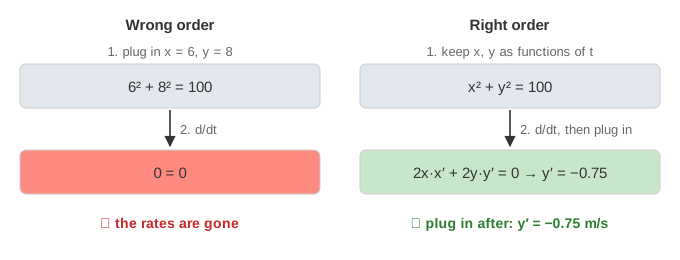
If you put x = 6 and y = 8 into the link first, you get 36 + 64 = 100, a true statement about two fixed numbers. Its derivative is 0 = 0, and the rates are gone. The link must be differentiated while the quantities are still functions of t; numbers go in only after. (Demo: mistake, plugging in before differentiating)
A steady rate in, a changing rate out
The given rate is constant on all three problems, yet the wanted rate is not. Tick the clock and solve again:
- Ladder: dy/dt = −x/y. As the top drops, y gets small and x/y gets large: −0.75, −0.98, −1.33, −2.07 m/s at t = 0, 1, 2, 3 s. At y = 0 the formula would be infinite, which a real ladder cannot do: it leaves the wall before that. (Demo: ladder, the top speeds up as it falls)
- Balloon: dr/dt = dV/dt / (4πr²) falls as the area grows: 0.318, 0.204, 0.156 cm/s at t = 0, 5, 10 s.
- Cone tank: the water surface widens as it rises, so dh/dt falls from 0.102 m/min at t = 0 to 0.060 m/min at t = 20 min.
The chart under the picture draws the same formula at every moment, and each solved moment adds a dot on it. Reading a rate from a graph like this is the subject of f, f′, f″: Reading Derivative Graphs.
What the page leaves out
The page does not cover problems with angles (a rising balloon seen from the ground, where tan θ links height and angle), shadows and moving lamps, two cars moving apart, or problems where the link involves more than two changing quantities without a way to remove one. It also leaves out implicit differentiation as a topic of its own, and second derivatives such as the acceleration of the ladder's top.
See where this page fits on the Calculus mind map.