The idea: a store where the key is the hash of the content
Under the commands, Git is a simple key-value store. You give it some bytes; it computes their SHA-1 hash and saves the bytes under that hash. The hash is the object's name, its object ID. This is called content addressing: the name comes from the content, so the same content always gets the same name. Everything Git keeps about your project is one of three kinds of object: a blob (the content of a file), a tree (a directory listing) and a commit (a snapshot with its history).
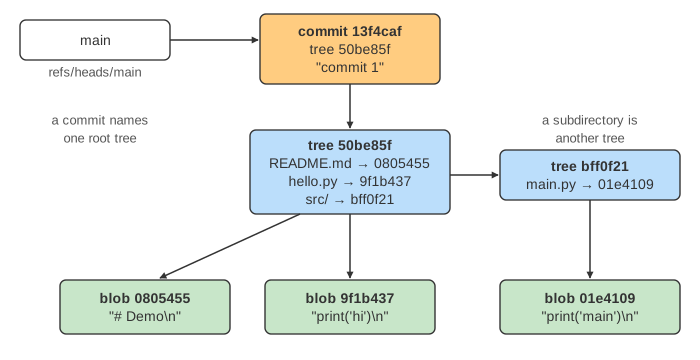
On the canvas, the left panel is your repository as you see it: the files in the working tree, the index (.git/index, also called the staging area) and the list of files in .git/objects. The right panel draws the same objects as a graph, commits on top, trees in the middle and blobs at the bottom, with a box below that shows the exact bytes being hashed. Pick a change in the change a file… menu, then press git add and git commit, or run a demo. The hashes are real: the same commands in a real repository, with the same author and dates, print the same IDs.
How an object ID is computed
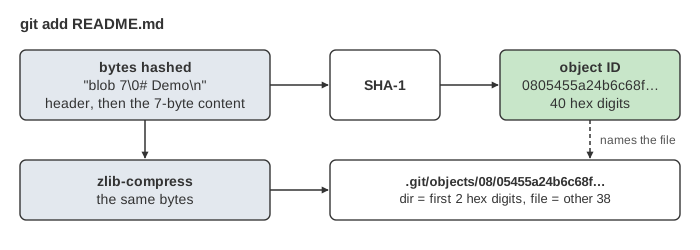
Git puts a short header in front of the content, <type> <size in bytes>\0, and hashes the whole thing. The file README.md with the 7 bytes # Demo\n becomes:
$ printf '# Demo\n' | git hash-object --stdin
0805455a24b6c68fbc38d0fa5d121f735984285d

SHA-1("blob 7\0# Demo\n") = 0805455a24b6c68fbc38d0fa5d121f735984285d
Git compresses those same bytes with zlib and writes them to a file named after the hash: the first two hex digits are a directory, the other 38 are the file name, so this blob lives in .git/objects/08/05455a24b6…. The two-digit directories keep any one directory from holding too many files. git cat-file -p 0805455 reads an object back, and git cat-file -t prints its type.
What git add writes
git add does two things for each changed file. It writes a blob holding the file's content, and it records mode hash path in the index (git ls-files -s shows it). The blob does not contain the file name or its permissions; those live in the index and later in a tree. Nothing else is written: no tree, no commit (Demo 1: first git add and git commit).
If you add a file, edit it and add it again before committing, the first blob stays in .git/objects with nothing pointing to it. It is unreferenced (or dangling), drawn grey on the canvas. git fsck --unreachable lists such objects, and git gc deletes them after a grace period, two weeks by default (Demo 5: add, edit, add again).
What git commit writes
git commit reads the index and writes, from the bottom up:
- a tree for every directory: one entry per file or subdirectory, sorted by name, each
mode name\0followed by the 20 raw bytes of the entry's hash (100644is a normal file,100755an executable,040000a subdirectory, which points to another tree); - a commit: the root tree's hash, the parent commit's hash (none for the first commit, two for a merge), the author and committer with a timestamp, a blank line and the message;
- then it moves the current branch, here
refs/heads/main, to the new commit's hash.
$ git cat-file -p HEAD
tree bedabea16b85697c69bd9452ce4f40502cc431b1
parent 8a22433c0ac845ab26191ae4d534f33214d6c7c1
author Ann <ann@example.com> 1700000060 +0000
committer Ann <ann@example.com> 1700000060 +0000

commit 2
Branches and HEAD are files outside .git/objects that hold a commit hash; the page GitRefsHead, next in this Git series, follows them.
Same content, same object
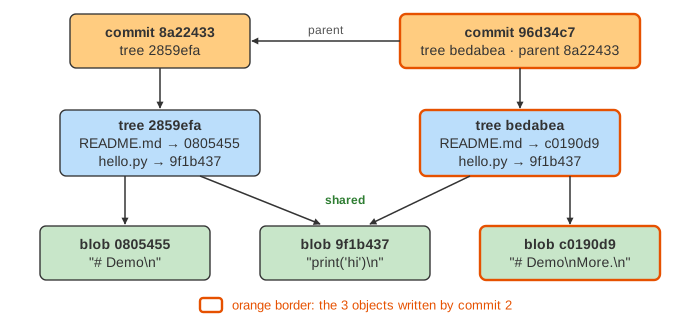
A commit is a full snapshot, not a list of changes, yet a new commit is cheap: anything that did not change already exists under the same hash, so the new tree simply points to it.
| you do | new blobs | new trees | new commits | demo |
|---|---|---|---|---|
| edit one file, commit | 1 | 1 | 1 | Demo 2 |
| copy a file under a new name, commit | 0 | 1 | 1 | Demo 3 |
| undo an edit, commit | 0 | 0 | 1 | Demo 4 |
In Demo 3 the tree has two names, README.md and notes.md, pointing to the one blob 0805455. In Demo 4 the third commit's tree has the same entries as the first commit's tree, so it has the same hash, 2859efa, and only a new commit is written. Renames work the same way: the blob is unchanged, only the tree differs.
Change one byte, change every hash above it
A tree contains the hashes of its blobs, and a commit contains the hash of its tree and of its parent. Change one byte in a file and its blob gets a new hash, so the tree listing it changes, so the commit changes, and so does every later commit. A commit hash therefore pins the whole snapshot and all of its history: this is a Merkle structure, the idea behind Merkle trees. If a byte on disk is damaged, the content no longer matches its name and git fsck finds it. Signed tags and commits sign only a hash, yet cover everything below it (see digital signatures, and encryption vs hashing for what a hash function guarantees).
SHA-1 is no longer considered collision-resistant: in 2017 the SHAttered attack produced two different PDFs with the same SHA-1. Git now uses a hardened SHA-1 that detects such attacks, and supports SHA-256 repositories (git init --object-format=sha256), where IDs have 64 hex digits.
How these objects are stored on disk, loose and packed with deltas: Git Packfiles.
Changing one file writes a new blob and new trees up to the root while every other object is reused by hash, which is the path copying of persistent trees.
Git Reset vs Revert vs Restore shows which undo commands overwrite the index and which only move a branch.
What the page leaves out
Subdirectories on the canvas (the figures show a nested tree), executable and symlink modes, annotated tag objects (the fourth object type), merge commits with two parents, and git commit -a. Real Git stores many objects packed and delta-compressed in .git/objects/pack, covered by the GitPackfiles page of this series; merging is in MergeVsRebase and ThreeWayMerge. The index is really a binary file that also caches file sizes and timestamps, so git status does not have to rehash every file.