The idea: a gap that shrinks to 0
An asymptote is a line, or sometimes a curve, that a graph gets closer and closer to. The gap between the graph and the line goes to 0, but the graph does not have to reach it. There are three common kinds: vertical (x = a), horizontal (y = L) and slant or oblique (y = mx + b). The page also shows a curved one, and holes that look like asymptotes but are not.
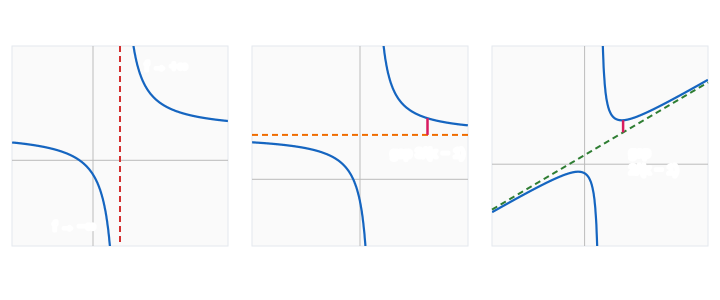
| Type | Equation | What happens | Example |
|---|---|---|---|
| vertical | x = a | f(x) → ±∞ as x → a (from one side or both) | (2x + 1)/(x − 1), x = 1 |
| horizontal | y = L | f(x) → L as x → +∞ or −∞ | (2x + 1)/(x − 1), y = 2 |
| slant (oblique) | y = mx + b | f(x) − (mx + b) → 0 as x → ±∞ | (x² + 1)/(x − 1), y = x + 1 |
| curvilinear | y = g(x) | f(x) − g(x) → 0 as x → ±∞ | (x³ + 1)/x, y = x² |
Each of these is a statement about a limit. Pick a function, press Find asymptotes to run the recipe, then Approach to watch the limit happen in the table.
Vertical asymptotes: where the bottom is 0
A line x = a is a vertical asymptote when f(x) → +∞ or −∞ as x comes near a, from the left (a⁻), from the right (a⁺) or both. For a fraction p(x)/q(x) this happens where the bottom q is 0 and the top is not: dividing a number near 3 by a number near 0 gives something huge. For (2x + 1)/(x − 1), f(1.1) = 32, f(1.01) = 302, f(1.001) = 3002: each step 10 times closer makes f about 10 times bigger (Demo: vertical + horizontal).
A graph can never cross a vertical asymptote, because f is not defined at x = a. It can approach from one side only: ln x exists only for x > 0, so it falls to −∞ as x → 0⁺ and there is nothing on the left (Demo: one-sided vertical (ln x)). tan x has a vertical asymptote at every odd multiple of π/2.
Holes are not asymptotes
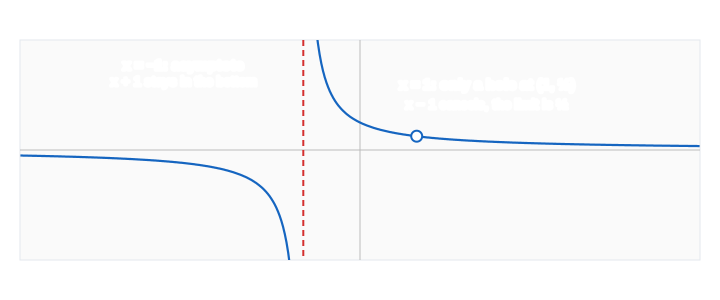
Factor first. If a zero of the bottom also makes the top 0, the common factor cancels and leaves a hole: one missing point, with a finite limit. In (x − 1)/(x² − 1) = (x − 1)/((x − 1)(x + 1)), the x − 1 cancels. What is left is 1/(x + 1), so x = −1 is a vertical asymptote while x = 1 is only a hole at (1, ½) (Demo: hole vs asymptote).
Horizontal asymptotes: compare degrees
As x grows, only the highest-power terms of p and q matter. So for a rational function the end behaviour is decided by the degrees:
| Degrees | As x → ±∞ | Asymptote | Example |
|---|---|---|---|
| deg p < deg q | f(x) → 0 | horizontal y = 0 | x/(x² + 1) |
| deg p = deg q | f(x) → ratio of leading coefficients | horizontal y = a/b | (2x + 1)/(x − 1) → y = 2 |
| deg p = deg q + 1 | f(x) grows like a line | slant y = quotient | (x² + 1)/(x − 1) → y = x + 1 |
| deg p ≥ deg q + 2 | f(x) grows like a polynomial | curvilinear y = quotient | (x³ + 1)/x → y = x² |
For (2x + 1)/(x − 1) the gap to y = 2 is exactly 3/(x − 1): 3 at x = 2, 0.4286 at x = 8, 0.003003 at x = 1000.
Slant asymptotes: long division
When the top is one degree higher, divide. Polynomial long division gives x² + 1 = (x − 1)(x + 1) + 2, so (x² + 1)/(x − 1) = x + 1 + 2/(x − 1). The remainder part 2/(x − 1) goes to 0, so the graph runs along the line y = x + 1. The page zooms out ×4 and ×16 to show the curve and the line merging (Demo: slant asymptote). With two degrees more, the quotient is a parabola: (x³ + 1)/x = x² + 1/x hugs y = x² (Demo: curvilinear y = x²).
Crossing, and different ends
A graph may cross a horizontal or slant asymptote, even many times. x/(x² + 1) passes through (0, 0), right on its asymptote y = 0, and only settles down toward 0 far away (Demo: crossing is allowed). sin x / x crosses y = 0 infinitely often.
The two ends can also behave differently. eˣ → 0 as x → −∞ but grows without bound as x → +∞, so y = 0 is an asymptote on the left only (see Exponentials and Logarithms). arctan x has two: y = −π/2 on the left and y = π/2 on the right (Demo: different ends (arctan)). Slow growth is not enough: ln x grows very slowly, but it never levels off, so it has no horizontal asymptote.
The recipe
- Factor p and q and cancel common factors. Each cancelled zero is a hole.
- Each zero left in the bottom is a vertical asymptote x = a.
- Compare deg p and deg q (table above). When the top is bigger, divide; the quotient is the slant or curvilinear asymptote.
- For other functions, work out the limits as x → a and x → ±∞ directly.
Moving a graph moves its asymptotes the same way: y = 1/(x − 2) + 3 is 1/x shifted right 2 and up 3, with asymptotes x = 2 and y = 3 (see Function Transformations).
To see what each coefficient of (ax² + bx + c)/(ex + f) does to the wall, the slant asymptote and the turning points, try Rational Functions: What a, b, c, e, f Do.
The hyperbola x²/a² − y²/b² = 1 and its asymptotes y = ±(b/a)x, the diagonals of a 2a × 2b box, are animated on Hyperbola: What h, k, a, b Do.
What the page leaves out
Asymptotes of curves that are not graphs y = f(x), such as the hyperbola x²/a² − y²/b² = 1 with asymptotes y = ±(b/a)x, asymptotes in polar coordinates, slant asymptotes of non-rational functions found with m = lim f(x)/x and b = lim (f(x) − mx), and "asymptotic" in the sense of growth rates (Big-O notation, f ~ g).