The idea: same angle, same ratio
Take a right triangle with sides 3, 4 and 5. Double every side and you get 6, 8, 10; triple them and you get 9, 12, 15. The angles do not change, only the size. Triangles like these are similar.
Divide two sides of one of them and you get the same number for all three: 3/5 = 6/10 = 9/15 = 0.6. The ratio does not care about the size, only about the angle. So each angle has its own ratios, and they get names: sine, cosine and tangent.
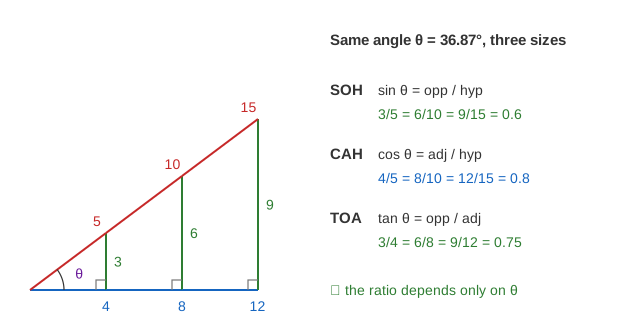
On the canvas the triangles share the corner with angle θ. Grow adds the next size (Demo: same angle, same ratio).
Naming the sides
The names come from the angle you are looking at, here θ:
- hypotenuse (red): across from the right angle. It is always the longest side.
- opposite (green): across from θ. It is the one side that does not touch θ.
- adjacent (blue): the side next to θ that is not the hypotenuse.
A right triangle has two acute angles, θ and φ = 90° − θ. Look from φ instead and opposite and adjacent swap; the hypotenuse stays the same (Demo: name the sides). This is why sin θ = cos(90° − θ): the side opposite θ is the side adjacent to φ.
SOH CAH TOA
The three ratios, with the usual way to remember them:
| Mnemonic | Ratio | 3-4-5 triangle, θ = 36.87° |
|---|---|---|
| SOH | sin θ = opposite / hypotenuse | 3/5 = 0.600 |
| CAH | cos θ = adjacent / hypotenuse | 4/5 = 0.800 |
| TOA | tan θ = opposite / adjacent | 3/4 = 0.750 |
The hypotenuse is the longest side, so sin and cos are always between 0 and 1. tan can be any positive number: it is 1 at 45°, where the two legs are equal, and grows without limit as θ nears 90° (Demo: SOH CAH TOA on a 3-4-5 triangle). A different angle gives a different shape and different ratios (Demo: a new angle, new ratios):
| θ | sin θ | cos θ | tan θ |
|---|---|---|---|
| 30° | 1/2 = 0.500 | √3/2 ≈ 0.866 | 1/√3 ≈ 0.577 |
| 45° | √2/2 ≈ 0.707 | √2/2 ≈ 0.707 | 1 |
| 60° | √3/2 ≈ 0.866 | 1/2 = 0.500 | √3 ≈ 1.732 |
Two checks that always hold: tan θ = sin θ / cos θ (the hypotenuse cancels), and sin²θ + cos²θ = 1, which is the Pythagorean theorem divided by hyp².
Finding a side: the angle of elevation
Measure one side and one angle and the ratios give every other side. You stand 20 m from a tree and look up 35° to its top: the angle of elevation. The 20 m is adjacent to the angle and the height is opposite, so TOA fits:
tan 35° = h / 20, so h = 20 × tan 35° = 20 × 0.700 = 14.00 m.
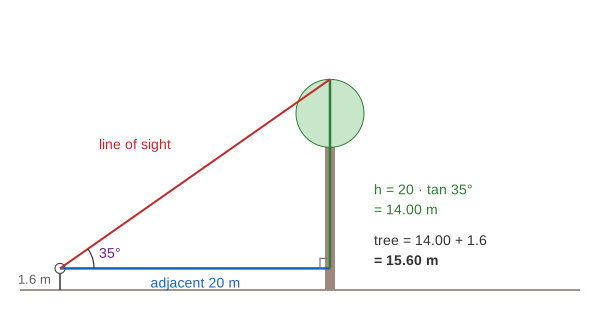
The triangle starts at your eye, not at the ground, so add the eye height: 14.00 + 1.6 = 15.60 m (Demo: height of a tree). Surveyors measure heights and distances the same way.
Finding an angle: inverse functions
With two sides you can go back to the angle. A 6 m ladder leans on a wall with its foot 1.5 m out. The 1.5 m is adjacent to the ground angle and the ladder is the hypotenuse, so CAH gives cos θ = 1.5 / 6 = 0.25. The inverse cosine answers "which angle has this cosine?": θ = cos⁻¹(0.25) ≈ 75.52°. That matches the usual ladder safety rule of about 75°, one unit out for every four up. Then SOH gives the height: 6 × sin 75.52° ≈ 5.81 m, the same as √(6² − 1.5²) (Demo: ladder, find the angle).
| You know | You want | Use |
|---|---|---|
| angle + adjacent | opposite | opp = adj · tan θ |
| angle + hypotenuse | opposite, adjacent | opp = hyp · sin θ, adj = hyp · cos θ |
| two sides | angle | θ = sin⁻¹, cos⁻¹ or tan⁻¹ of their ratio |
See also the unit circle, where the hypotenuse is 1 so sin θ and cos θ are the legs themselves and the angle can go past 90°, and Triangle Centres for more about triangles that are not right-angled.
For triangles without a right angle, see Law of Sines and Cosines.
What the page leaves out
Angles of 90° and more, and negative angles, where the triangle picture stops working and the unit circle takes over; the reciprocal ratios sec, csc and cot; triangles without a right angle, which need the law of sines and the law of cosines; angles of depression (the same idea, looking down); exact values from the 30-60-90 and 45-45-90 triangles beyond the table; and radians. Measurement error is ignored: real angles are read to a degree or so.
See where this page fits on the Trigonometry & Geometry mind map.