The idea: three doors, one car
A game show has three closed doors. A car is behind one of them and a goat behind each of the other two. You pick a door. The host, Monty, then opens one of the other two doors and shows a goat. He never opens your door and never shows the car. Now he asks: do you want to stick with your door or switch to the other closed door? Most people say "two doors left, so it is 50/50". It is not: switching wins 2/3 of the time.
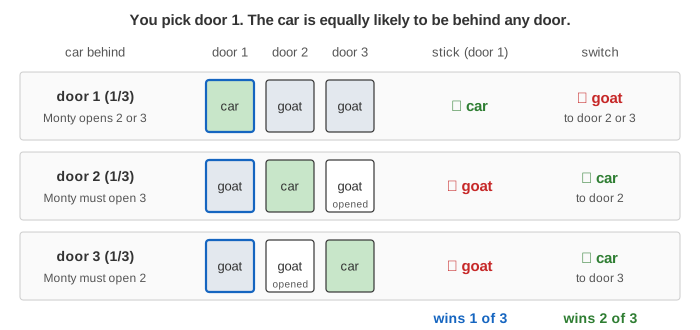
Why switching wins 2/3
Your first pick hides the car with probability 1/3. Monty's action cannot change that, because he can always open a goat door whatever you picked: sticking wins exactly when your first pick was right, 1/3. Your first pick is wrong with probability 2/3. Then the two other doors hold the car and one goat, and Monty must open the goat. The door he leaves closed is the car. So switching wins exactly when your first pick was wrong, 2/3 (Demo: one game, pick door 1 and stick, then Demo: the same game, but switch: same seed, same car, opposite result).
Another way to see it: switching is the same as choosing both other doors. Monty just shows you which of the two to take.
Running many games
One game proves nothing; you can win by sticking. Play 100 Games runs seeded games: a random car door, a random first pick, Monty's door, and then both choices are scored. Every counted game is a win for exactly one strategy, so stick wins + switch wins = games. The grid gets one square per game (green: switching wins, blue: sticking wins), and the two bars show the win rates against the 1/3, 1/2 and 2/3 lines. After 100 games the rates are already close to 1/3 and 2/3; after 1000 they are closer still, by the law of large numbers (the error shrinks like 1/√n, as in Monte Carlo estimation of π) (Demo: 100 games, Demo: 1000 games, the long run).
The probability tree and conditioning
A probability tree lists every way the game can go. Say you pick door 1. Level 1: the car is behind door 1, 2 or 3, each with 1/3. Level 2: the door Monty opens, given where the car is. If the car is behind door 1 he picks door 2 or 3 with 1/2 each. If it is behind door 2 he must open 3 (probability 1, and 0 for door 2). Multiply along a path to get its joint probability: 1/6, 1/6, 1/3, 1/3.
Now you see that Monty opened door 3. That rules out every path where he opened door 2. Two paths are left: car behind 1 (1/6) and car behind 2 (1/3). Conditioning means rescaling the paths that are left so they add up to 1: divide by their total 1/2. So P(car behind 1 | opened 3) = (1/6) / (1/2) = 1/3 and P(car behind 2 | opened 3) = (1/3) / (1/2) = 2/3 (Demo: the tree). The key is the 1/2 vs 1: when the car is behind door 2, Monty is forced to open door 3, so seeing door 3 opened is twice as likely in that world.
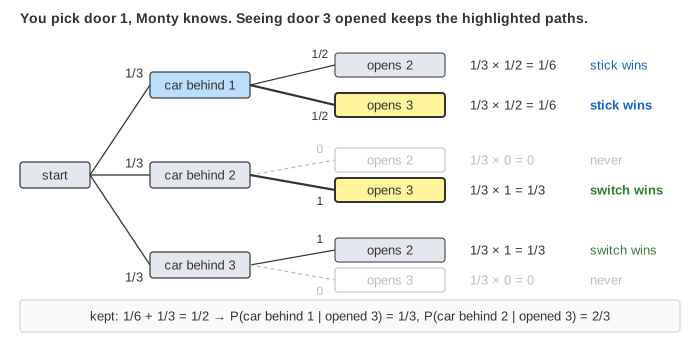
This is Bayes' theorem in tree form. The prior is 1/3 for each door, the likelihoods of "Monty opens 3" are 1/2, 1 and 0, and
| Car behind | Prior | P(Monty opens 3 | car) | Prior × likelihood | Posterior |
|---|---|---|---|---|
| door 1 (yours) | 1/3 | 1/2 | 1/6 | 1/3 |
| door 2 | 1/3 | 1 | 1/3 | 2/3 |
| door 3 | 1/3 | 0 | 0 | 0 |
| total | 1 | 1/2 | 1 |
The host's knowledge matters
Switch the host to guesses a door. Now Monty opens one of the two other doors at random, and sometimes it is the car; such a game is void (grey square, not counted). In the tree every level-2 branch is 1/2, so all six paths are 1/6. Two of them show the car. Given that he showed a goat behind door 3, the paths left are car behind 1 (1/6) and car behind 2 (1/6): 1/2 each. Switching no longer helps (Demo: Monty guesses). The goat is the same, but a guessing host's goat carries no information about where the car is; a knowing host's goat does.
| Host | P(stick wins) | P(switch wins) | Why |
|---|---|---|---|
| Knows, always shows a goat | 1/3 | 2/3 | he avoids the car, so the door he leaves closed is informative |
| Guesses, happened to show a goat | 1/2 | 1/2 | his choice did not depend on the car |
If 1/3 vs 2/3 still feels wrong, try 100 doors: you pick one, Monty opens 98 goat doors and leaves one closed. Your door is still 1/100; the one he carefully skipped is 99/100.
Common mistakes
- "Two doors are left, so each is 1/2." Equal counting needs equally likely cases; Monty's forced choice makes the cases unequal.
- "Monty's door gives no new information about my door." True: your door stays at 1/3. But it does move the other 1/3 onto the remaining closed door.
- "It only works with many games." It is a probability for a single game too: one switch wins with probability 2/3. Many games just make it visible.
What the page leaves out
Hosts with other rules (a host who opens a door only when you picked the car, or prefers the lowest-numbered goat door, which changes the conditional odds for a specific opened door), more doors and more opened doors, the history of the puzzle (Steve Selvin 1975, Marilyn vos Savant's 1990 column and the letters that said she was wrong), and the related three prisoners and Bertrand's box paradoxes.