The idea: treat a tree uniformly, add operations outside it
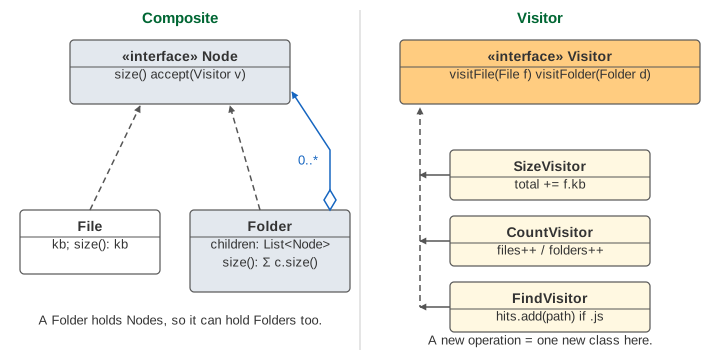
Many things are trees: folders and files, the HTML DOM, a compiler's syntax tree, a GUI window with panels and buttons. The Composite pattern (Gamma, Helm, Johnson and Vlissides, 1994) gives the leaves and the containers one interface, so code can call the same method on a single file or on a whole folder. The Visitor pattern lets you add new operations over such a tree without editing the node classes.
The canvas holds one tree: root/ with 6 files in 4 folders, 273 KB in all. On the left, each row is one object; grey boxes are Folders, white boxes are Files. Calls fly as blue boxes in the lane on the right of the rows, and answers fly back in green. The call stack shows which calls are open, and the code panels light the line that runs.
Composite: one call, the whole tree
A leaf (File) answers size() with its own size. A composite (Folder) does not know any sizes. It starts with s = 0, calls size() on each child and adds the answers. Because a child may be another Folder, the call recurses until it reaches files, and the sums come back up: lib/ returns 45, src/ returns 30 + 10 + 45 = 85, root/ returns 124 + 85 + 64 = 273 KB (Demo 1).
The client never asks "is this a file or a folder?". The same call works on src/ (85 KB, a small recursion) and on main.js (30 KB, no recursion at all) (Demo 2). The call stack is never deeper than the tree: at most 4 frames here. See recursion and the call stack for the same mechanism in general.
Visitor: double dispatch
Suppose you also want to count files, find all .js files and export the tree as JSON. Adding a method to Node for each one fills File and Folder with unrelated code. A visitor puts one operation in one class instead. Each node has a single extra method, accept(Visitor v), and the visitor has one method per node class: visitFile and visitFolder.
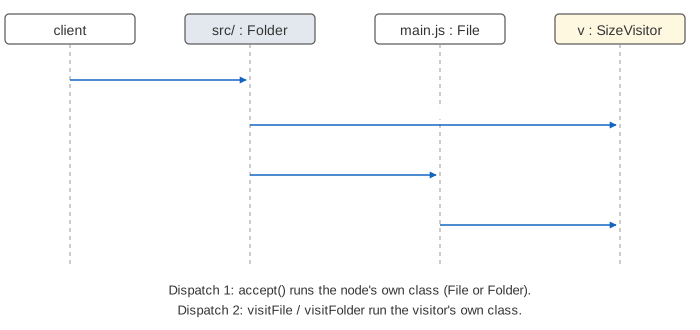
node.accept(v) runs the method of the node's real class: File.accept calls v.visitFile(this), Folder.accept calls v.visitFolder(this). That call then runs the method of the visitor's real class. Two virtual calls pick the code from two classes, which is called double dispatch. Java, C# and C++ choose a method by one object's class only, so the visitor needs this trick. Here the Folder also passes v on to its children, so the tree does the walking and the visitor only collects.
- SizeVisitor adds each file's KB and does nothing for folders: total = 273 KB, the same as
size()(Demo 3). - CountVisitor does something different in each method: 6 files, 4 folders (Demo 4).
- FindVisitor keeps
src/main.js,src/util.jsandsrc/lib/parse.js, in tree order (Demo 5).
None of the three needed a change to File or Folder. Adding files does not need one either: after Add File three times (test.js, todo.txt, fmt.js) the same SizeVisitor reports 289 KB (Demo 6).
Adding operations vs adding node classes
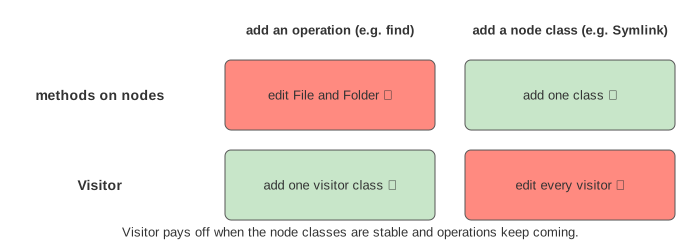
The visitor makes one kind of change cheap and the other expensive. A new operation is one new class. A new node class, for example Symlink, needs a visitSymlink method in the Visitor interface and in every visitor that exists.
| methods on the nodes | Visitor | |
|---|---|---|
| Add an operation | edit every node class | add one visitor class |
| Add a node class | add one class | edit every visitor |
| Code of one operation | spread over the node classes | in one class |
| Access to private node fields | yes | only through public getters |
Compilers are the classic fit: the syntax tree's node classes rarely change, but passes keep being added (type checking, constant folding, code generation). See the compiler pipeline. For a simpler choice between objects behind one interface, see Strategy and Factory Method; a macro in the Command pattern is itself a composite of commands.
Where they show up
- The DOM. Elements contain elements and text nodes behind one
Nodetype;textContentwalks the subtree likesize()(see Virtual DOM diffing). - Syntax trees. Java's
javax.lang.modeland the TypeScript and Babel compilers walk trees with visitors. - File systems. Java's
Files.walkFileTree(path, FileVisitor)callsvisitFileandpreVisitDirectoryfor you. - Pattern matching. Languages with sealed types and
switchon type (Java 21, Kotlin, Rust, Scala) can replace a visitor with oneswitchper operation; the compiler checks every node class is handled.
What the page leaves out
Real file systems also have links and cycles, so a walker must track what it has seen. The tree here is walked depth first, in preorder; visitors can also walk after the children (postorder) or let the visitor decide the order. Composite has design choices the page skips: whether add() and remove() belong on Node or only on Folder, parent pointers, and caching a folder's size. Visitors that return values (Visitor<R>) and acyclic visitors are left out too.