The idea: the push acts only along the line of centres
Ball 1 slides across a frictionless table with speed v₁ toward ball 2, which is at rest. Its aim is a little off: the impact offset b is the distance between ball 1's aim line and ball 2's centre. With b = 0 the hit is head-on, the 1-D collision of Elastic Collision. With b > 0 the balls fly off in two directions, and we want both the speeds and the angles after the hit.
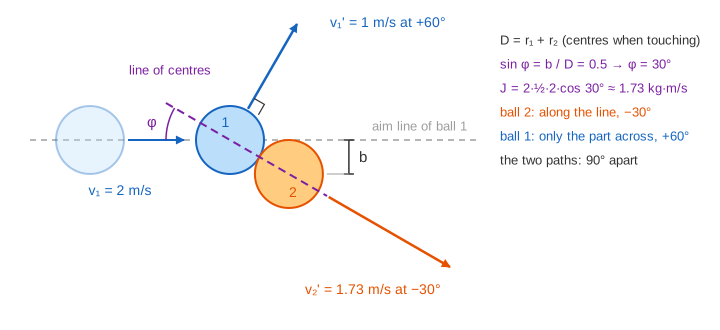
The key is the line of centres: the line through both centres at the moment they touch. Smooth discs cannot grip each other, so the only force between them points along that line. If D = r₁ + r₂ is the distance between the centres when they touch, the line of centres makes an angle φ with the aim line, with sin φ = b / D.
Split each velocity: along and across the line of centres
Write every velocity as a part along the line of centres (direction n̂) and a part across it. Across the line nothing pushes, so the across parts do not change: ball 2 had none and keeps none, ball 1 keeps its v₁·sin φ. Along the line it is exactly the 1-D collision, with the closing speed v₁·cos φ. The impulse (the push times its short duration) is
J = (1 + e)·m₁m₂/(m₁ + m₂)·v₁·cos φ
v₂' = (J/m₂)·n̂                 ball 2 always leaves along the line of centres
v₁' = v₁ − (J/m₁)·n̂            ball 1 loses that much momentum along n̂
For the start case (two 1 kg discs, v₁ = 2 m/s, b = 0.5·D, e = 1): φ = 30°, cos φ ≈ 0.87, J = 2·½·2·0.87 ≈ 1.73 kg·m/s, so v₂' ≈ 1.73 m/s at −30° and v₁' = 1 m/s at +60° (Demo 2).
Momentum is kept as a vector
Ball 2 gets J along n̂, ball 1 gets −J: equal and opposite, so the total momentum does not change. In 2-D that is two equations, one for x and one for y:
x:  m₁v₁ + 0 = m₁v₁x' + m₂v₂x'
y:     0 + 0 = m₁v₁y' + m₂v₂y'
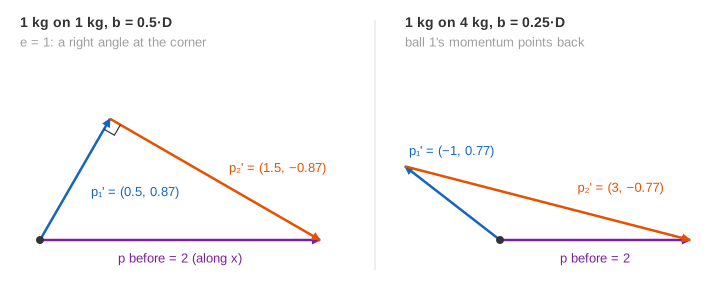
Before the hit all the momentum points along the aim line, so after the hit the two y parts must cancel: one ball goes up, the other goes down. On the page the momentum panel draws the vectors head to tail: p₁' from the origin, then p₂' from its tip. The chain always ends exactly at the tip of p before.
Equal masses fly apart at 90°
With m₁ = m₂ = m and e = 1, cancel m in both laws: momentum says v₁ = v₁' + v₂' (as vectors), energy says v₁² = v₁'² + v₂'². The second is Pythagoras for the triangle of the first, so the angle between v₁' and v₂' is a right angle, for every b between 0 and D. Billiard players know this as the 90° rule: after a clean hit on a ball at rest, the cue ball leaves at a right angle to the object ball (spin aside).
Special cases
| case | what happens | on the page |
|---|---|---|
| b = 0 (head-on) | everything stays on the aim line: the 1-D collision | Demo 1: 1 kg on 1 kg → 0 and 2 m/s |
| m₁ = m₂, 0 < b < D | the paths are 90° apart | Demo 2: 1 m/s at +60°, 1.73 m/s at −30° |
| m₁ ≫ m₂ | ball 1 is deflected only a little, at most arcsin(m₂/m₁) | Demo 3: 4 kg on 1 kg → +13.9° (limit 14.5°) |
| m₁ ≪ m₂ | ball 1 bounces back, ball 2 moves off slowly | Demo 4: 1 kg on 4 kg → ball 1 at +142° |
| m₂ → ∞ (a wall) | ball 1 is reflected like light in a mirror: angle in = angle out | Demo 5: m₂ = 100 → +119.5° (mirror: +120°) |
| b just under D | a grazing touch: ball 2 barely moves, ball 1 barely turns | Demo 6: b = 0.95·D → 1.9 m/s at +18.2° |
| b ≥ D | a miss: no contact, nothing changes | pick b = 1.2·D |
Restitution e, and why smooth discs do not stick
As in 1-D, the coefficient of restitution e says how much of the closing speed comes back as opening speed, but only along the line of centres: after the hit the balls separate along n̂ at e times the speed they closed in. Momentum is still kept in x and y; kinetic energy is lost when e < 1.
| 1 kg on 1 kg, v₁ = 2 m/s | v₁' | v₂' | KE after (before 2 J) |
|---|---|---|---|
| b = 0, e = 1 (Demo 1) | 0 | 2 m/s at 0° | 2 J |
| b = 0, e = 0 (Demo 7) | 1 m/s at 0° | 1 m/s at 0° | 1 J: they stick and move together |
| b = 0.5·D, e = 1 (Demo 2) | 1 m/s at +60° | 1.73 m/s at −30° | 2 J |
| b = 0.5·D, e = 0 (Demo 8) | 1.32 m/s at +19.1° | 0.87 m/s at −30° | 1.25 J |
With e = 0 the balls stop moving apart along n̂, but nothing stops the across parts. In a glancing hit the smooth discs therefore slide off each other instead of sticking (Demo 8). They only stick together when the hit is head-on (Demo 7).
If ball 2 is moving too
The page keeps ball 2 at rest. If it moves with u, ride along with it: subtract u from both velocities, solve the at-rest collision above, then add u back to both answers. The laws are the same in every frame moving at a constant velocity.
See also
The head-on case, the formulas along the line of centres, the centre-of-mass view and the table of e values are on Elastic Collision, the 1-D page this one builds on.
What the page leaves out
Friction between the discs and spin: real billiard balls grip a little, which "throws" the object ball off the line of centres and lets the cue ball curve after the hit. Also left out: ball 2 moving (see above), spheres in 3-D (the same idea, with a line of centres in space), the short time the discs are squeezed together (here the contact is instant), and three or more balls at once. The page keeps masses from 0.5 to 100 kg and speeds from 1 to 3 m/s, and shortens the movie when a fast ball would leave the table.